
Heyser Memorial Lecture
AES 122nd Convention
Austria Center Vienna - Austria, Vienna
Sunday, May 6, 2007 - 18:15-19:15
What is needed to have the Audio-Eldorado at home?
by Gerhard Steinke, Fellow AES
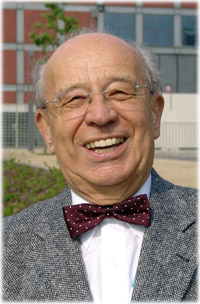
Biography
Gerhard Steinke was born in 1927 and studied acoustics in Dresden, Germany. He began his career at Radio Dresden as a sound engineer in 1947. In 1953 he moved to Berlin's Radio and Television Research Centre (RFZ), where he established a laboratory for acoustical-musical boundary problems in broadcasting. In 1956, he set up the first subjective listening test group to assess sound recordings, studios and impairments in the broadcasting chain. This concept and the associated findings are included in various international standards (OIRT, ITU-R, and EBU) and documents (SSF, AES) on listening tests and test rooms. He was also responsible for the introduction of stereophonic broadcasting in East Germany and established an experimental electronic music studio with the new Subharchord synthesizer in 1962. In 1971 he became the director of the Research and Development Department of Sound and Video System Technology of RFZ. Together with co-inventors he developed the "Delta Stereophony" sound reinforcement system and a home processor for multi-channel sound. He moved to Deutsche Telekom in 1990 where he set up the research and development group for new sound transmission systems.
Gerhard Steinke lectured sound technology and electronic music at Berlin's University of Music in the Tonmeister discipline for 27 years. Since his retirement he published further numerous papers and lectures, and contributed documents to the Surround Sound Forum of the Tonmeister Society (VDT) and to the AES.
For his work in the field of standards he received the Honorary Golden Medal of the OIRT and was awarded the Bèkesy Medal for his contributions to audio by the Hungarian Acoustical Society.
He is a life member and fellow of the AES, and served as vice president, Europe Region of the AES from 1991-1993, where he initiated the inauguration of new AES sections in the Eastern European countries. He is also member of the VDT.
"What is needed to have the Audio-Eldorado at home?"
"A life without music is a mistake" - Friedrich Nietzsche (1844-1900) said. The love of audio engineers for music is the crucial/essential basis for their constant striving to develop best systems and apparatus to produce and reproduce signals for music and speech in high definition audio quality and, eventually, to delight the recipients of radio, TV and recordings.
Dedicated to audio and broadcasting, the life of the author was auspicious and rich because of his close ties to music and artists. This connection along with cooperation with excellent teams of experts and musicians over the last 60 years has exerted enormous influence on the life experience. It has, however, driven our endeavours to envision and to search for useful realistic ideas in the acoustical-musical borderlands and the necessary techniques for those problems.
Some milestones in these six decades show the benefit of such a close collaboration of audio teams with outstanding artists - musicians, singers, conductors - in selected fields, such as electronic music, subjective evaluation of transmission systems, multi-channel stereophony technologies as well as sound reinforcement systems for halls and home. All this was fostered by many conjoint experiments with artists who played a key role in acquiring the desired knowledge and realistic approaches in the acoustical dimensioning of large recording studios and dealing with the requirements to audio systems, always following the goal: not simply to convey high-quality audio programs to the recipient at his home, but rather to vest him with a convincing imagination of listening events, an intensive experience, achieved by appropriate technical means.
The presentation will be followed by a reception hosted by the AES Technical Council.