
Heyser Memorial Lecture
AES 115th Convention
Jacob K. Javits Convention Center - New York, NY, USA
Saturday, October 11, 2003 - 6:30pm
The Future of Music in the Age of Spiritual Machines
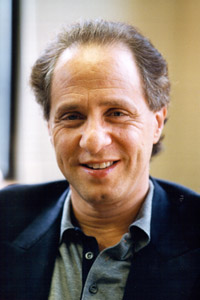
by Ray Kurzweil
Abstract
 Music is the only cultural expression common to every human society that we are aware of. Musical expression has always used the most advanced technologies available, from ancient drums, the cabinet-making crafts of the eighteenth century, the mechanical linkages of the nineteenth century, the analog electronics of the mid twentieth century, the digital technology of the 1980s and 1990s to the artificial intelligence coming in the twenty-first century. Communication bandwidths, the shrinking size of technology, our knowledge of the human brain, and human knowledge in general are all accelerating. Three-dimensional molecular computing will provide the hardware for human-level "strong" AI well before 2030. The more important software insights will be gained in part from the reverse-engineering of the human brain, a process well under way. Once non-biological intelligence matches the range and subtlety of human intelligence, it will necessarily soar past it because of the continuing acceleration of information-based technologies, as well as the ability of machines to instantly share their knowledge. The impact of these developments will deeply affect all human endeavors. Music will remain the communication of human emotion and insight through sound from musicians to their audience, but the concepts and process of music will be transformed once again.
A Brief Career Summary (Autumn 2002)
Ray Kurzweil was the principal developer of the first omni-font optical character recognition, the first print-to-speech reading machine for the blind, the first CCD flat-bed scanner, the first text-to-speech synthesizer, the first music synthesizer capable of recreating the grand piano and other orchestral instruments, and the first commercially marketed large-vocabulary speech recognition. Ray has successfully founded and developed nine businesses in OCR, music synthesis, speech recognition, reading technology, virtual reality, financial investment, medical simulation, and cybernetic art. All of these technologies continue today as market leaders. Ray's Web site, KurzweilAI.net,, is a leading resource on artificial intelligence.
Ray Kurzweil was inducted into the National Inventors Hall of Fame, established by the U.S. Patent Office, in 2002, and received the $500,000 Lemelson-MIT Prize, the nation's largest award in invention and innovation. He also received the 1999 National Medal of Technology, the nation's highest honor in technology, from President Clinton in a White House ceremony. He has also received scores of other national and international awards, including the 1994 Dickson Prize (Carnegie Mellon University's top science prize), Engineer of the Year from Design News, Inventor of the Year from MIT, and the Grace Murray Hopper Award from the Association for Computing Machinery. He has received eleven honorary Doctorates and honors from three U.S. presidents. He has received seven national and international film awards. His book, The Age of Intelligent Machines, was named Best Computer Science Book of 1990. His current best-selling book, The Age of Spiritual Machines, When Computers Exceed Human Intelligence has been published in nine languages and achieved the #1 best selling book on Amazon in the categories of "Science" and "Artificial Intelligence."