
You are currently logged in as an
Institutional Subscriber.
If you would like to logout,
please click on the button below.
Home / Publications / E-library page
Only AES members and Institutional Journal Subscribers can download
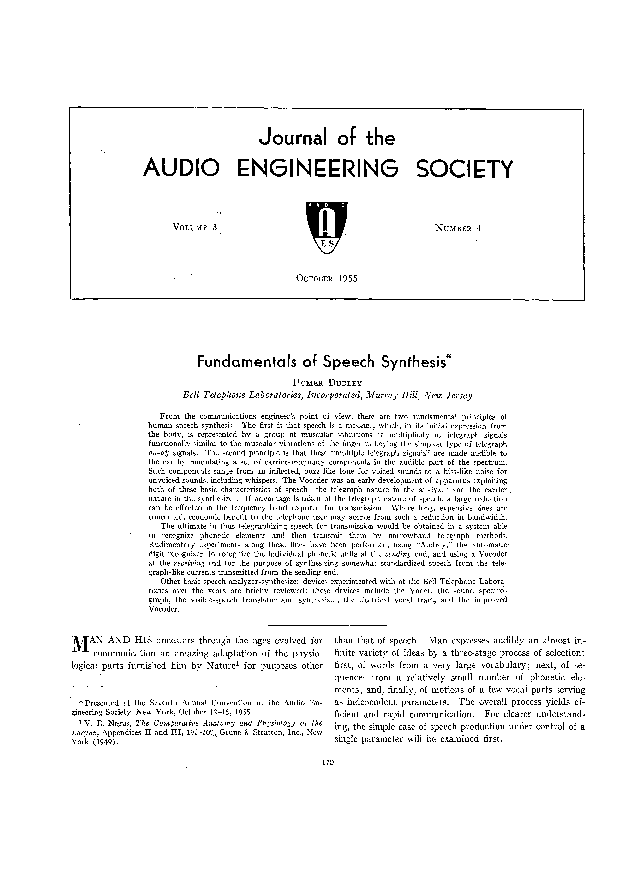
From the communication engineer`s point of view, there are two fundamental principles of human speech synthesis. The first is that speech is a message, which, in its initial expression from the body, is represented by a group of muscular vibrations-a multiplicity of telegraph signals functionally similar to the muscular vibrations of the finger in keying the simplest type of telegraph on-off signals. The second principle is that these -multiple telegraphed signals- are made audible to the ear by modulating a set of carrier-frequency components in the audible part of the spectrum. Such components range from an inflected, buzz-like tone for voiced sounds to a hiss-like noise for unvoiced sounds, including whispers. The Vocoder was an early development of apparatus exploiting both of these basic characteristics of speech-the telegraph nature in the analyzer and the carrier nature in the synthesizer. If advantage is taken of the telegraph nature of speech, a large reduction can be effected in the frequency band required for transmission. Where long, expensive lines are concerned, economic benefit to the telephone user may accrue from such a reduction in bandwidth. The ultimate in thus telegraphizing speech for transmission would be obtained in a system able to recognize phonetic elements and then transmit them by narrowband telegraph methods. Rudimentary experiments along these lines have been performed, using -Audrey,- the automatic digit recognizer, to recognize the individual phonetic units of the sending end, and using a Vocoder at the receiving end for the purpose of synthesizing somewhat standardized speech from the telegraph-like currents transmitted from the sending end. Other basic speech analyzer-synthesizer devices experimented with at the Bell Telephone Laboratories over the years are briefly reviewed; these devices include the Vocoder, the sound spectrograph, the visible-speech translator and synthesizer, the electrical vocal tract, and the improved Vocoder.
Author (s): Dudley, Homer;
Affiliation:
Bell Telephone Laboratories, Incorporated, Murray Hill, NJ
(See document for exact affiliation information.)
Publication Date:
1955-10-06
DOI:
Click to purchase paper as a non-member or login as an AES member. If your company or school subscribes to the E-Library then switch to the institutional version. If you are not an AES member Join the AES. If you need to check your member status, login to the Member Portal.
Dudley, Homer; 1955; Fundamentals of Speech Synthesis [PDF]; Bell Telephone Laboratories, Incorporated, Murray Hill, NJ; Paper ; Available from: https://aes.org/publications/elibrary-page/?id=9
Dudley, Homer; Fundamentals of Speech Synthesis [PDF]; Bell Telephone Laboratories, Incorporated, Murray Hill, NJ; Paper ; 1955 Available: https://aes.org/publications/elibrary-page/?id=9
Notifications
