
You are currently logged in as an
Institutional Subscriber.
If you would like to logout,
please click on the button below.
Home / Publications / E-library page
Only AES members and Institutional Journal Subscribers can download
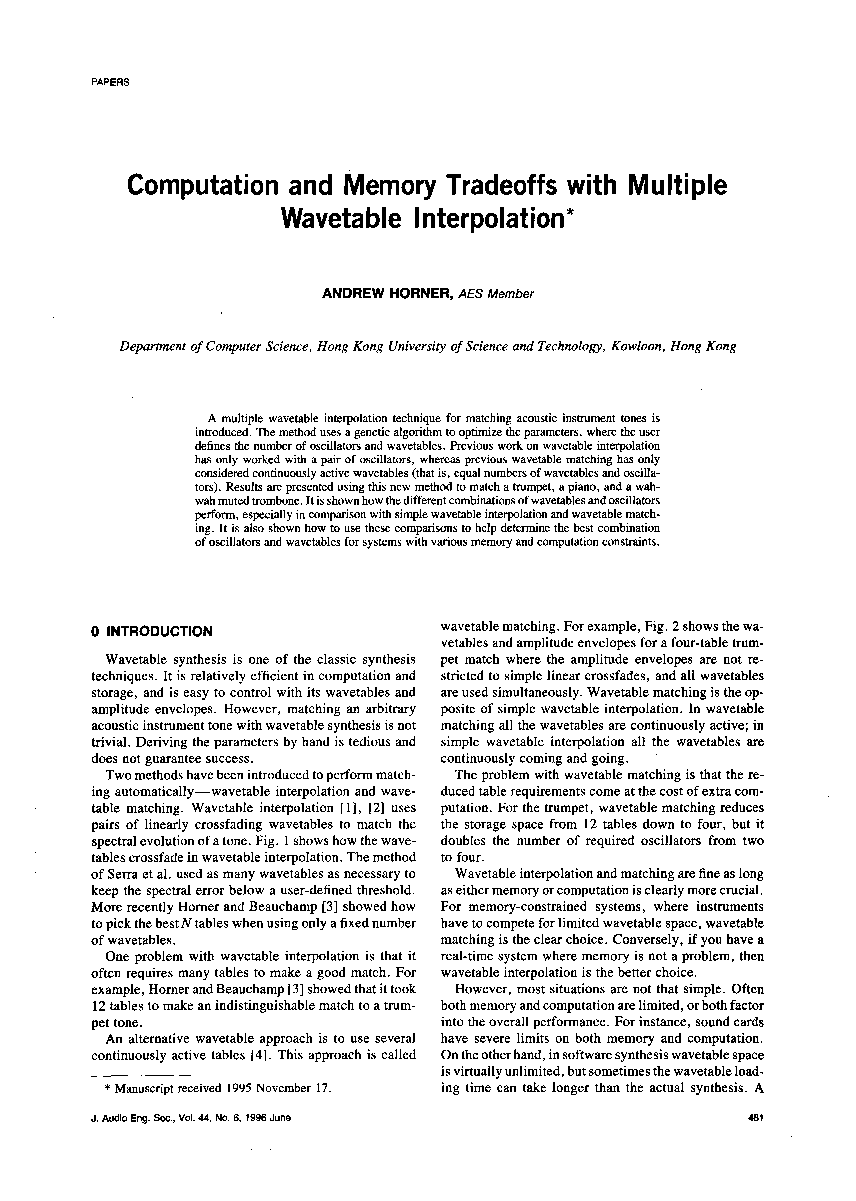
A multiple wavetable interpolation technique for matching acoustic instrument tones is introduced. The method uses a genetic algorithm to optimize the parameters, where the user defines the number of oscillators and wavetables. Previous work on wavetable interpolation has only worked with a pair of oscillators, whereas previous wavetable matching has only considered continuously active wavetables (that is, equal numbers of wavetables and oscillators). Results are presented using this new method to match a trumpet, a piano, and a wah-wah muted trombone. It is shown how the different combinations of wavetables and oscillators perform, especially in comparison with simple wavetable interpolation and wavetable matching. It is also shown how to use these comparisons tohelp determine the best combination of oscillators and wavetables for systems with various memory and computation constraints.
Author (s): Horner, Andrew;
Affiliation:
Department of Computer Science, Hong Kong University of Science and Technology, Kowloon, Hong Kong
(See document for exact affiliation information.)
Publication Date:
1996-06-06
DOI:
Click to purchase paper as a non-member or login as an AES member. If your company or school subscribes to the E-Library then switch to the institutional version. If you are not an AES member Join the AES. If you need to check your member status, login to the Member Portal.
Horner, Andrew; 1996; Computation and Memory Tradeoffs with Multiple Wavetable Interpolation [PDF]; Department of Computer Science, Hong Kong University of Science and Technology, Kowloon, Hong Kong; Paper ; Available from: https://aes.org/publications/elibrary-page/?id=7895
Horner, Andrew; Computation and Memory Tradeoffs with Multiple Wavetable Interpolation [PDF]; Department of Computer Science, Hong Kong University of Science and Technology, Kowloon, Hong Kong; Paper ; 1996 Available: https://aes.org/publications/elibrary-page/?id=7895
Notifications
