
You are currently logged in as an
Institutional Subscriber.
If you would like to logout,
please click on the button below.
Home / Publications / E-library page
Only AES members and Institutional Journal Subscribers can download
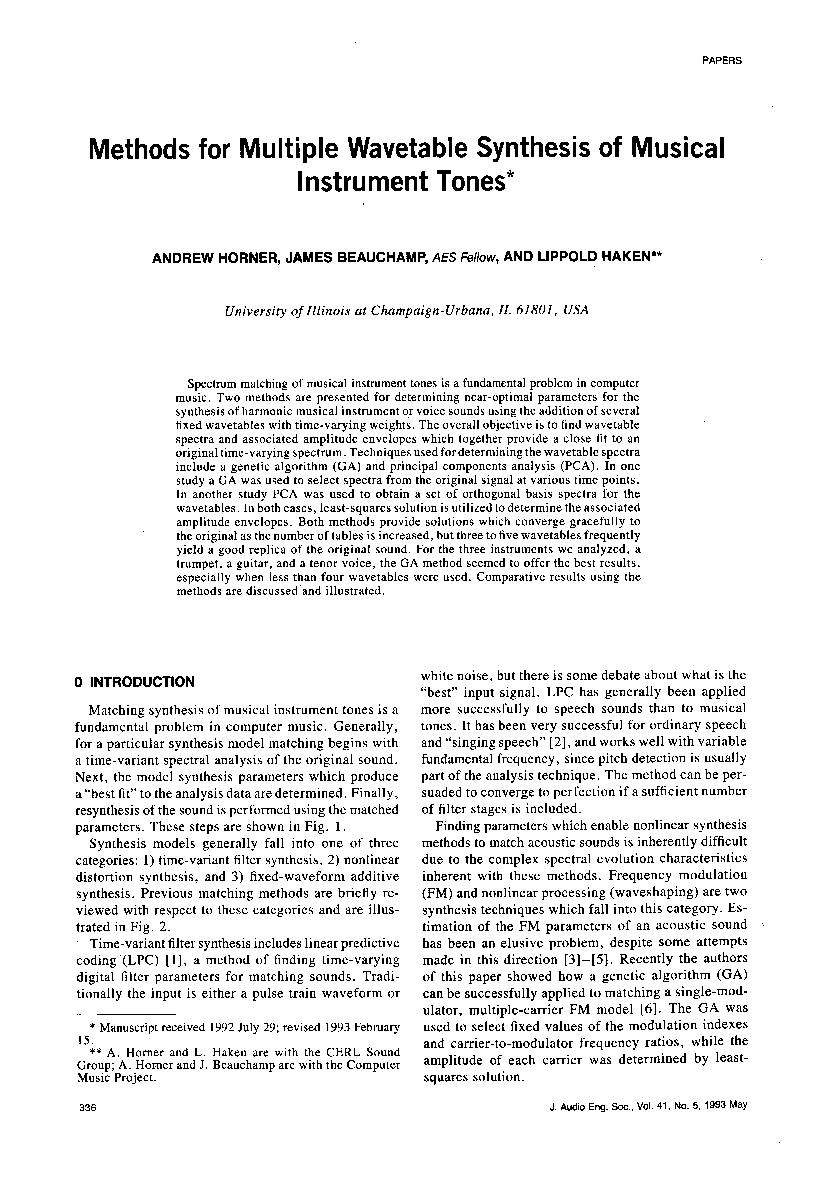
Spectrum matching of musical instrument tones is a fundamental problem in computer music. Two methods are presented for determining near-optimal parameters for the synthesis of harmonic musical instrument orvoice sounds using the addition of several fixed wavetables with time-varying weights. The overall objective is to find wavetable spectra and associated amplitude envelopes which together provide a close fit to an original time-varying spectrum. Techniques used for determining the wavetable spectra include a genetic algorithm (GA) and principal components analysis (PCA). In one study a GA was used to select spectra from the original signal at various time points. In another study PCA was used to obtain a set of orthogonal basis spectra for the wavetables. In both cases, least-squares solution is utilized to determine the associated amplitude envelopes. Both methods provide solutions which converge gracefully to the original as the number of tables is increased, but three to five wavetables frequently yield a good replica of the original sound. For the three instruments we analyzed, a trumpet, a guitar, and a tenor voice, the GA method seemed to offer the best results, especially when less than four wavetables were used. Comparative results using the methods are discussed and illustrated.
Author (s): Horner, Andrew;
Beauchamp, James;
Haken, Lippold;
Affiliation:
University of lllinois at Champaign-Urbana, IL
(See document for exact affiliation information.)
Publication Date:
1993-05-06
DOI:
Click to purchase paper as a non-member or login as an AES member. If your company or school subscribes to the E-Library then switch to the institutional version. If you are not an AES member Join the AES. If you need to check your member status, login to the Member Portal.
Horner, Andrew; Beauchamp, James; Haken, Lippold; 1993; Methods for Multiple Wavetable Synthesis of Musical Instrument Tones [PDF]; University of lllinois at Champaign-Urbana, IL; Paper ; Available from: https://aes.org/publications/elibrary-page/?id=7003
Horner, Andrew; Beauchamp, James; Haken, Lippold; Methods for Multiple Wavetable Synthesis of Musical Instrument Tones [PDF]; University of lllinois at Champaign-Urbana, IL; Paper ; 1993 Available: https://aes.org/publications/elibrary-page/?id=7003
@article{Horner1993methods,
title={{Methods for Multiple Wavetable Synthesis of Musical Instrument Tones}},
author={Horner, Andrew and Beauchamp, James and Haken, Lippold},
year={1993},
month={may},
journal={Journal of the Audio Engineering Society},
volume={41},
number={5},
pages={336-356},
}
Notifications
