
You are currently logged in as an
Institutional Subscriber.
If you would like to logout,
please click on the button below.
Home / Publications / E-library page
Only AES members and Institutional Journal Subscribers can download
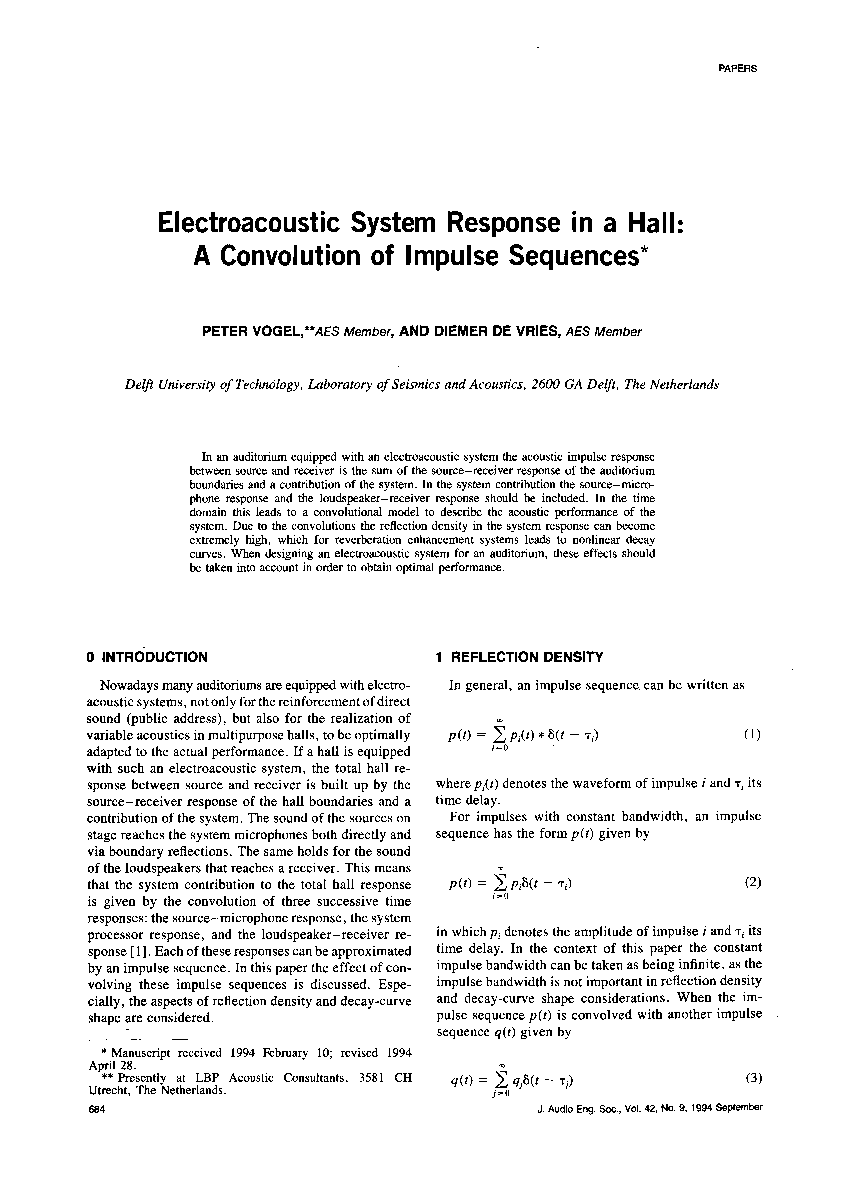
In an auditorium equipped with an electroacoustic system the acoustic impulse response between source and receiver is the sum of the source-receiver response of the auditorium boundaries and a contribution of the system. In the system contribution the source-microphone response and the loudspeaker-receiver response should be included. In the time domain this leads to a convolutional model to describe the acoustic performance of the system. Due to the convolutions the reflection density in the system response can become extremely high, which for reverberation enhancement systems leads to nonlinear decay corves. When designing an electroacoustic system for an auditorium, these effects should be taken into account in order to obtain optimal performance.
Author (s): Vogel, Peter;
de Vries, Diemer;
Affiliation:
Delft University of TechnOlogy, Laboratory of Seismics and Acoustics, Delft, The Netherlands
(See document for exact affiliation information.)
Publication Date:
1994-09-06
DOI:
Click to purchase paper as a non-member or login as an AES member. If your company or school subscribes to the E-Library then switch to the institutional version. If you are not an AES member Join the AES. If you need to check your member status, login to the Member Portal.
Vogel, Peter; de Vries, Diemer; 1994; Electroacoustic System Response in a Hall: A Convolution of Impulse Sequences [PDF]; Delft University of TechnOlogy, Laboratory of Seismics and Acoustics, Delft, The Netherlands; Paper ; Available from: https://aes.org/publications/elibrary-page/?id=6929
Vogel, Peter; de Vries, Diemer; Electroacoustic System Response in a Hall: A Convolution of Impulse Sequences [PDF]; Delft University of TechnOlogy, Laboratory of Seismics and Acoustics, Delft, The Netherlands; Paper ; 1994 Available: https://aes.org/publications/elibrary-page/?id=6929
@article{Vogel1994electroacoustic,
title={{Electroacoustic System Response in a Hall: A Convolution of Impulse Sequences}},
author={Vogel, Peter and de Vries, Diemer},
year={1994},
month={sep},
journal={Journal of the Audio Engineering Society},
volume={42},
number={9},
pages={684-690},
}
Notifications
