
You are currently logged in as an
Institutional Subscriber.
If you would like to logout,
please click on the button below.
Home / Publications / E-library page
Only AES members and Institutional Journal Subscribers can download
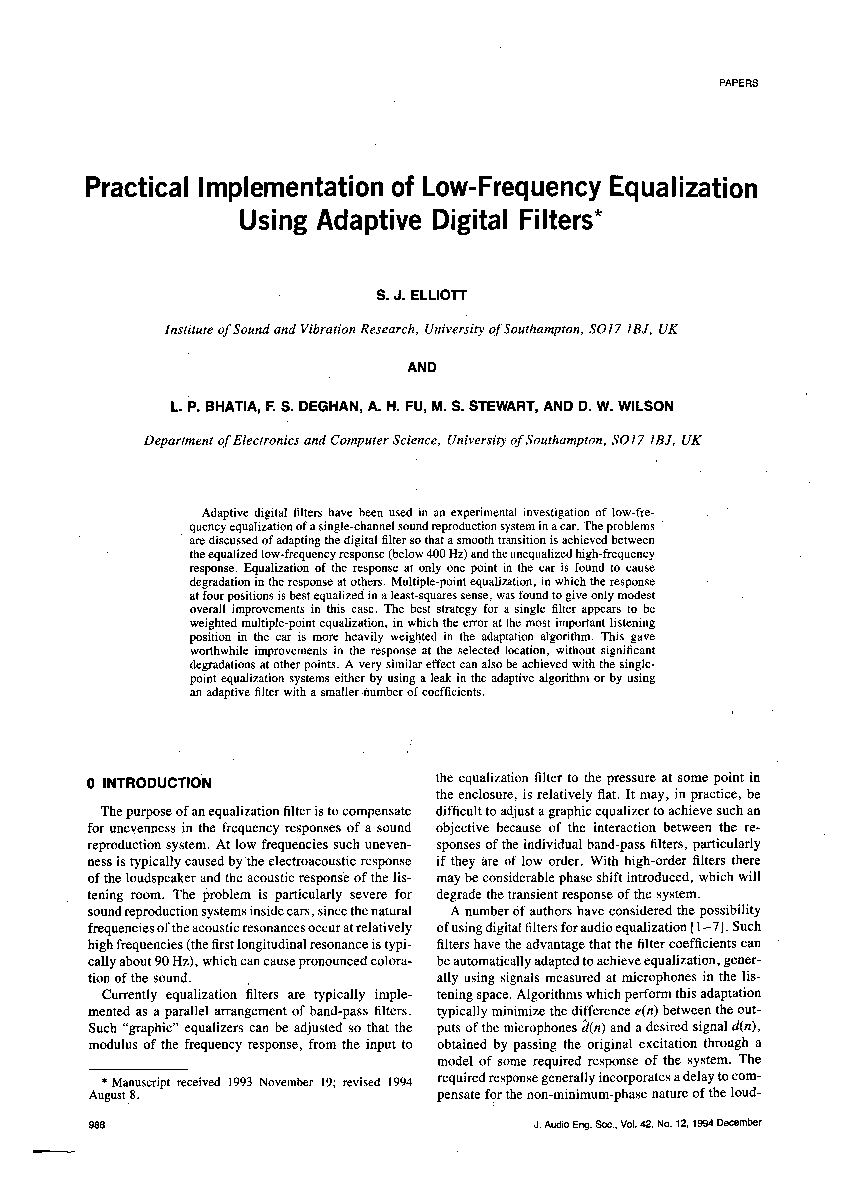
Adaptive digital filters have been used in an experimental investigation of low-frequency equalization of a single-channel sound reproduction system in a car. The problems are discussed of adapting the digital filter so that a smooth transition is achieved between the equalized low-frequency (below 400 Hz) and the unequalized high-frequency response. Equalization of the response at only one point in the car is found to cause degradation in the response at others. Multiple-point equalization, in which the response at four positions is best equalized in a least-squares sense, was found to give only modest overall improvements in this case. The best strategy for a single filter appears to be weighted multiple-point equalization, in which the error at the most important listening position in the car is more heavily weighted in the adaptation algorithm. This gave worthwhile improvements in the response at the selected location, without significant degradations at other points. A very similar effect can also be achieved with the single-point equalization systems either by using a leak in the adaptive algorithm or by using an adaptive filter with a smaller number of coefficients.
Author (s): Elliott, Steven J.;
Bhatia, Lev P.;
Deghan, F. Shirin;
Fu, Adrian H.;
Stewart, Magnus S.;
Wilson, Dave W.;
Affiliation:
Institute of Sound and Vibration Research, University of Southampton, UK ; Department of Electronics and Computer Science, University of Southampton, UK
(See document for exact affiliation information.)
Publication Date:
1994-12-06
DOI:
Click to purchase paper as a non-member or login as an AES member. If your company or school subscribes to the E-Library then switch to the institutional version. If you are not an AES member Join the AES. If you need to check your member status, login to the Member Portal.
Elliott, Steven J.; Bhatia, Lev P.; Deghan, F. Shirin; Fu, Adrian H.; Stewart, Magnus S.; Wilson, Dave W.; 1994; Practical Implementation of Low-Frequency Equalization Using Adaptive Digital Filters [PDF]; Institute of Sound and Vibration Research, University of Southampton, UK ; Department of Electronics and Computer Science, University of Southampton, UK ; Paper ; Available from: https://aes.org/publications/elibrary-page/?id=6916
Elliott, Steven J.; Bhatia, Lev P.; Deghan, F. Shirin; Fu, Adrian H.; Stewart, Magnus S.; Wilson, Dave W.; Practical Implementation of Low-Frequency Equalization Using Adaptive Digital Filters [PDF]; Institute of Sound and Vibration Research, University of Southampton, UK ; Department of Electronics and Computer Science, University of Southampton, UK ; Paper ; 1994 Available: https://aes.org/publications/elibrary-page/?id=6916
@article{Elliott1994practical,
title={{Practical Implementation of Low-Frequency Equalization Using Adaptive Digital Filters}},
author={Elliott, Steven J. and Bhatia, Lev P. and Deghan, F. Shirin and Fu, Adrian H. and Stewart, Magnus S. and Wilson, Dave W.},
year={1994},
month={dec},
journal={Journal of the Audio Engineering Society},
volume={42},
number={12},
pages={988-998},
}
TY – paper
TI – Practical Implementation of Low-Frequency Equalization Using Adaptive Digital Filters
SP – 988 EP – 998
AU – Elliott, Steven J.
AU – Bhatia, Lev P.
AU – Deghan, F. Shirin
AU – Fu, Adrian H.
AU – Stewart, Magnus S.
AU – Wilson, Dave W.
PY – 1994
JO – Journal of the Audio Engineering Society
VO – 42
IS – 12
Y1 – December 1994
Notifications
