
You are currently logged in as an
Institutional Subscriber.
If you would like to logout,
please click on the button below.
Home / Publications / E-library page
Only AES members and Institutional Journal Subscribers can download
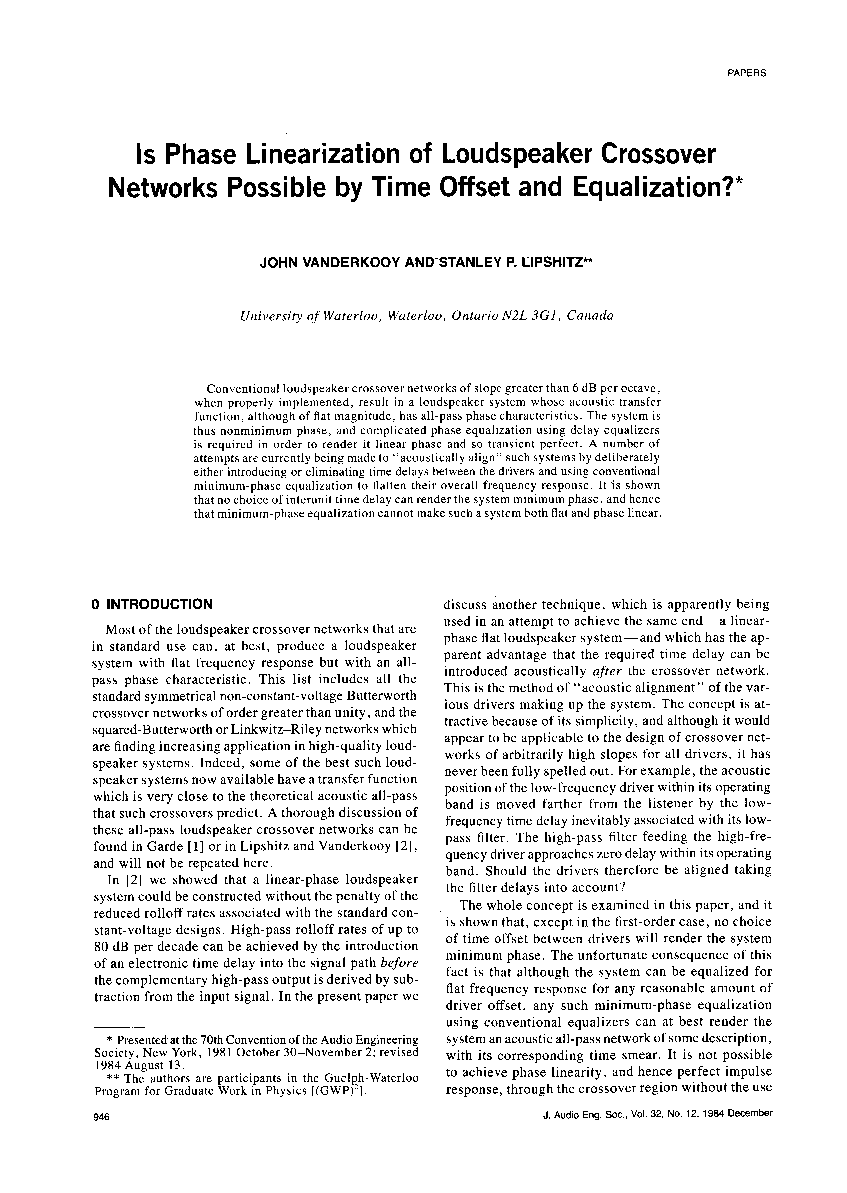
Conventional loudspeaker crossover networks of slope greater than 6 dB per octave, when properly implemented, result in a loudspeaker system whose acoustic transfer function, although of flat magnitude, has all-pass phase characteristics. The system is thus nonminimum phase, and complicated phase equalization using delay equalizers is required in order to render it linear phase and so transient perfect. A number of attempts are currently being made to "acoustically align" such systems by deliberately either introducing or eliminating time delays between the drivers and using conventional minimum-phase equalization to flatten their overall frequency response. It is shown that no choice of interunit time delay can render the system minimum phase, and hence that minimum-phase equalization cannot make such a system both flat and phase linear.
Author (s): Vanderkooy, John;
Lipshitz, Stanley P.;
Affiliation:
University of Waterloo, Waterloo, Ontario N2L 3Gl, Canada
(See document for exact affiliation information.)
Publication Date:
1984-12-06
DOI:
Click to purchase paper as a non-member or login as an AES member. If your company or school subscribes to the E-Library then switch to the institutional version. If you are not an AES member Join the AES. If you need to check your member status, login to the Member Portal.
Vanderkooy, John; Lipshitz, Stanley P.; 1984; Is Phase Linearization of Loudspeaker Crossover Networks Possible by Time Offset and Equalization? [PDF]; University of Waterloo, Waterloo, Ontario N2L 3Gl, Canada; Paper ; Available from: https://aes.org/publications/elibrary-page/?id=4468
Vanderkooy, John; Lipshitz, Stanley P.; Is Phase Linearization of Loudspeaker Crossover Networks Possible by Time Offset and Equalization? [PDF]; University of Waterloo, Waterloo, Ontario N2L 3Gl, Canada; Paper ; 1984 Available: https://aes.org/publications/elibrary-page/?id=4468
@article{Vanderkooy1984is,
title={{Is Phase Linearization of Loudspeaker Crossover Networks Possible by Time Offset and Equalization?}},
author={Vanderkooy, John and Lipshitz, Stanley P.},
year={1984},
month={dec},
journal={Journal of the Audio Engineering Society},
volume={32},
number={12},
pages={946-955},
}
Notifications
