
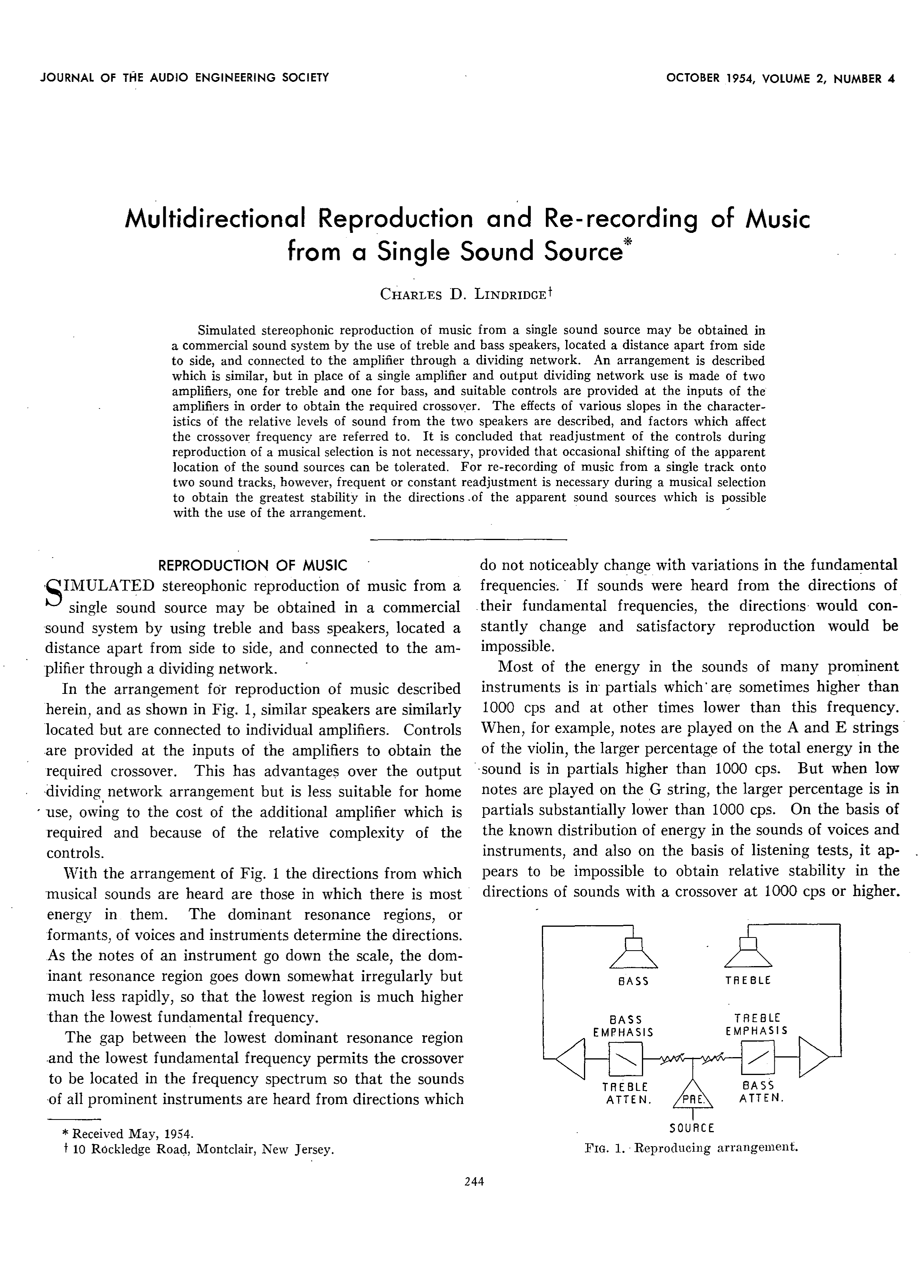
Simulated stereophonic reproduction of music from a single sound source may be obtained in a commercial sound system by the use of treble and bass speakers, located a distance apart from side to side, and connected to the amplifier through a dividing network. An arrangement is described which is similar, but in place of a single amplifier and output dividing network use is made of two amplifiers, one for treble and one for bass, and suitable controls are provided at the inputs of the amplifiers in order to obtain the required crossover. The effects of various slopes in the characteristics of the relative levels of sound from the two speakers are described, and factors which affect the crossover frequency are referred to. It is concluded that readjustment of the controls during reproduction of a musical selection is not necessary, provided that occasional shifting of the apparent location of the sound sources can be tolerated. For re-recording of music from a single track onto two sound tracks, however, frequent or constant readjustment is necessary during a musical selection to obtain the greatest stability in the directions of the apparent sound sources which is possible with the use of the arrangement.
https://www.aes.org/e-lib/browse.cfm?elib=43
Click to purchase paper as a non-member or login as an AES member. If your company or school subscribes to the E-Library then switch to the institutional version. If you are not an AES member and would like to subscribe to the E-Library then Join the AES!
This paper costs $33 for non-members and is free for AES members and E-Library subscribers.
Learn more about the AES E-Library
Start a discussion about this paper!