
You are currently logged in as an
Institutional Subscriber.
If you would like to logout,
please click on the button below.
Home / Publications / E-library page
Only AES members and Institutional Journal Subscribers can download
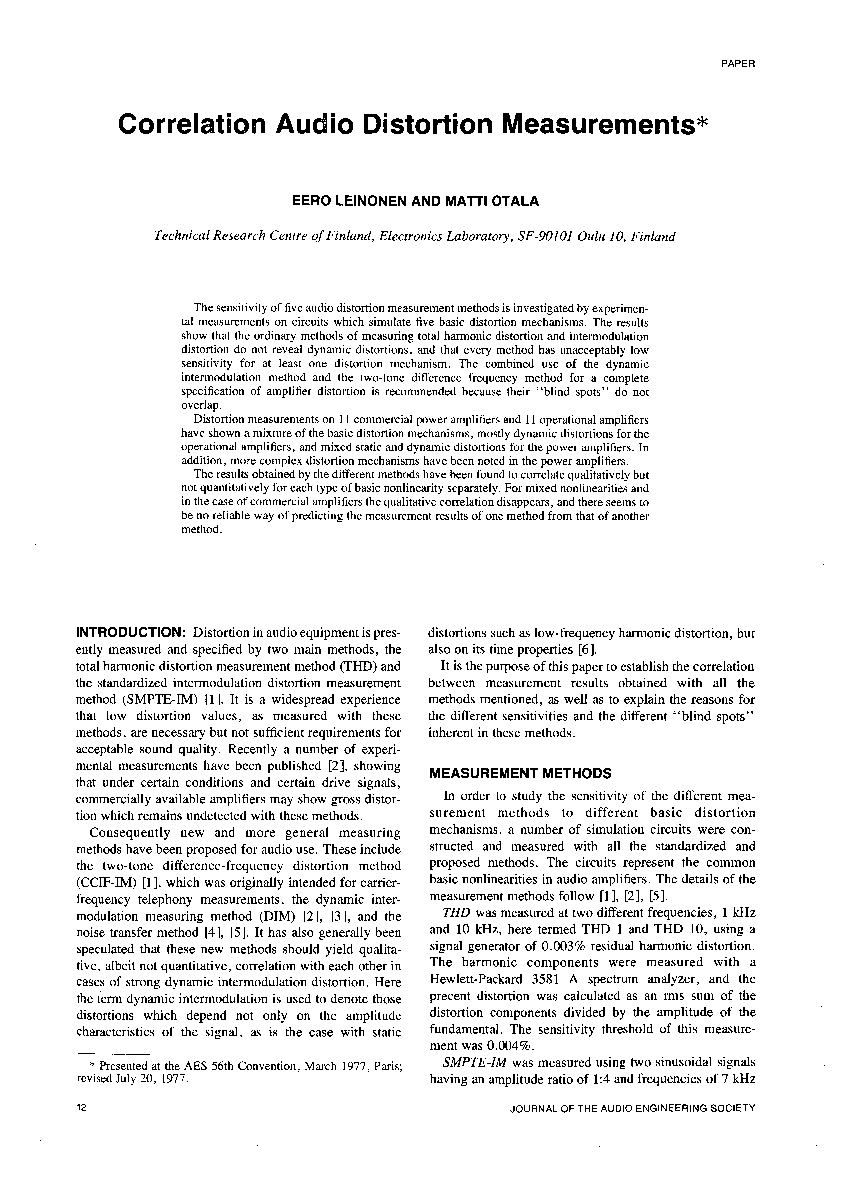
The sensitivity of five audio distortion measurement methods is investigated by experimental measurements on circuits which simulate five basic distortion mechanisms. The results show that the ordinary methods of measuring total harmonic distortion and intermodulation distortion do not reveal dynamic distortions, and that every method has unacceptably low sensitivity for at least one distortion mechanism. The combined use of the dynamic intermodulation method and the two-tone difference frequency method for a complete specification of amplifier distortion is recommended because their "blind spots" do not overlap. Distortion measurements on 11 commercial power amplifiers and 11 operational amplifiers have shown a mixture of the basic distortion mechanisms, mostly dynamic distortions for the operational amplifiers, and mixed static and dynamic distortions for the power amplifiers. In addition, more complex distortion mechanisms have been noted in the power amplifiers. The results obtained by the different methods have been found to correlate qualitatively but not quantitatively for each type of basic nonlinearity separately. For mixed nonlinearities and in the case of commercial amplifiers the qualitative correlation disappears, and there seems to be no reliable way of predicting the measurement results of one method from that of another method.
Author (s): Leinonen, Eero;
Otala, Matti;
Affiliation:
Technical Research Centre of Finland, Electronics Laboratory, SF-90101 Oulu 10, Finland
(See document for exact affiliation information.)
Publication Date:
1978-02-01
DOI:
Click to purchase paper as a non-member or login as an AES member. If your company or school subscribes to the E-Library then switch to the institutional version. If you are not an AES member Join the AES. If you need to check your member status, login to the Member Portal.
Leinonen, Eero; Otala, Matti; 1978; Correlation of Audio Distortion Measurements [PDF]; Technical Research Centre of Finland, Electronics Laboratory, SF-90101 Oulu 10, Finland; Paper ; Available from: https://aes.org/publications/elibrary-page/?id=3296
Leinonen, Eero; Otala, Matti; Correlation of Audio Distortion Measurements [PDF]; Technical Research Centre of Finland, Electronics Laboratory, SF-90101 Oulu 10, Finland; Paper ; 1978 Available: https://aes.org/publications/elibrary-page/?id=3296
Notifications
