You are currently logged in as an
Institutional Subscriber.
If you would like to logout,
please click on the button below.
Home / Publications / E-library page
Only AES members and Institutional Journal Subscribers can download
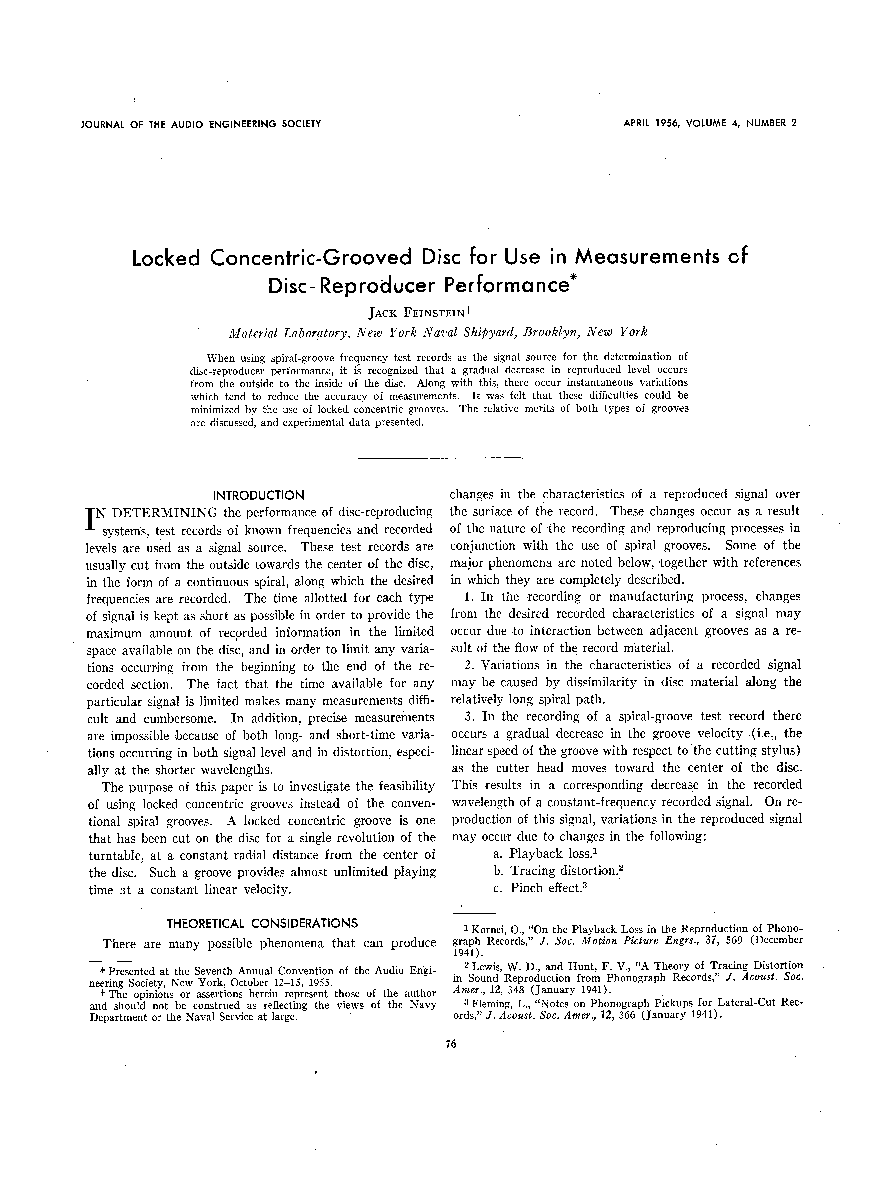
When using spiral-groove frequency test records as the signal source for the determination of disc-reproducer performance, it is recognized that a gradual decrease in reproduced level occurs from the outside to the inside of the disc. Along with this, there occur instantaneous variations which tend to reduce the accuracy of measurements. It was felt that these difficulties could be minimized by the use of locked concentric grooves. The relative merits of both types of grooves are discussed, and experimental data presented.
Author (s): Feinstein, Jack;
Affiliation:
Material Laboratory, New York Naval Shipyard, Brooklyn, NY
(See document for exact affiliation information.)
Publication Date:
1956-04-06
DOI:
Click to purchase paper as a non-member or login as an AES member. If your company or school subscribes to the E-Library then switch to the institutional version. If you are not an AES member Join the AES. If you need to check your member status, login to the Member Portal.

Feinstein, Jack; 1956; Locked Concentric-Grooved Disc for Use in Measurements of Disc-Reproducer Performance [PDF]; Material Laboratory, New York Naval Shipyard, Brooklyn, NY; Paper ; Available from: https://aes.org/publications/elibrary-page/?id=303
Feinstein, Jack; Locked Concentric-Grooved Disc for Use in Measurements of Disc-Reproducer Performance [PDF]; Material Laboratory, New York Naval Shipyard, Brooklyn, NY; Paper ; 1956 Available: https://aes.org/publications/elibrary-page/?id=303
Notifications