
You are currently logged in as an
Institutional Subscriber.
If you would like to logout,
please click on the button below.
Home / Publications / E-library page
Only AES members and Institutional Journal Subscribers can download
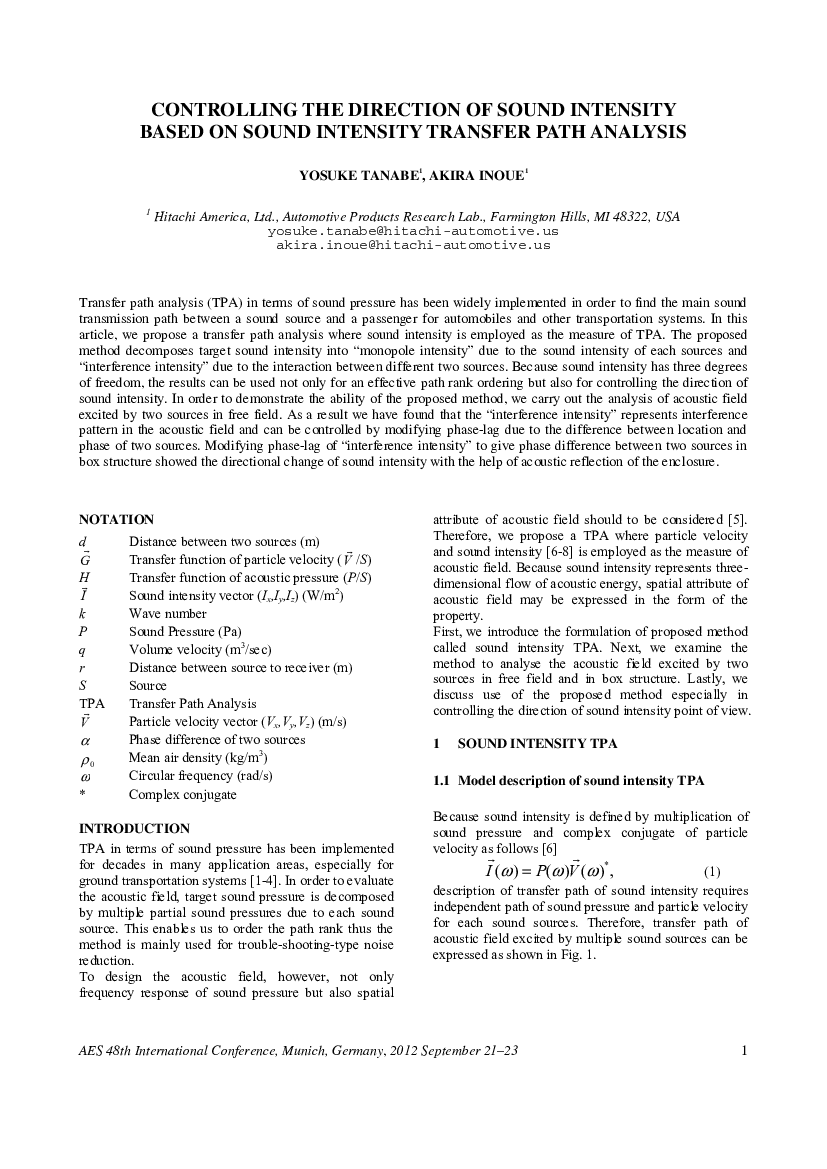
Transfer path analysis (TPA) in terms of sound pressure has been widely implemented in order to find the main sound transmission path between a sound source and a passenger for automobiles and other transportation systems. In this article, we propose a transfer path analysis where sound intensity is employed as the measure of TPA. The proposed method decomposes target sound intensity into “monopole intensity” due to the sound intensity of each sources and “interference intensity” due to the interaction between different two sources. Because sound intensity has three degrees of freedom, the results can be used not only for an effective path rank ordering but also for controlling the direction of sound intensity. In order to demonstrate the ability of the proposed method, we carry out the analysis of acoustic field excited by two sources in free field. As a result we have found that the “interference intensity” represents interference pattern in the acoustic field and can be controlled by modifying phase-lag due to the difference between location and phase of two sources. Modifying phase-lag of “interference intensity” to give phase difference between two sources in box structure showed the directional change of sound intensity with the help of acoustic reflection of the enclosure.
Author (s): Tanabe, Yosuke;
Inoue, Akira;
Affiliation:
Hitachi America, Ltd., Farmington Hills, MI, USA
(See document for exact affiliation information.)
Publication Date:
2012-09-06
Session subject:
Audio Reproduction in Cars - Spatial Enhancement
DOI:
Click to purchase paper as a non-member or login as an AES member. If your company or school subscribes to the E-Library then switch to the institutional version. If you are not an AES member Join the AES. If you need to check your member status, login to the Member Portal.
Tanabe, Yosuke; Inoue, Akira; 2012; Controlling the Direction of Sound Intensity Based on Sound Intensity Transfer Path Analysis [PDF]; Hitachi America, Ltd., Farmington Hills, MI, USA; Paper 2-3; Available from: https://aes.org/publications/elibrary-page/?id=16424
Tanabe, Yosuke; Inoue, Akira; Controlling the Direction of Sound Intensity Based on Sound Intensity Transfer Path Analysis [PDF]; Hitachi America, Ltd., Farmington Hills, MI, USA; Paper 2-3; 2012 Available: https://aes.org/publications/elibrary-page/?id=16424
@inproceedings{Tanabe2012controlling,
title={{Controlling the Direction of Sound Intensity Based on Sound Intensity Transfer Path Analysis}},
author={Tanabe, Yosuke and Inoue, Akira},
year={2012},
month={sep},
booktitle={Journal of the Audio Engineering Society},
publisher={Paper 2-3; AES Conference: 48th International Conference: Automotive Audio; September 2012},
number={2-3},
organization={AES},
}
Notifications
