
You are currently logged in as an
Institutional Subscriber.
If you would like to logout,
please click on the button below.
Home / Publications / E-library page
Only AES members and Institutional Journal Subscribers can download
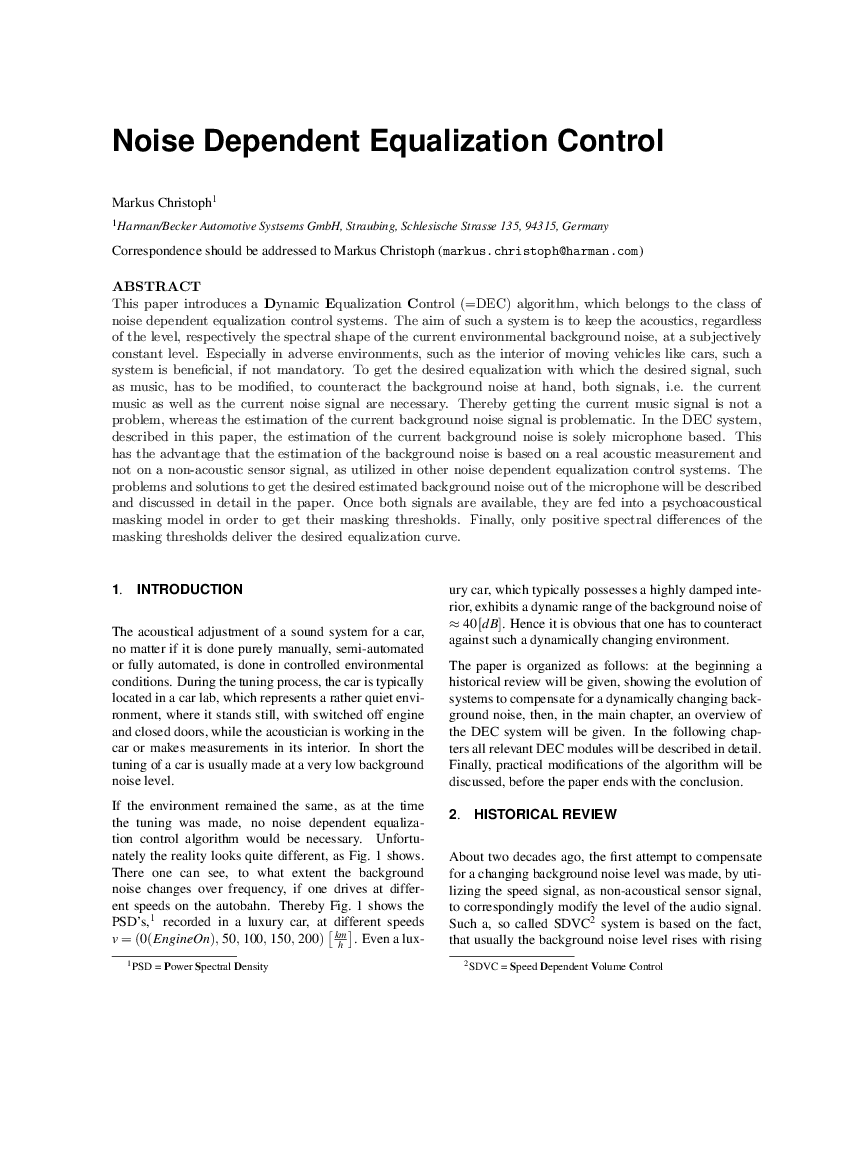
This paper introduces a Dynamic Equalization Control (=DEC) algorithm, which belongs to the class of noise dependent equalization control systems. The aim of such a system is to keep the acoustics, regardless of the level, respectively the spectral shape of the current environmental background noise, at a subjectively constant level. Especially in adverse environments, such as the interior of moving vehicles like cars, such a system is beneficial, if not mandatory. To get the desired equalization with which the desired signal, such as music, has to be modified, to counteract the background noise at hand, both signals, i.e. the current music as well as the current noise signal are necessary. Thereby getting the current music signal is not a problem, whereas the estimation of the current background noise signal is problematic. In the DEC system, described in this paper, the estimation of the current background noise is solely microphone based. This has the advantage that the estimation of the background noise is based on a real acoustic measurement and not on a non-acoustic sensor signal, as utilized in other noise dependent equalization control systems. The problems and solutions to get the desired estimated background noise out of the microphone will be described and discussed in detail in the paper. Once both signals are available, they are fed into a psychoacoustical masking model in order to get their masking thresholds. Finally, only positive spectral differences of the masking thresholds deliver the desired equalization curve.
Author (s): Christoph, Markus;
Affiliation:
Harman/Becker Automotive Systems GmbH, Straubing, Germany
(See document for exact affiliation information.)
Publication Date:
2012-09-06
Session subject:
Dynamic Audio Reproduction in Cars - Noise Compensation
DOI:
Click to purchase paper as a non-member or login as an AES member. If your company or school subscribes to the E-Library then switch to the institutional version. If you are not an AES member Join the AES. If you need to check your member status, login to the Member Portal.
Christoph, Markus; 2012; Noise Dependent Equalization Control [PDF]; Harman/Becker Automotive Systems GmbH, Straubing, Germany; Paper 4-1; Available from: https://aes.org/publications/elibrary-page/?id=16410
Christoph, Markus; Noise Dependent Equalization Control [PDF]; Harman/Becker Automotive Systems GmbH, Straubing, Germany; Paper 4-1; 2012 Available: https://aes.org/publications/elibrary-page/?id=16410
@inproceedings{Christoph2012noise,
title={{Noise Dependent Equalization Control}},
author={Christoph, Markus},
year={2012},
month={sep},
booktitle={Journal of the Audio Engineering Society},
publisher={Paper 4-1; AES Conference: 48th International Conference: Automotive Audio; September 2012},
number={4-1},
organization={AES},
}
Notifications
