
You are currently logged in as an
Institutional Subscriber.
If you would like to logout,
please click on the button below.
Home / Publications / E-library page
Only AES members and Institutional Journal Subscribers can download
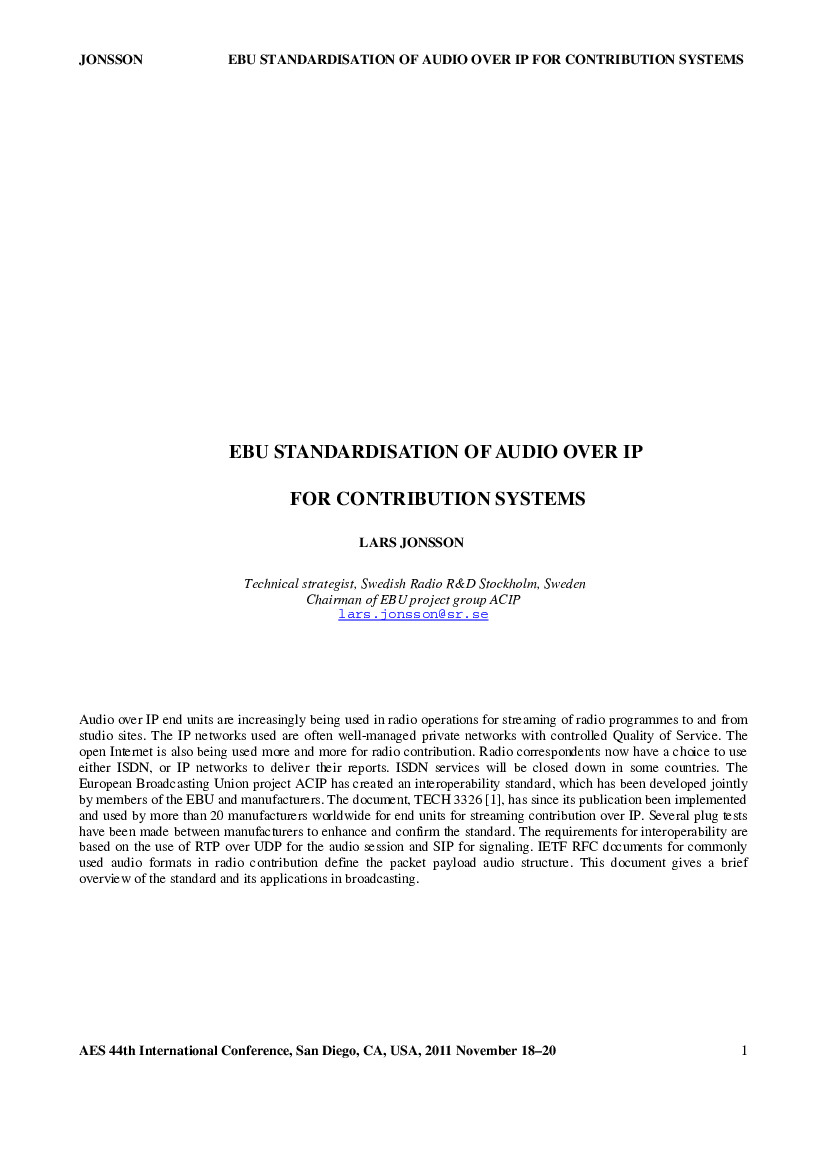
Audio over IP end units are increasingly being used in radio operations for streaming of radio programmes to and from studio sites. The IP networks used are often well-managed private networks with controlled Quality of Service. The open Internet is also more and more being used for radio contribution. Radio correspondents now have a choice to use either ISDN, or the Internet or managed IP networks to deliver their reports. ISDN services will be closed down in some countries. The European Broadcasting Union project ACIP has created an interoperability standard, which has been developed jointly by members of the EBU and manufacturers. The document, TECH 3326 [1], has since its publication quickly been implemented and used by more than 20 manufacturers worldwide for end units for streaming contribution over IP. Several plug tests have been made between manufacturers to enhance and confirm the standard. The requirements for interoperability are based on the use of RTP over UDP for the audio session and SIP for signaling. IETF RFC documents for commonly used audio formats in radio contribution define the packet payload audio structure. This document gives an overview of the standard and its applications in broadcasting.
Author (s): Jonsson, Lars;
Affiliation:
Swedish Radio R&D, Stockholm, Sweden
(See document for exact affiliation information.)
Publication Date:
2011-11-06
Session subject:
Broadcasters, Teleconferencing, and Wireless
DOI:
Click to purchase paper as a non-member or login as an AES member. If your company or school subscribes to the E-Library then switch to the institutional version. If you are not an AES member Join the AES. If you need to check your member status, login to the Member Portal.
Jonsson, Lars; 2011; EBU Standardisation of Audio Over IP for Contribution Systems [PDF]; Swedish Radio R&D, Stockholm, Sweden; Paper 6; Available from: https://aes.org/publications/elibrary-page/?id=16134
Jonsson, Lars; EBU Standardisation of Audio Over IP for Contribution Systems [PDF]; Swedish Radio R&D, Stockholm, Sweden; Paper 6; 2011 Available: https://aes.org/publications/elibrary-page/?id=16134
@inproceedings{Jonsson2011ebu,
title={{EBU Standardisation of Audio Over IP for Contribution Systems}},
author={Jonsson, Lars},
year={2011},
month={nov},
booktitle={Journal of the Audio Engineering Society},
publisher={Paper 6; AES Conference: 44th International Conference: Audio Networking; November 2011},
number={6},
organization={AES},
}
Notifications
