
You are currently logged in as an
Institutional Subscriber.
If you would like to logout,
please click on the button below.
Home / Publications / E-library page
Only AES members and Institutional Journal Subscribers can download
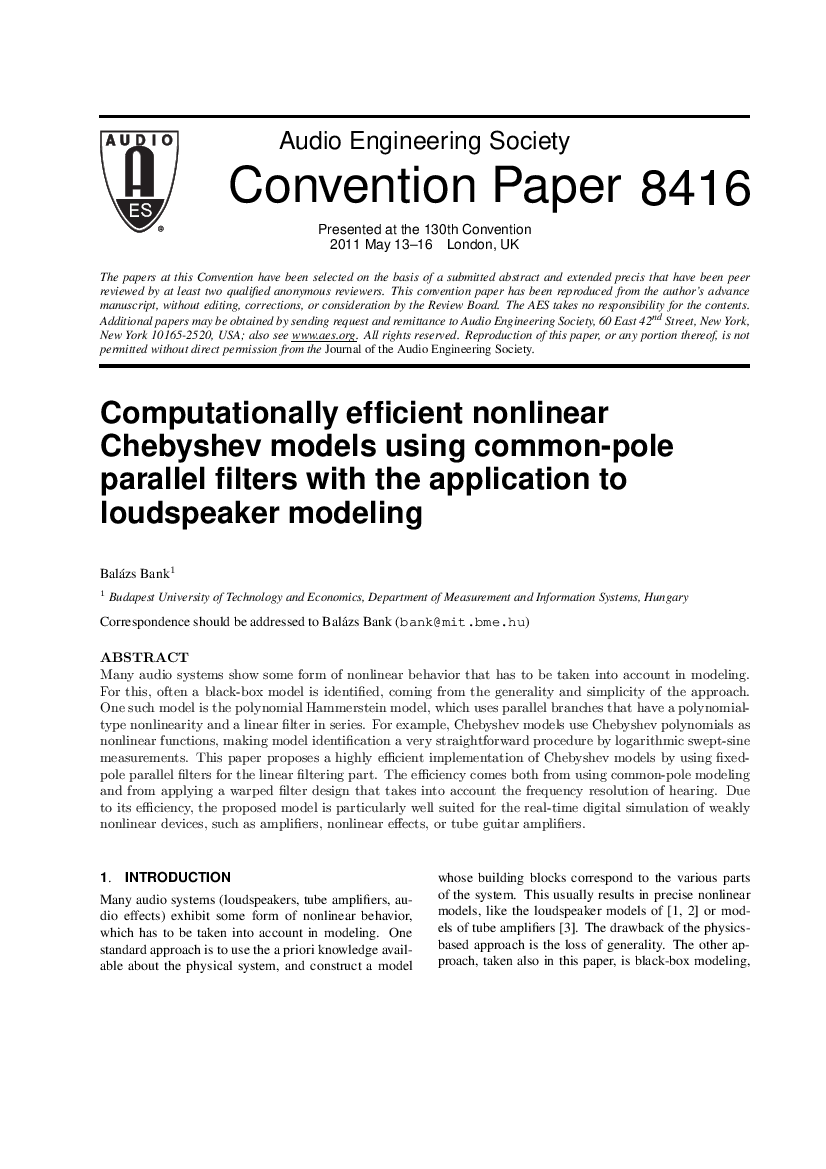
Many audio systems show some form of nonlinear behavior that has to be taken into account in modeling. For this, often a black-box model is identified, coming from the generality and simplicity of the approach. One such model is the polynomial Hammerstein model, which uses parallel branches that have a polynomial-type nonlinearity and a linear filter in series. For example, Chebyshev models use Chebyshev polynomials as nonlinear functions, making model identification a very straightforward procedure by logarithmic swept-sine measurements. This paper proposes a highly efficient implementation of Chebyshev models by using fixed-pole parallel filters for the linear filtering part. The efficiency comes both from using common-pole modeling and from applying a warped filter design that takes into account the frequency resolution of hearing. Due to its efficiency, the proposed model is particularly well suited for the real-time digital simulation of weakly nonlinear devices, such as amplifiers, nonlinear effects, or tube guitar amplifiers.
Author (s): Bank, Balázs;
Affiliation:
Budapest University of Technology and Economics, Budapest, Hungary
(See document for exact affiliation information.)
AES Convention: 130
Paper Number:8416
Publication Date:
2011-05-06
Session subject:
Audio Signal Processing and Analysis
DOI:
Click to purchase paper as a non-member or login as an AES member. If your company or school subscribes to the E-Library then switch to the institutional version. If you are not an AES member Join the AES. If you need to check your member status, login to the Member Portal.
Bank, Balázs; 2011; Computationally Efficient Nonlinear Chebyshev Models Using Common-Pole Parallel Filters with the Application to Loudspeaker Modeling [PDF]; Budapest University of Technology and Economics, Budapest, Hungary; Paper 8416; Available from: https://aes.org/publications/elibrary-page/?id=15883
Bank, Balázs; Computationally Efficient Nonlinear Chebyshev Models Using Common-Pole Parallel Filters with the Application to Loudspeaker Modeling [PDF]; Budapest University of Technology and Economics, Budapest, Hungary; Paper 8416; 2011 Available: https://aes.org/publications/elibrary-page/?id=15883
@inproceedings{Bank2011computationally,
title={{Computationally Efficient Nonlinear Chebyshev Models Using Common-Pole Parallel Filters with the Application to Loudspeaker Modeling}},
author={Bank, Balázs},
year={2011},
month={may},
booktitle={Journal of the Audio Engineering Society},
publisher={Paper 8416; AES Convention 130; May 2011},
number={8416},
organization={AES},
}
Notifications
