
You are currently logged in as an
Institutional Subscriber.
If you would like to logout,
please click on the button below.
Home / Publications / E-library page
Only AES members and Institutional Journal Subscribers can download
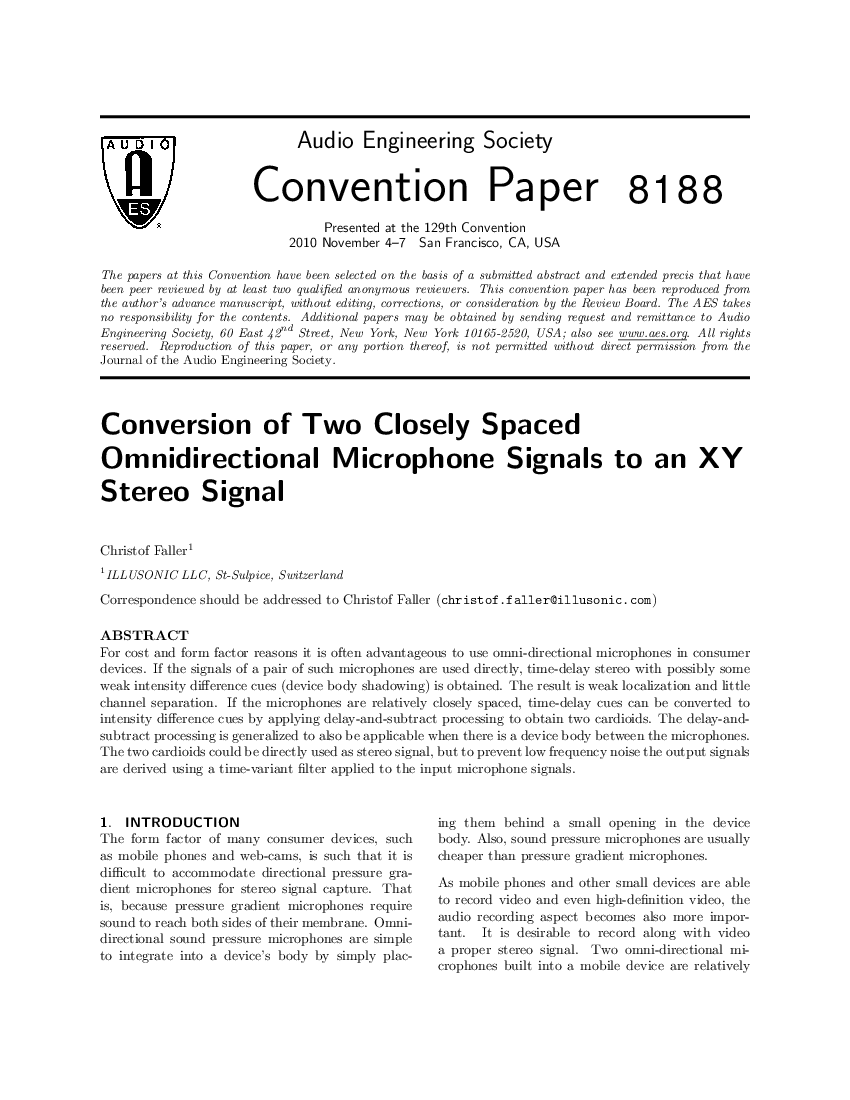
For cost and form factor reasons it is often advantageous to use omni-directional microphones in consumer devices. If the signals of a pair of such microphones are used directly, time-delay stereo with possibly some weak intensity difference cues (device body shadowing) is obtained. The result is weak localization and little channel separation. If the microphones are relatively closely spaced, time-delay cues can be converted to intensity difference cues by applying delay-and-subtract processing to obtain two cardioids. The delay-and-subtract processing is generalized to also be applicable when there is a device body between the microphones. The two cardioids could be directly used as stereo signal, but to prevent low frequency noise the output signals are derived using a time-variant filter applied to the input microphone signals.
Author (s): Faller, Christof;
Affiliation:
Illusonic LLC, St.-Sulpice, Switzerland
(See document for exact affiliation information.)
AES Convention: 129
Paper Number:8188
Publication Date:
2010-11-06
Session subject:
Microphone Processing
DOI:
Click to purchase paper as a non-member or login as an AES member. If your company or school subscribes to the E-Library then switch to the institutional version. If you are not an AES member Join the AES. If you need to check your member status, login to the Member Portal.
Faller, Christof; 2010; Conversion of Two Closely Spaced Omnidirectional Microphone Signals to an XY Stereo Signal [PDF]; Illusonic LLC, St.-Sulpice, Switzerland; Paper 8188; Available from: https://aes.org/publications/elibrary-page/?id=15610
Faller, Christof; Conversion of Two Closely Spaced Omnidirectional Microphone Signals to an XY Stereo Signal [PDF]; Illusonic LLC, St.-Sulpice, Switzerland; Paper 8188; 2010 Available: https://aes.org/publications/elibrary-page/?id=15610
@inproceedings{Faller2010conversion,
title={{Conversion of Two Closely Spaced Omnidirectional Microphone Signals to an XY Stereo Signal}},
author={Faller, Christof},
year={2010},
month={nov},
booktitle={Journal of the Audio Engineering Society},
publisher={Paper 8188; AES Convention 129; November 2010},
number={8188},
organization={AES},
}
Notifications
