
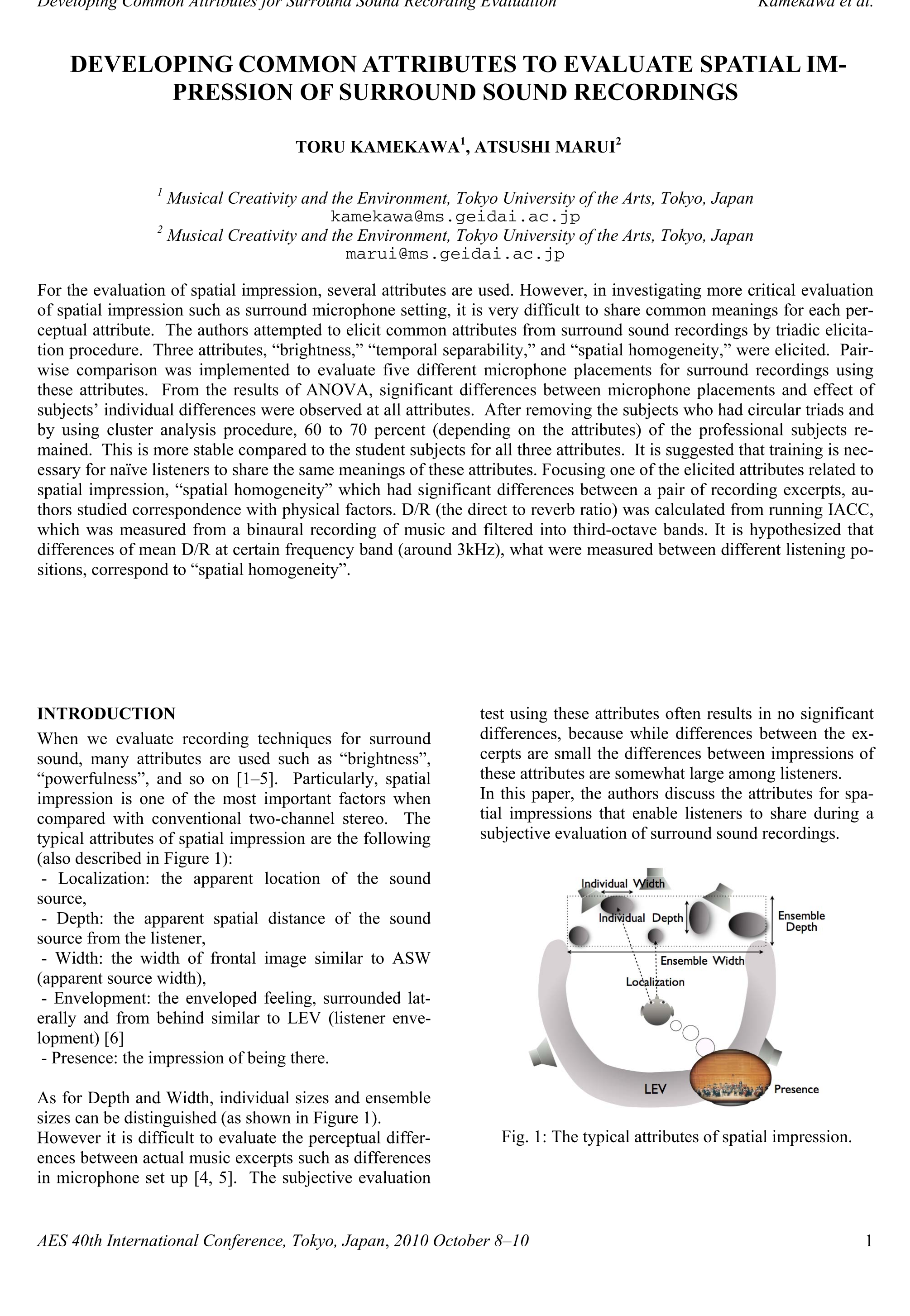
For the evaluation of spatial impression, several attributes are used. However, in investigating more critical evaluation of spatial impression such as surround microphone setting, it is very difficult to share common meanings for each per-ceptual attribute. The authors attempted to elicit common attributes from surround sound recordings by triadic elicita-tion procedure. Three attributes, “brightness,” “temporal separability,” and “spatial homogeneity,” were elicited. Pair-wise comparison was implemented to evaluate five different microphone placements for surround recordings using the-se attributes. From the results of ANOVA, significant differences between microphone placements and effect of sub-jects’ individual differences were observed at all attributes. After removing the subjects who had circular triads and by using cluster analysis procedure, 60 to 70 percent (depending on the attributes) of the professional subjects remained. This is more stable compared to the student subjects for all three attributes. It is suggested that training is necessary for naïve listeners to share the same meanings of these attributes. Focusing one of the elicited attributes related to spatial impression, “spatial homogeneity” which has significant differences between a pair of recording excerpts, authors stud-ied correspondence with physical factors. D/R (the direct to reverb ratio) was calculated from running IACC, which was measured from a binaural recording of music and filtered into third-octave bands. It is hypothesized that differences of mean D/R at certain frequency band (around 3kHz), what were measured between different listening positions, corre-spond to “spatial homogeneity”.
https://www.aes.org/e-lib/browse.cfm?elib=15528
Click to purchase paper as a non-member or login as an AES member. If your company or school subscribes to the E-Library then switch to the institutional version. If you are not an AES member and would like to subscribe to the E-Library then Join the AES!
This paper costs $33 for non-members and is free for AES members and E-Library subscribers.
Learn more about the AES E-Library
Start a discussion about this paper!