
You are currently logged in as an
Institutional Subscriber.
If you would like to logout,
please click on the button below.
Home / Publications / E-library page
Only AES members and Institutional Journal Subscribers can download
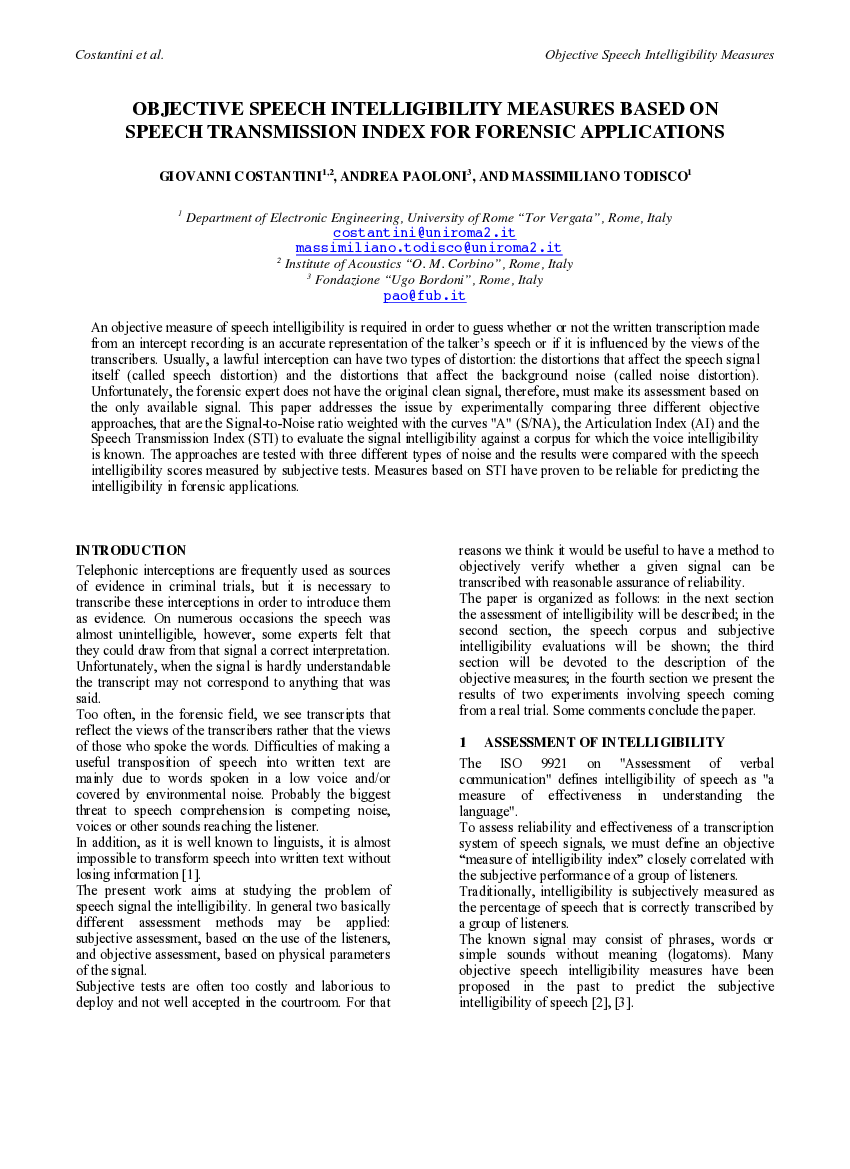
In order to decide whether the transposition of the speech originated from a lawful interception, in the written text reflect the views of those who spoke the words or only the views of the transcriber, is required to have an objective method to measure speech intelligibility. Usually, a lawful interception can have two types of distortion: the distortions that affect the speech signal itself (called speech distortion) and the distortions that affect the background noise (called noise distortion). Unfortunately, the forensic expert does not have the original clean signal, therefore, must make its assessment based on the only available signal. This paper addresses the issue by using three different objective approaches, that are the Signal-to-Noise ratio weighted with the curves "A" (S/NA), the Articulation Index (AI) and Speech Transmission Index (STI) to evaluate the signal and a corpus which is measured voice intelligibility. The approaches are tested with three different types of noise and the results were compared with the speech intelligibility scores measured by subjective tests. Measures based on STI have proven to be reliable for predicting the intelligibility in forensic applications.
Author (s): Costantini, Giovanni;
Paoloni, Andrea;
Todisco, Massimiliano;
Affiliation:
Fondazione Ugo Bordoni, Rome, Italy; Università Tor Vergata, Rome, Italy; Institute of Acoustics O.M. Corbino, Rome, Italy
(See document for exact affiliation information.)
Publication Date:
2010-06-06
Session subject:
Speech and Forensics - Automated Systems
DOI:
Click to purchase paper as a non-member or login as an AES member. If your company or school subscribes to the E-Library then switch to the institutional version. If you are not an AES member Join the AES. If you need to check your member status, login to the Member Portal.
Costantini, Giovanni; Paoloni, Andrea; Todisco, Massimiliano; 2010; Objective Speech Intelligibility Measures Based on Speech Transmission Index for Forensic Applications [PDF]; Fondazione Ugo Bordoni, Rome, Italy; Università Tor Vergata, Rome, Italy; Institute of Acoustics O.M. Corbino, Rome, Italy; Paper 8-2; Available from: https://aes.org/publications/elibrary-page/?id=15496
Costantini, Giovanni; Paoloni, Andrea; Todisco, Massimiliano; Objective Speech Intelligibility Measures Based on Speech Transmission Index for Forensic Applications [PDF]; Fondazione Ugo Bordoni, Rome, Italy; Università Tor Vergata, Rome, Italy; Institute of Acoustics O.M. Corbino, Rome, Italy; Paper 8-2; 2010 Available: https://aes.org/publications/elibrary-page/?id=15496
@inproceedings{Costantini2010objective,
title={{Objective Speech Intelligibility Measures Based on Speech Transmission Index for Forensic Applications}},
author={Costantini, Giovanni and Paoloni, Andrea and Todisco, Massimiliano},
year={2010},
month={jun},
booktitle={Journal of the Audio Engineering Society},
publisher={Paper 8-2; AES Conference: 39th International Conference: Audio Forensics: Practices and Challenges; June 2010},
number={8-2},
organization={AES},
}
Notifications
