
You are currently logged in as an
Institutional Subscriber.
If you would like to logout,
please click on the button below.
Home / Publications / E-library page
Only AES members and Institutional Journal Subscribers can download
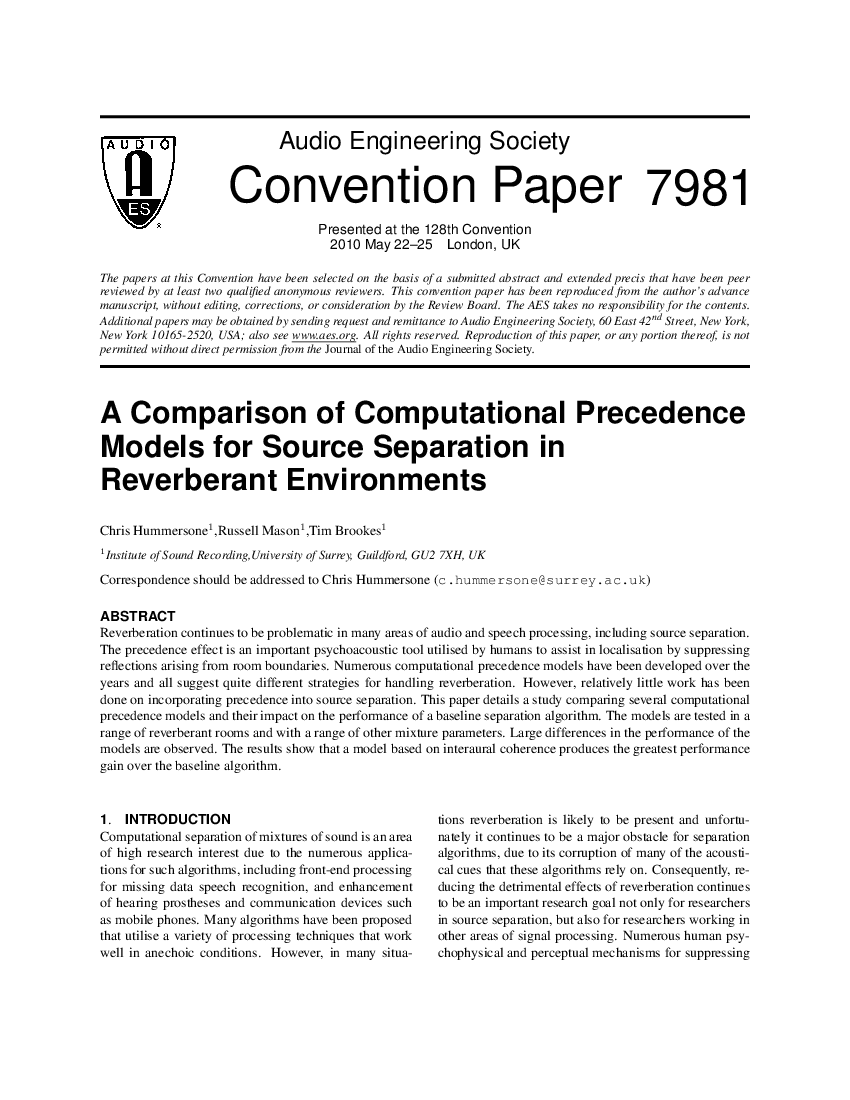
Reverberation continues to be problematic in many areas of audio and speech processing, including source separation. The precedence effect is an important psychoacoustic tool utilised by humans to assist in localisation by suppressing reflections arising from room boundaries. Numerous computational precedence models have been developed over the years and all suggest quite different strategies for handling reverberation. However, relatively little work has been done on incorporating precedence into source separation. This paper details a study comparing several computational precedence models and their impact on the performance of a baseline separation algorithm. The models are tested in a range of reverberant rooms and with a range of other mixture parameters. Large differences in the performance of the models are observed. The results show that a model based on interaural coherence produces the greatest performance gain over the baseline algorithm.
Author (s): Hummersone, Christopher;
Brookes, Tim;
Mason, Russell;
Affiliation:
Institute of Sound Recording, University of Surrey, Guildford, Surrey, UK
(See document for exact affiliation information.)
AES Convention: 128
Paper Number:7981
Publication Date:
2010-05-06
Session subject:
Spatial Signal Processing
DOI:
Click to purchase paper as a non-member or login as an AES member. If your company or school subscribes to the E-Library then switch to the institutional version. If you are not an AES member Join the AES. If you need to check your member status, login to the Member Portal.
Hummersone, Christopher; Brookes, Tim; Mason, Russell; 2010; A Comparison of Computational Precedence Models for Source Separation in Reverberant Environments [PDF]; Institute of Sound Recording, University of Surrey, Guildford, Surrey, UK; Paper 7981; Available from: https://aes.org/publications/elibrary-page/?id=15278
Hummersone, Christopher; Brookes, Tim; Mason, Russell; A Comparison of Computational Precedence Models for Source Separation in Reverberant Environments [PDF]; Institute of Sound Recording, University of Surrey, Guildford, Surrey, UK; Paper 7981; 2010 Available: https://aes.org/publications/elibrary-page/?id=15278
@inproceedings{Hummersone2010a,
title={{A Comparison of Computational Precedence Models for Source Separation in Reverberant Environments}},
author={Hummersone, Christopher and Brookes, Tim and Mason, Russell},
year={2010},
month={may},
booktitle={Journal of the Audio Engineering Society},
publisher={Paper 7981; AES Convention 128; May 2010},
number={7981},
organization={AES},
}
Notifications
