
You are currently logged in as an
Institutional Subscriber.
If you would like to logout,
please click on the button below.
Home / Publications / E-library page
Only AES members and Institutional Journal Subscribers can download
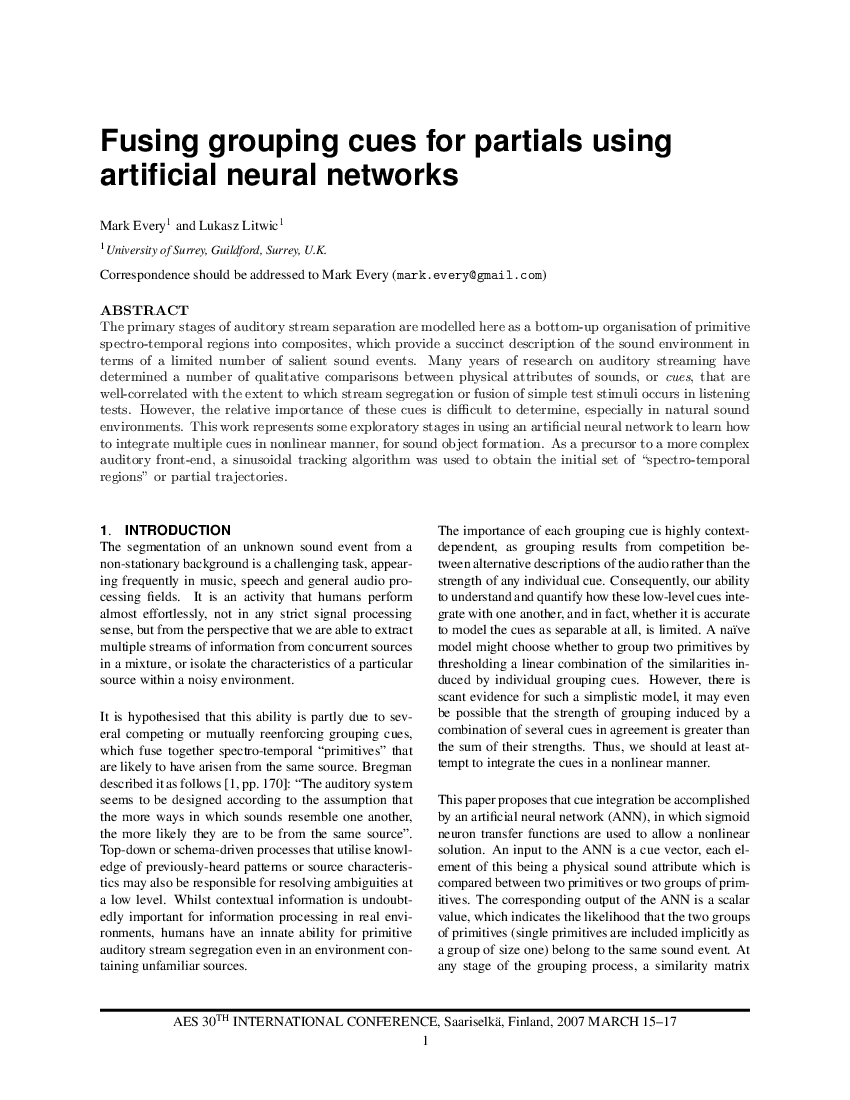
The primary stages of auditory stream separation are modelled here as a bottom-up organisation of primitive spectro-temporal regions into composites, which provide a succinct description of the sound environment in terms of a limited number of salient sound events. Many years of research on auditory streaming have determined a number of qualitative comparisons between physical attributes of sounds, or cues, that are well-correlated with the extent to which stream segregation or fusion of simple test stimuli occurs in listening tests. However, the relative importance of these cues is difficult to determine, especially in natural sound environments. This work represents some exploratory stages in using an artificial neural network to learn how to integrate multiple cues in nonlinear manner, for sound object formation. As a precursor to a more complex auditory front-end, a sinusoidal tracking algorithm was used to obtain the initial set of "spectro-temporal regions" or partial trajectories.
Author (s): Every, Mark;
Litwic, Lukasz;
Affiliation:
University of Surrey
(See document for exact affiliation information.)
Publication Date:
2007-03-06
Session subject:
Intelligent Audio Environments
DOI:
Click to purchase paper as a non-member or login as an AES member. If your company or school subscribes to the E-Library then switch to the institutional version. If you are not an AES member Join the AES. If you need to check your member status, login to the Member Portal.
Every, Mark; Litwic, Lukasz; 2007; Fusing Grouping Cues for Partials Using Artificial Neural Networks [PDF]; University of Surrey; Paper 24; Available from: https://aes.org/publications/elibrary-page/?id=13923
Every, Mark; Litwic, Lukasz; Fusing Grouping Cues for Partials Using Artificial Neural Networks [PDF]; University of Surrey; Paper 24; 2007 Available: https://aes.org/publications/elibrary-page/?id=13923
@inproceedings{Every2007fusing,
title={{Fusing Grouping Cues for Partials Using Artificial Neural Networks}},
author={Every, Mark and Litwic, Lukasz},
year={2007},
month={mar},
booktitle={Journal of the Audio Engineering Society},
publisher={Paper 24; AES Conference: 30th International Conference: Intelligent Audio Environments; March 2007},
number={24},
organization={AES},
}
Notifications
