
You are currently logged in as an
Institutional Subscriber.
If you would like to logout,
please click on the button below.
Home / Publications / E-library page
Only AES members and Institutional Journal Subscribers can download
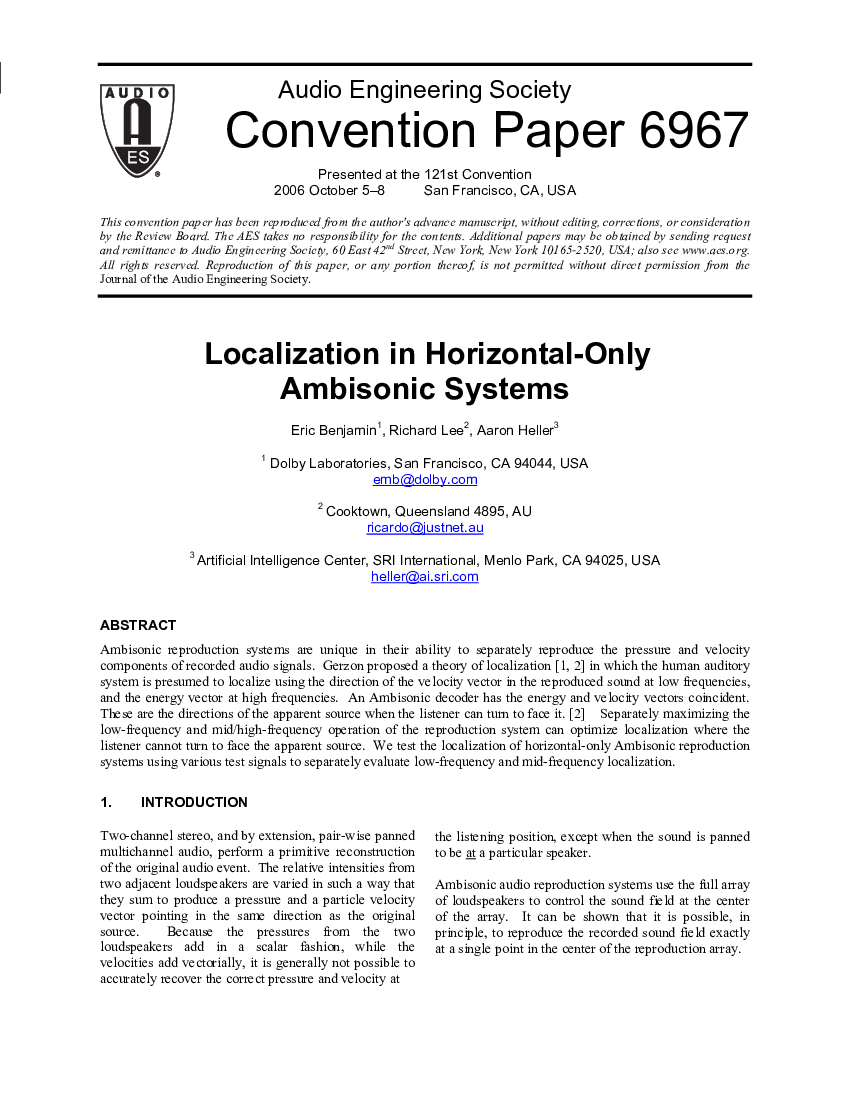
Ambisonic reproduction systems are unique in their ability to separately reproduce the pressure and velocity components of the recorded audio signals. Gerzon proposed a theory of localization[1,2] in which the human auditory system is presumed to localize using the direction of the velocity vector in the reproduced sound at low frequencies, and the energy vector at high frequencies. An Ambisonic decoder has the energy and velocity vectors coincident. These are the directions of the apparent source when the listener can turn to face it. [2] Separately maximizing the low-frequency and mid/high-frequency operation of the reproduction system can optimize localization where the listener cannot turn to face the apparent source. We test the localization of horizontal-only Ambisonic reproduction systems using various narrow-band test signals to separately evaluate low-frequency and mid-frequency localization.
Author (s): Benjamin, Eric;
Heller, Aaron;
Lee, Richard;
Affiliation:
Consultant; Dolby Laboratories; SRI International
(See document for exact affiliation information.)
AES Convention: 121
Paper Number:6967
Publication Date:
2006-10-06
Session subject:
Multichannel Sound
DOI:
Click to purchase paper as a non-member or login as an AES member. If your company or school subscribes to the E-Library then switch to the institutional version. If you are not an AES member Join the AES. If you need to check your member status, login to the Member Portal.
Benjamin, Eric; Heller, Aaron; Lee, Richard; 2006; Localization in Horizontal-Only Ambisonic Systems [PDF]; Consultant; Dolby Laboratories; SRI International; Paper 6967; Available from: https://aes.org/publications/elibrary-page/?id=13801
Benjamin, Eric; Heller, Aaron; Lee, Richard; Localization in Horizontal-Only Ambisonic Systems [PDF]; Consultant; Dolby Laboratories; SRI International; Paper 6967; 2006 Available: https://aes.org/publications/elibrary-page/?id=13801
@inproceedings{Benjamin2006localization,
title={{Localization in Horizontal-Only Ambisonic Systems}},
author={Benjamin, Eric and Heller, Aaron and Lee, Richard},
year={2006},
month={oct},
booktitle={Journal of the Audio Engineering Society},
publisher={Paper 6967; AES Convention 121; October 2006},
number={6967},
organization={AES},
}
Notifications
