
You are currently logged in as an
Institutional Subscriber.
If you would like to logout,
please click on the button below.
Home / Publications / E-library page
Only AES members and Institutional Journal Subscribers can download
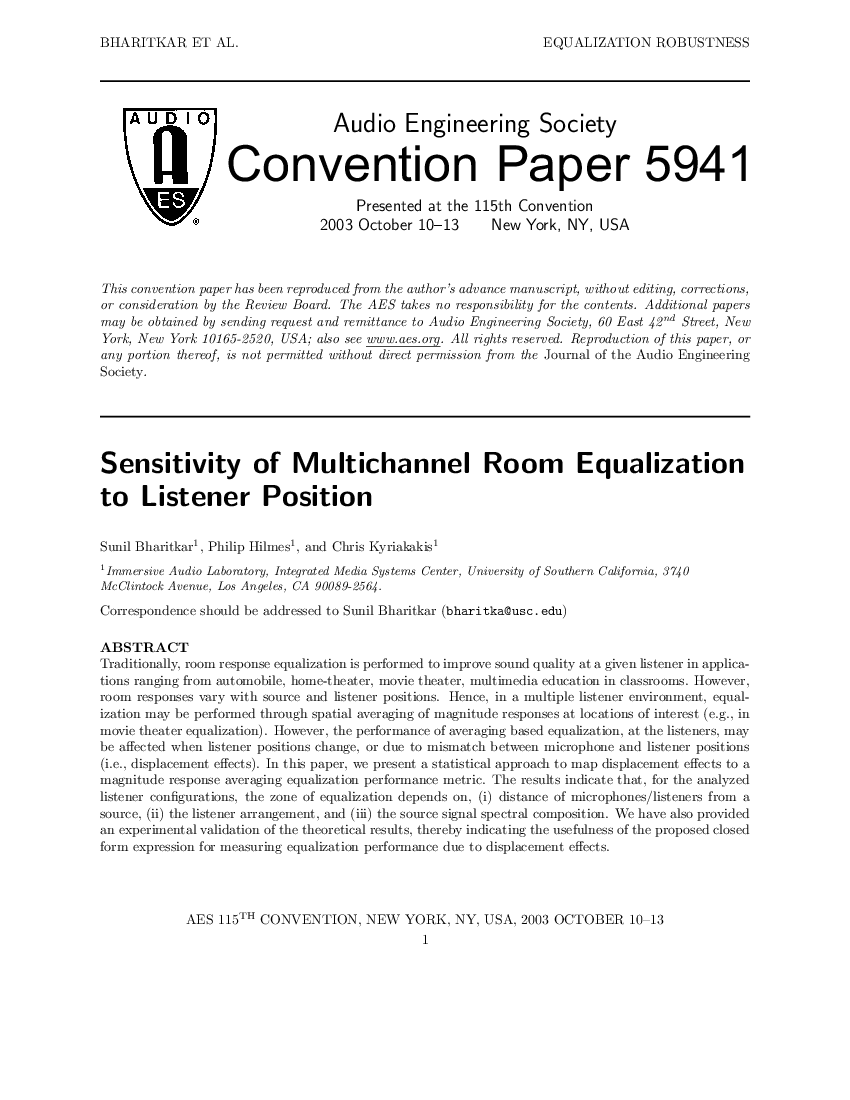
Traditionally, room response equalization is performed to improve sound quality at a given listener in applications ranging from automobile, home-theater, movie theater, multimedia education in classrooms. However, room responses vary with source and listener positions. Hence, in a multiple listener environment, equalization may be performed through spatial averaging of magnitude responses at locations of interest (e.g., in movie theater equalization). However, the performance of averaging based equalization, at the listeners, may be affected when listener positions change, or due to mismatch between microphone and listener positions (i.e., displacement effects). In this paper, we present a statistical approach to map displacement effects to a magnitude response averaging equalization performance metric. The results indicate that, for the analyzed listener configurations, the zone of equalization depends on, (i) distance of microphones/listeners from a source, (ii) the listener arrangement, and (iii) the source signal spectral composition. We have also provided an experimental validation of the theoretical results, thereby indicating the usefulness of the proposed closed form expression for measuring equalization performance due to displacement effects.
Author (s): Bharitkar, Sunil;
Hilmes, Philip;
Kyriakakis, Chris;
Affiliation:
Immersive Audio Laboratory, Integrated Media Systems Center, University of Southern California, Los Angeles, CA
(See document for exact affiliation information.)
AES Convention: 115
Paper Number:5941
Publication Date:
2003-10-06
Session subject:
Room Acoustics
DOI:
Click to purchase paper as a non-member or login as an AES member. If your company or school subscribes to the E-Library then switch to the institutional version. If you are not an AES member Join the AES. If you need to check your member status, login to the Member Portal.
Bharitkar, Sunil; Hilmes, Philip; Kyriakakis, Chris; 2003; Sensitivity of Multichannel Room Equalization to Listener Position [PDF]; Immersive Audio Laboratory, Integrated Media Systems Center, University of Southern California, Los Angeles, CA ; Paper 5941; Available from: https://aes.org/publications/elibrary-page/?id=12357
Bharitkar, Sunil; Hilmes, Philip; Kyriakakis, Chris; Sensitivity of Multichannel Room Equalization to Listener Position [PDF]; Immersive Audio Laboratory, Integrated Media Systems Center, University of Southern California, Los Angeles, CA ; Paper 5941; 2003 Available: https://aes.org/publications/elibrary-page/?id=12357
@inproceedings{Bharitkar2003sensitivity,
title={{Sensitivity of Multichannel Room Equalization to Listener Position}},
author={Bharitkar, Sunil and Hilmes, Philip and Kyriakakis, Chris},
year={2003},
month={oct},
booktitle={Journal of the Audio Engineering Society},
publisher={Paper 5941; AES Convention 115; October 2003},
number={5941},
organization={AES},
}
Notifications
