
You are currently logged in as an
Institutional Subscriber.
If you would like to logout,
please click on the button below.
Home / Publications / E-library page
Only AES members and Institutional Journal Subscribers can download
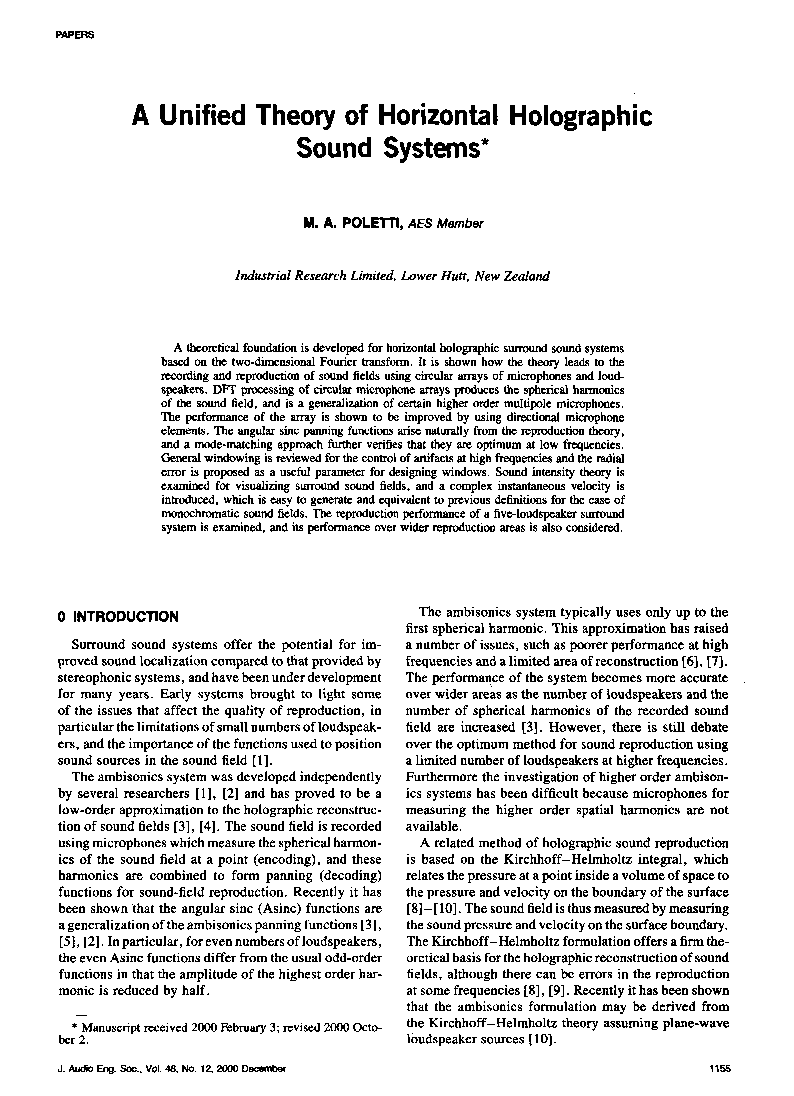
A theoretical foundation is development for horizontal holographic surround sound systems based on the two-dimensional Fourier transform. It is shown how the theory leads to the recording and reproduction of sound fields using circular arrays of microphones and loudspeakers. DFT processing of circular microphone arrays produces the spherical harmonics of the sound field, and is a generalization of certain higher order multipole microphones. The performance of the array is shown to be improved by using directional microphone elements. The angular sinc panning functions arise naturally from the reproduction theory, and a mode-matching approach further verifies that they are optimum at low frequencies. General windowing is reviewed for the control of artifacts at high frequencies and the radial error is proposed as a useful parameter for designing windows. Sound intensity theory is examined for visualizing surround sound fields, and a complex instantaneous velocity is introduced, which is easy to generate and equivalent to previous definitions for the case of monochromatic sound fields. The reproduction performance of a five-loudspeaker surround system is examined, and its performance over wider reproduction areas is also considered.
Author (s): Poletti, Mark A.;
Affiliation:
Industrial Research Limited, Lower Hutt, New Zealand
(See document for exact affiliation information.)
Publication Date:
2000-12-06
DOI:
Click to purchase paper as a non-member or login as an AES member. If your company or school subscribes to the E-Library then switch to the institutional version. If you are not an AES member Join the AES. If you need to check your member status, login to the Member Portal.
Poletti, Mark A.; 2000; A Unified Theory of Horizontal Holographic Sound Systems [PDF]; Industrial Research Limited, Lower Hutt, New Zealand; Paper ; Available from: https://aes.org/publications/elibrary-page/?id=12033
Poletti, Mark A.; A Unified Theory of Horizontal Holographic Sound Systems [PDF]; Industrial Research Limited, Lower Hutt, New Zealand; Paper ; 2000 Available: https://aes.org/publications/elibrary-page/?id=12033
Notifications
