
You are currently logged in as an
Institutional Subscriber.
If you would like to logout,
please click on the button below.
Home / Publications / E-library page
Only AES members and Institutional Journal Subscribers can download
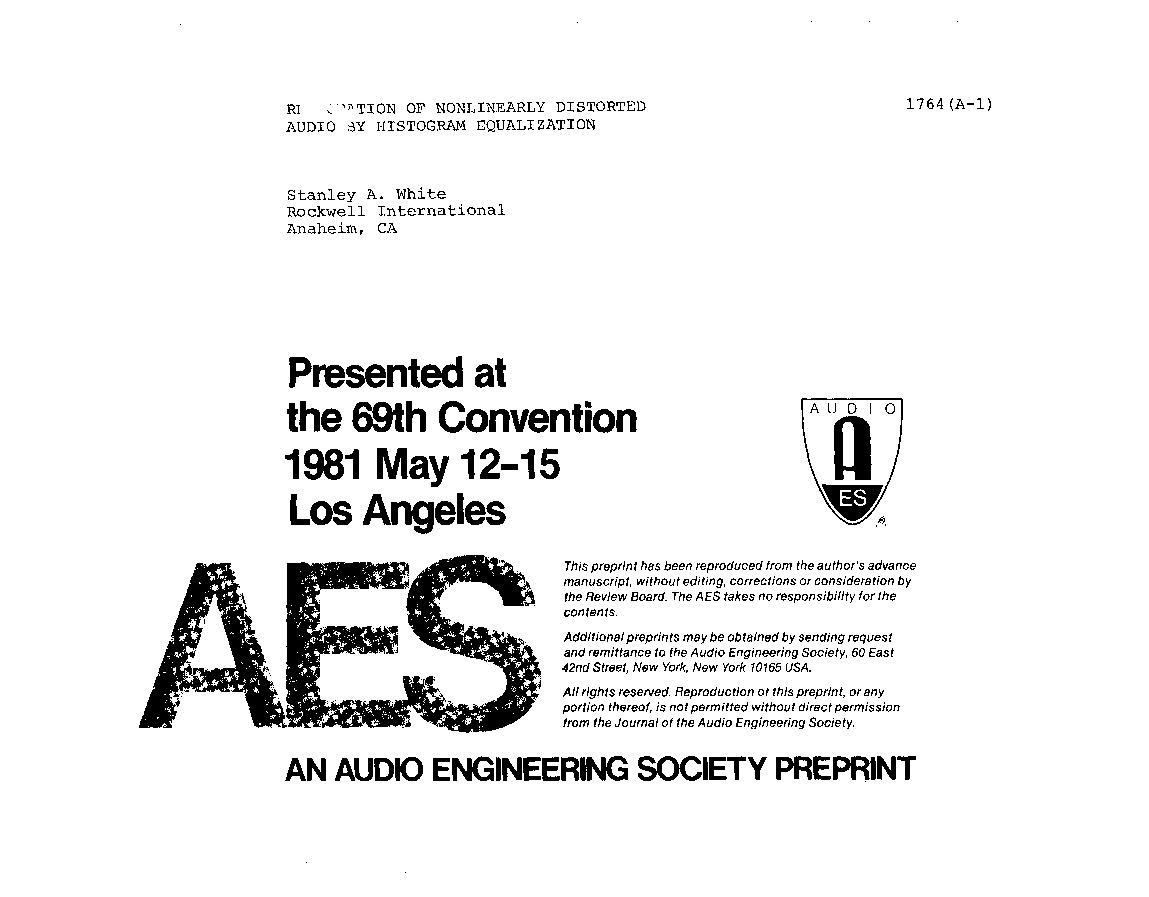
Restoration of degraded speech which has been captured on audio tape often relies on linear adaptive-filtering procedures or their hardware embodiments such as the Rockwell ADAP. If the speech degradation can be modeled by a linear process, then liner adaptive filtering can provide suitable restoration. If, however, a nonlinear phenomenon, such as soft saturation, has been a contributor to the degradation, then the linear adaptive filter is no longer adequate. Linear adaptive filters consist of one or more transversal and/or recursive sections whose tap weights or gains are linear and whose values are adjusted so that the filter minimizes a performance criterion in some prescribed sense, such as minimum mean-squared error. A more general form of adaptive filter is proposed, one in which the gain at each tap location is a function of the signal at that tap. Next, this new filter is approximated by an alternating sequence of short linear adaptive filters which perform frequency-domain equalization, and nonlinear amplitude correctors which perform amplitude-domain equalization. Preliminary experiments have been performed using the nonlinear corrector portion of this new class of adaptive filter. Histogram equalization is used to define the nonlinear-gain strategy. The training to obtain the reference histogram for histogram equalization is remarkably speaker invariant when proper techniques are used for modeling. Sample audio tapes will be played to demonstrate the results which have been obtained by this technique.
Author (s): White, Stanley A.;
Affiliation:
Rockwell International, Anaheim, CA
(See document for exact affiliation information.)
AES Convention: 69
Paper Number:1764
Publication Date:
1981-05-06
DOI:
Click to purchase paper as a non-member or login as an AES member. If your company or school subscribes to the E-Library then switch to the institutional version. If you are not an AES member Join the AES. If you need to check your member status, login to the Member Portal.
White, Stanley A.; 1981; Restoration of Nonlinearly Distorted Audio by Histogram Equalization [PDF]; Rockwell International, Anaheim, CA; Paper 1764; Available from: https://aes.org/publications/elibrary-page/?id=11989
White, Stanley A.; Restoration of Nonlinearly Distorted Audio by Histogram Equalization [PDF]; Rockwell International, Anaheim, CA; Paper 1764; 1981 Available: https://aes.org/publications/elibrary-page/?id=11989
@inproceedings{White1981restoration,
title={{Restoration of Nonlinearly Distorted Audio by Histogram Equalization}},
author={White, Stanley A.},
year={1981},
month={may},
booktitle={Journal of the Audio Engineering Society},
publisher={Paper 1764; AES Convention 69; May 1981},
number={1764},
organization={AES},
}
Notifications
