
You are currently logged in as an
Institutional Subscriber.
If you would like to logout,
please click on the button below.
Home / Publications / E-library page
Only AES members and Institutional Journal Subscribers can download
Near instantaneous or block companding has been readily adopted even for broadcast-quality digital audio transmission. The British NICAM-3, e.g., uses block companding for data reduction from 14 to 10 bits per sample. Further reduction of the data stream down to 8 bits per sample for several applications in consumer electronics can degrade the signal quality. In this paper it will be shown how an additional 6 dB of S/N can be gained by a very simple adaptive quantizing scheme. The background for this procedure is deduced from long-term statistical data of typical program material. These statistical data and the results of computer simulation of the proposed Adaptive-Near-Instantaneous-Companding are shown.
Author (s): Schroeder, Ernst F.;
Scholz, W.;
Affiliation:
TELEFUNKEN FERNESH UND RUNDFUNK, HANNOVER, W. GERMANY
(See document for exact affiliation information.)
AES Convention: 75
Paper Number:2069
Publication Date:
1984-03-06
Session subject:
Digital Processing
DOI:
Click to purchase paper as a non-member or login as an AES member. If your company or school subscribes to the E-Library then switch to the institutional version. If you are not an AES member Join the AES. If you need to check your member status, login to the Member Portal.
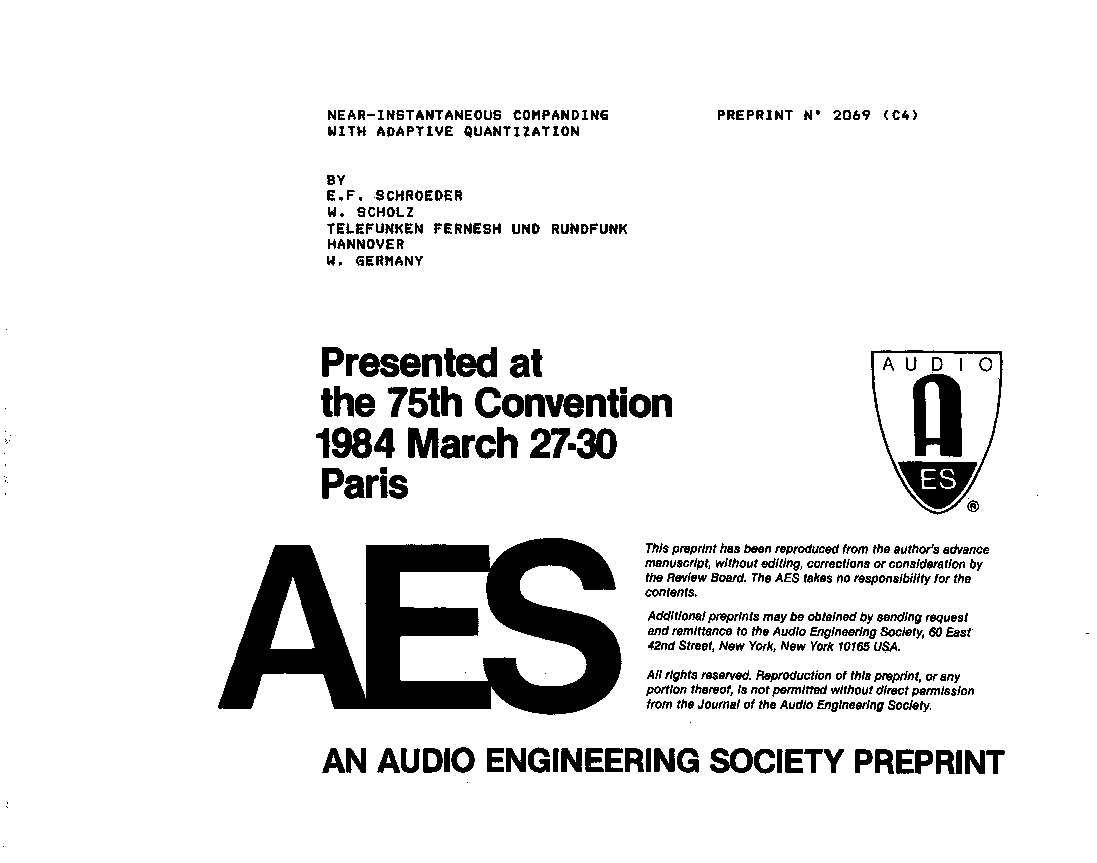
Schroeder, Ernst F.; Scholz, W.; 1984; Near-Instantaneous Companding with Adaptive Quantization [PDF]; TELEFUNKEN FERNESH UND RUNDFUNK, HANNOVER, W. GERMANY; Paper 2069; Available from: https://aes.org/publications/elibrary-page/?id=11695
Schroeder, Ernst F.; Scholz, W.; Near-Instantaneous Companding with Adaptive Quantization [PDF]; TELEFUNKEN FERNESH UND RUNDFUNK, HANNOVER, W. GERMANY; Paper 2069; 1984 Available: https://aes.org/publications/elibrary-page/?id=11695
@inproceedings{Schroeder1984near-instantaneous,
title={{Near-Instantaneous Companding with Adaptive Quantization}},
author={Schroeder, Ernst F. and Scholz, W.},
year={1984},
month={mar},
booktitle={Journal of the Audio Engineering Society},
publisher={Paper 2069; AES Convention 75; March 1984},
number={2069},
organization={AES},
}
Notifications
