
You are currently logged in as an
Institutional Subscriber.
If you would like to logout,
please click on the button below.
Home / Publications / E-library page
Only AES members and Institutional Journal Subscribers can download
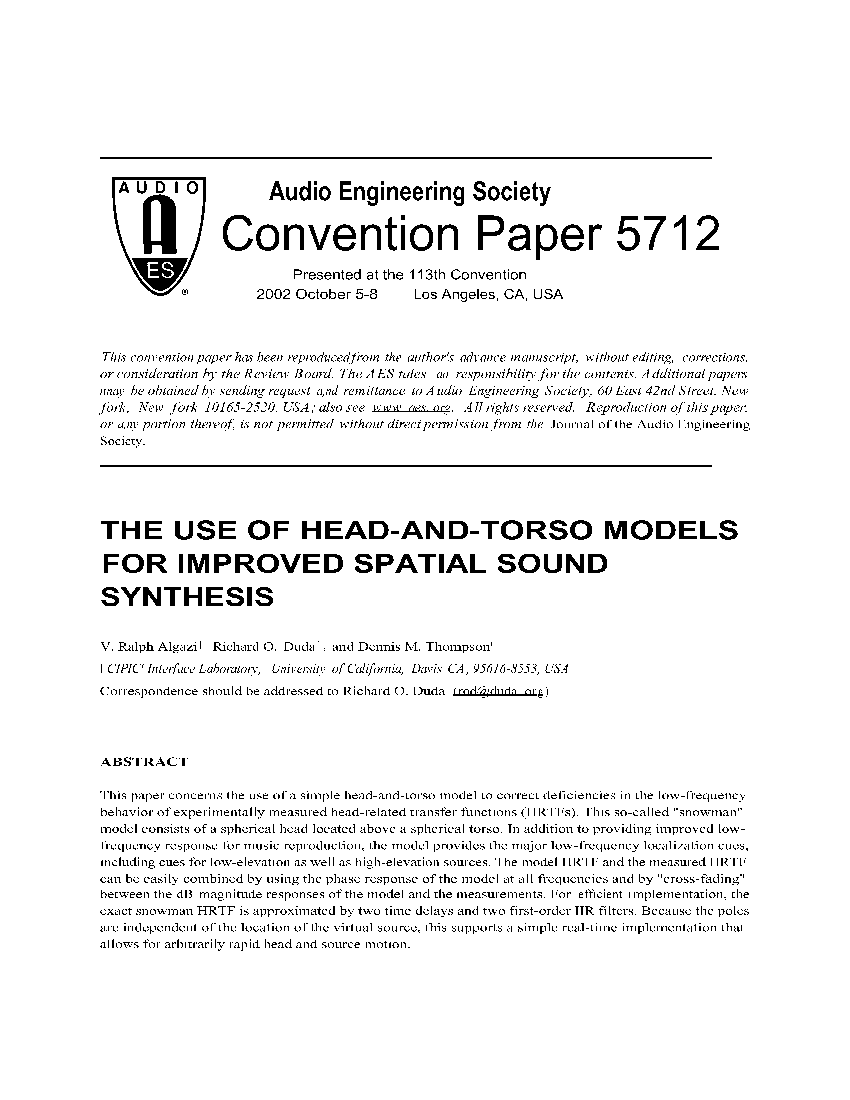
This paper concerns the use of a simple head-and-torso model to correct deficiencies in the low-frequency behavior of experimentally measured head-related transfer functions (HRTFs). This so-called "snowman" model consists of a spherical head located above a spherical torso. In addition to providing improved low-frequency response for music reproduction, the model provides the major low-frequency localization cues, including cues for low-elevation as well as high-elevation sources. The model HRTF and the measured HRTF can be easily combined by using the phase response of the model at all frequencies and by "cross-fading" between the dB magnitude responses of the model and the measurements. For efficient implementation, the exact snowman HRTF is approximated by two time delays and two first-order IIR filters. Because the poles are independent of the location of the virtual source, this supports a simple real-time implementation that allows for arbitrarily rapid head and source motion.
Author (s): Duda, Richard O.;
Algazi, V. Ralph;
Thompson, Dennis M.;
Affiliation:
CIPIC Interface Laboratory, University of California, Davis CA,
(See document for exact affiliation information.)
AES Convention: 113
Paper Number:5712
Publication Date:
2002-10-06
Session subject:
Psychoacoustics
DOI:
Click to purchase paper as a non-member or login as an AES member. If your company or school subscribes to the E-Library then switch to the institutional version. If you are not an AES member Join the AES. If you need to check your member status, login to the Member Portal.
Duda, Richard O.; Algazi, V. Ralph; Thompson, Dennis M.; 2002; The Use of Head-and-Torso Models for Improved Spatial Sound Synthesis [PDF]; CIPIC Interface Laboratory, University of California, Davis CA,; Paper 5712; Available from: https://aes.org/publications/elibrary-page/?id=11294
Duda, Richard O.; Algazi, V. Ralph; Thompson, Dennis M.; The Use of Head-and-Torso Models for Improved Spatial Sound Synthesis [PDF]; CIPIC Interface Laboratory, University of California, Davis CA,; Paper 5712; 2002 Available: https://aes.org/publications/elibrary-page/?id=11294
@inproceedings{Duda2002the,
title={{The Use of Head-and-Torso Models for Improved Spatial Sound Synthesis}},
author={Duda, Richard O. and Algazi, V. Ralph and Thompson, Dennis M.},
year={2002},
month={oct},
booktitle={Journal of the Audio Engineering Society},
publisher={Paper 5712; AES Convention 113; October 2002},
number={5712},
organization={AES},
}
Notifications
