
You are currently logged in as an
Institutional Subscriber.
If you would like to logout,
please click on the button below.
Home / Publications / E-library page
Only AES members and Institutional Journal Subscribers can download
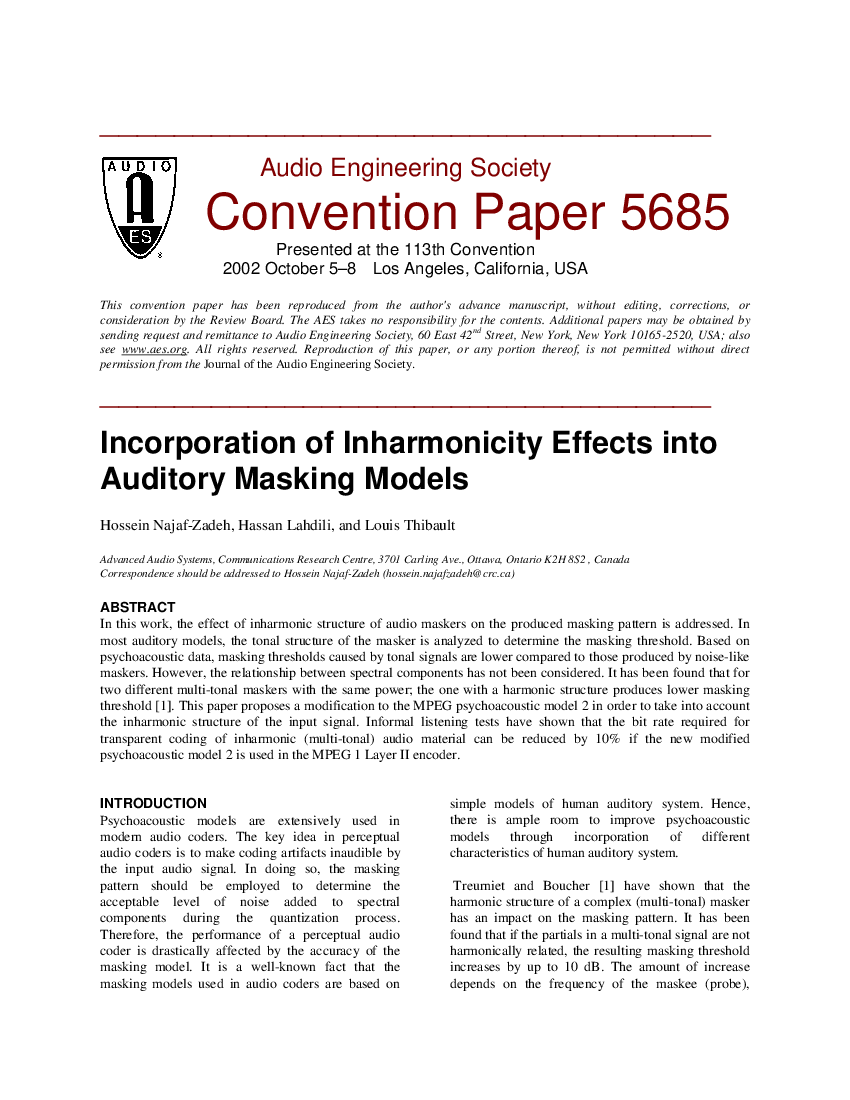
In this work, the effect of inharmonic structure of audio maskers on the produced masking pattern is addressed. In most auditory models, the tonal structure of the masker is analyzed to determine the masking threshold. Based on psychoacoustic data, masking thresholds caused by tonal signals are lower compared to those produced by noise-like maskers. However, the relationship between spectral components has not been considered. It has been found that for two different multi-tonal maskers with the same power; the one with a harmonic structure produces lower masking threshold. This paper proposes a modification to the MPEG psychoacoustic model 2 in order to take into account the inharmonic structure of the input signal. Informal listening tests have shown that the bit rate required for transparent coding of inharmonic (multi-tonal) audio material can be reduced by 10% if the new modified psychoacoustic model 2 is used in the MPEG 1 Layer II encoder.
Author (s): Najaf-Zadeh, Hossein;
Lahdili, Hassan;
Thibault, Louis;
Affiliation:
Advanced Audio Systems, Communications Research Centre, Ottawa, Ontario, Canada
(See document for exact affiliation information.)
AES Convention: 113
Paper Number:5685
Publication Date:
2002-10-06
Session subject:
Low Bit-Rate Coding
DOI:
Click to purchase paper as a non-member or login as an AES member. If your company or school subscribes to the E-Library then switch to the institutional version. If you are not an AES member Join the AES. If you need to check your member status, login to the Member Portal.
Najaf-Zadeh, Hossein; Lahdili, Hassan; Thibault, Louis; 2002; Incorporation of Inharmonicity Effects into Auditory Masking Models [PDF]; Advanced Audio Systems, Communications Research Centre, Ottawa, Ontario, Canada; Paper 5685; Available from: https://aes.org/publications/elibrary-page/?id=11281
Najaf-Zadeh, Hossein; Lahdili, Hassan; Thibault, Louis; Incorporation of Inharmonicity Effects into Auditory Masking Models [PDF]; Advanced Audio Systems, Communications Research Centre, Ottawa, Ontario, Canada; Paper 5685; 2002 Available: https://aes.org/publications/elibrary-page/?id=11281
@inproceedings{Najaf-Zadeh2002incorporation,
title={{Incorporation of Inharmonicity Effects into Auditory Masking Models}},
author={Najaf-Zadeh, Hossein and Lahdili, Hassan and Thibault, Louis},
year={2002},
month={oct},
booktitle={Journal of the Audio Engineering Society},
publisher={Paper 5685; AES Convention 113; October 2002},
number={5685},
organization={AES},
}
Notifications
