
You are currently logged in as an
Institutional Subscriber.
If you would like to logout,
please click on the button below.
Home / Publications / E-library page
Only AES members and Institutional Journal Subscribers can download
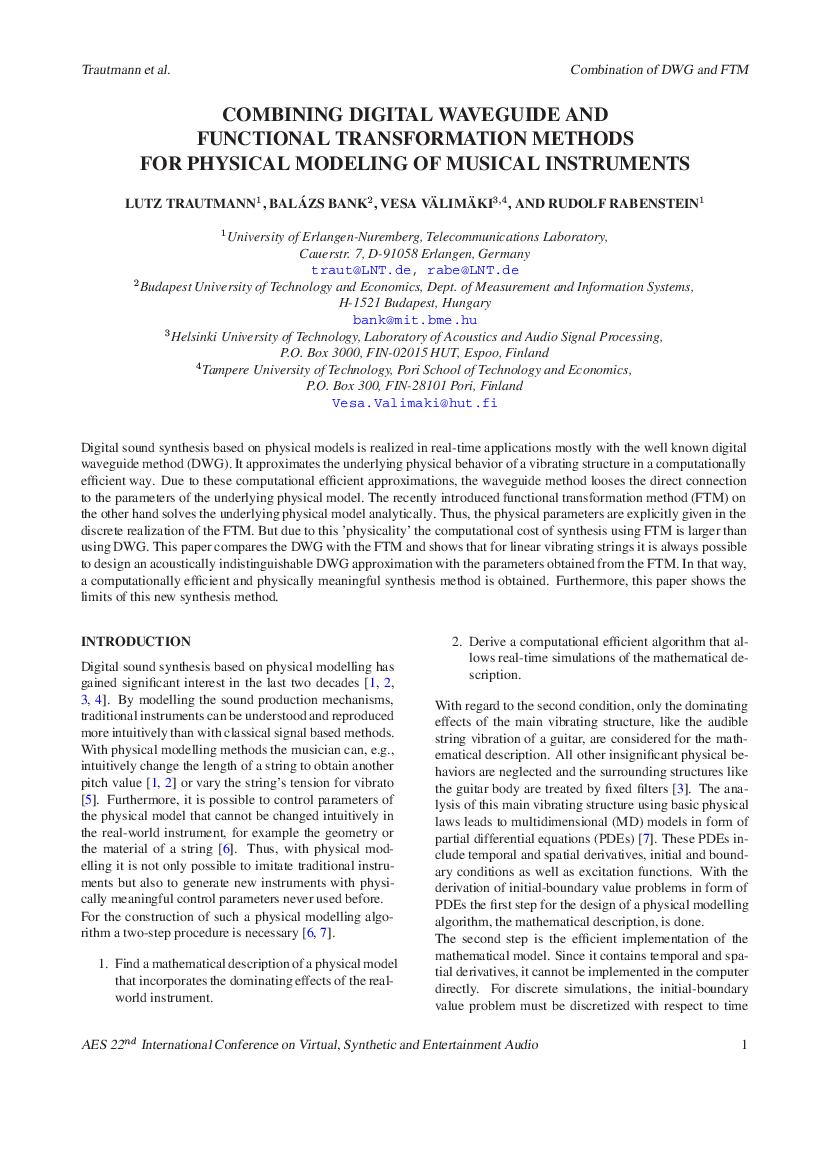
Digital sound synthesis based on physical models is realized in real-time applications mostly with the well known digital waveguide method (DWG). It approximates the underlying physical behavior of a vibrating structure in a computationally efficient way. Due to these computational efficient approximations, the waveguide method looses the direct connection to the parameters of the underlying physical model. The recently introduced functional transformation method (FTM) on the other hand solves the underlying physical model analytically. Thus, the physical parameters are explicitly given in the discrete realization of the FTM. But due to this `physicality` the computational cost of synthesis using FTM is larger than using DWG. This paper compares the DWG with the FTM and shows that for linear vibrating strings it is always possible to design an acoustically indistinguishable DWG approximation with the parameters obtained from the FTM. In that way, a computationally efficient and physically meaningful synthesis method is obtained. Furthermore, this paper shows the limits of this new synthesis method.
Author (s): Trautmann, Lutz;
Bank, Balazs;
Valimaki, Vesa;
Rabenstein, Rudolf;
Affiliation:
University of Erlangen-Nuremberg, Telecommunications Laboratory, Erlangen, Germany ; Budapest University of Technology and Economics, Dept. of Measurement and Information Systems, Budapest, Hungary ; Helsinki University of Technology, Laboratory of Acoustics and Audio Signal Processing, Espoo, Finland ; Tampere University of Technology, Pori School of Technology and Economics, Pori, Finland
(See document for exact affiliation information.)
Publication Date:
2002-06-06
Session subject:
Virtual, Synthetic and Entertainment Audio
DOI:
Click to purchase paper as a non-member or login as an AES member. If your company or school subscribes to the E-Library then switch to the institutional version. If you are not an AES member Join the AES. If you need to check your member status, login to the Member Portal.
Trautmann, Lutz; Bank, Balazs; Valimaki, Vesa; Rabenstein, Rudolf; 2002; Combining Digital Waveguide and Functional Transformation Methods for Physical Modeling of Musical Instruments [PDF]; University of Erlangen-Nuremberg, Telecommunications Laboratory, Erlangen, Germany ; Budapest University of Technology and Economics, Dept. of Measurement and Information Systems, Budapest, Hungary ; Helsinki University of Technology, Laboratory of Acoustics and Audio Signal Processing, Espoo, Finland ; Tampere University of Technology, Pori School of Technology and Economics, Pori, Finland; Paper 000215; Available from: https://aes.org/publications/elibrary-page/?id=11157
Trautmann, Lutz; Bank, Balazs; Valimaki, Vesa; Rabenstein, Rudolf; Combining Digital Waveguide and Functional Transformation Methods for Physical Modeling of Musical Instruments [PDF]; University of Erlangen-Nuremberg, Telecommunications Laboratory, Erlangen, Germany ; Budapest University of Technology and Economics, Dept. of Measurement and Information Systems, Budapest, Hungary ; Helsinki University of Technology, Laboratory of Acoustics and Audio Signal Processing, Espoo, Finland ; Tampere University of Technology, Pori School of Technology and Economics, Pori, Finland; Paper 000215; 2002 Available: https://aes.org/publications/elibrary-page/?id=11157
@inproceedings{Trautmann2002combining,
title={{Combining Digital Waveguide and Functional Transformation Methods for Physical Modeling of Musical Instruments}},
author={Trautmann, Lutz and Bank, Balazs and Valimaki, Vesa and Rabenstein, Rudolf},
year={2002},
month={jun},
booktitle={Journal of the Audio Engineering Society},
publisher={Paper 000215; AES Conference: 22nd International Conference: Virtual, Synthetic, and Entertainment Audio; June 2002},
number={000215},
organization={AES},
}
Notifications
