
You are currently logged in as an
Institutional Subscriber.
If you would like to logout,
please click on the button below.
Home / Publications / E-library page
Only AES members and Institutional Journal Subscribers can download
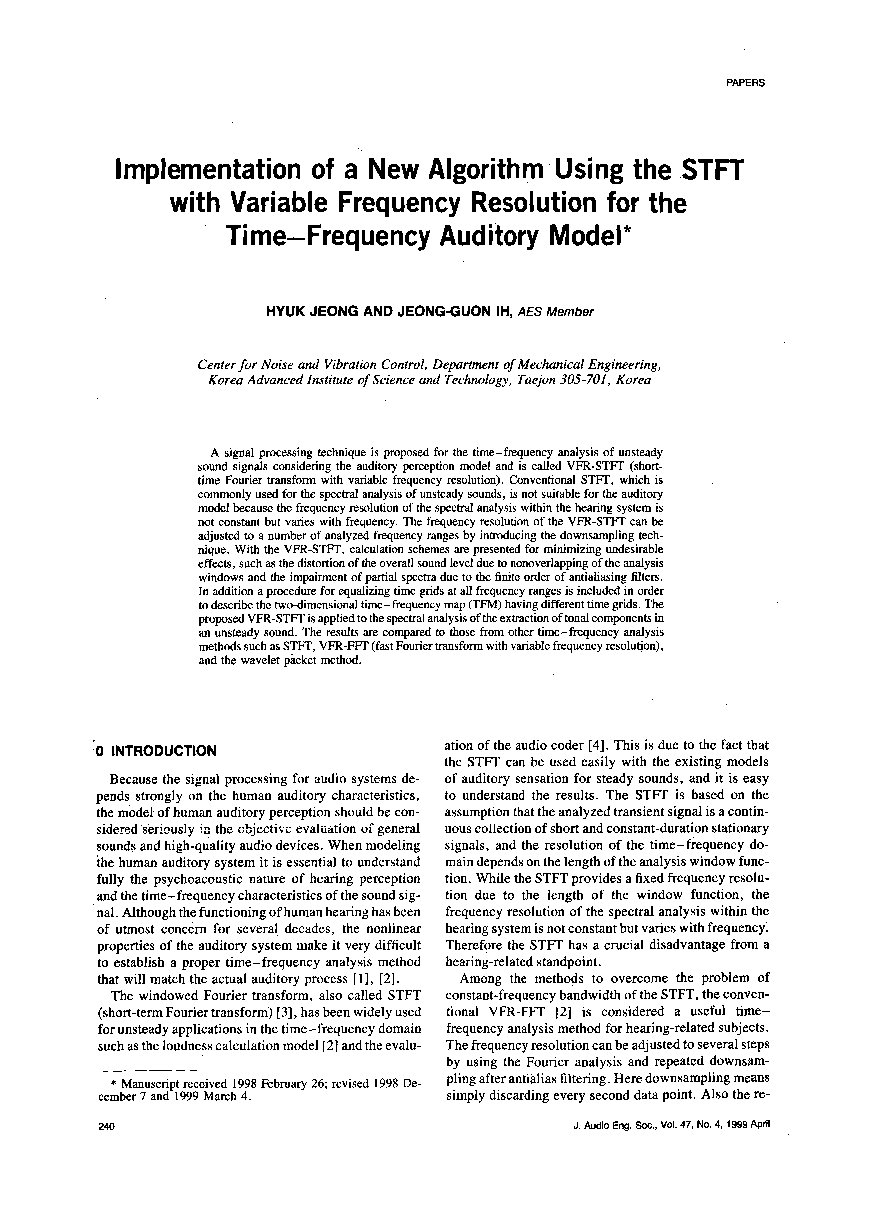
A signal processing technique is proposed for the time-frequency analysis of unsteady sound signals considering the auditory perception model and is called VFR-STFT (short-time Fourier transform with variable frequency resolution). Conventional STFT, which is commonly used for the spectral analysis of unsteady sounds, is not suitable for the auditory model because the frequency resolution of the spectral analysis within the hearing system is not constant but varies with frequency. The frequency resolution VFR-STFT can be adjusted to a number of analyzed frequency ranges by introducing the downsampling technique. With the VFR-STFT, calculation schemes are presented for minimizing undesirable effects, such as the distortion of the overall sound level due to nonoverlapping of the analysis windows and the impairment of partial spectra due to the finite order of antialiasing filters. In addition, a procedure for equalizing time grids at all frequency ranges is included in order to describe the two-dimensional time-frequency map (TFM) having different time grids. The proposed VFR-STFT is applied to the spectral analysis of the extraction of tonal components in an unsteady sound. The results are compared to those from other time-frequency analysis methods such as STFT, VFR-FFT (fast Fourier transform with variable frequency resolution), and the wavelet packet method.
Author (s): Jeong, Hyuk;
Ih, Jeong-Guon;
Affiliation:
(See document for exact affiliation information.)
Publication Date:
1999-04-06
DOI:
Click to purchase paper as a non-member or login as an AES member. If your company or school subscribes to the E-Library then switch to the institutional version. If you are not an AES member Join the AES. If you need to check your member status, login to the Member Portal.
Jeong, Hyuk; Ih, Jeong-Guon; 1999; Implementation of a New Algorithm Using the STFT with Variable Frequency Resolution for the Time-Frequency Auditory Model [PDF]; ; Paper ; Available from: https://aes.org/publications/elibrary-page/?id=10267
Jeong, Hyuk; Ih, Jeong-Guon; Implementation of a New Algorithm Using the STFT with Variable Frequency Resolution for the Time-Frequency Auditory Model [PDF]; ; Paper ; 1999 Available: https://aes.org/publications/elibrary-page/?id=10267
@article{Jeong1999implementation,
title={{Implementation of a New Algorithm Using the STFT with Variable Frequency Resolution for the Time-Frequency Auditory Model}},
author={Jeong, Hyuk and Ih, Jeong-Guon},
year={1999},
month={apr},
journal={Journal of the Audio Engineering Society},
volume={47},
number={4},
pages={240-251},
}
Notifications
