
You are currently logged in as an
Institutional Subscriber.
If you would like to logout,
please click on the button below.
Home / Publications / E-library page
Only AES members and Institutional Journal Subscribers can download
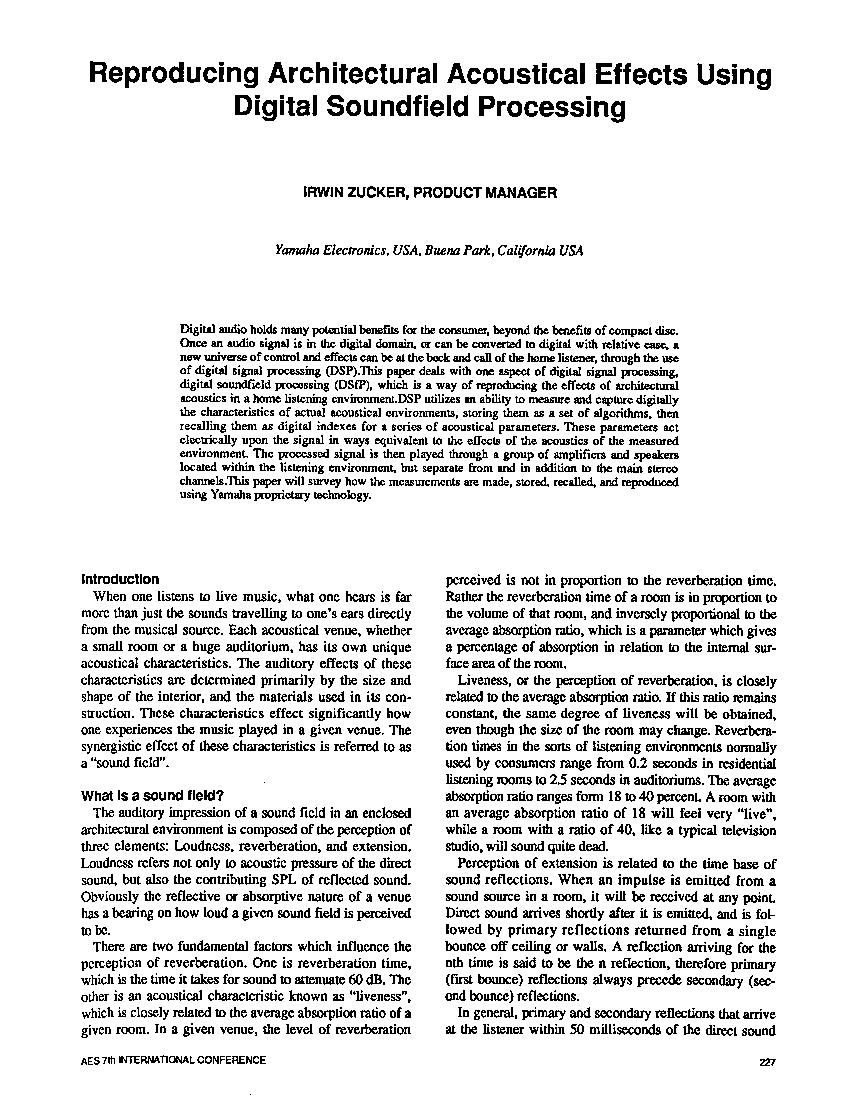
Digital audio holds many potential benefits for the consumer, beyond the benefits of compact disc. Once an audio signal is in the digital domain, or can be converted to digital with relative ease, a new universe of control and effects can be at the beck and call of the home listener, through the use of digital signal processing (DSP). This paper deals with one aspect of digital signal processing, digital soundfield processing (DSfP), which is a way of reproducing the effects of architectural acoustics in a home listening environment. DSP utilizes an ability to measure and capture digitally the characteristics of actual acoustical environments, storing them as a set of algorithms, then recalling them as digital indexes for a series of acoustical parameters. These parameters act electrically upon the signal in ways equivalent to the effects of the acoustics of the measured environment. The processed signal is then played through a group of amplifiers and speakers located within the listening environment, but separate from and in addition to the main stereo channels. This paper will survey how the measurements are made, stored, recalled, and reproduced using Yamaha proprietary technology.
Author (s): Zucker, Irwin;
Affiliation:
Yamaha Electronics, USA, Buena Park, CA
(See document for exact affiliation information.)
Publication Date:
1989-05-06
Session subject:
Audio in Digital Times
DOI:
Click to purchase paper as a non-member or login as an AES member. If your company or school subscribes to the E-Library then switch to the institutional version. If you are not an AES member Join the AES. If you need to check your member status, login to the Member Portal.
Zucker, Irwin; 1989; Reproducing Architectural Acoustical Effects Using Digital Soundfield Processing [PDF]; Yamaha Electronics, USA, Buena Park, CA; Paper 7-033; Available from: https://aes.org/publications/elibrary-page/?id=5463
Zucker, Irwin; Reproducing Architectural Acoustical Effects Using Digital Soundfield Processing [PDF]; Yamaha Electronics, USA, Buena Park, CA; Paper 7-033; 1989 Available: https://aes.org/publications/elibrary-page/?id=5463
@inproceedings{Zucker1989reproducing,
title={{Reproducing Architectural Acoustical Effects Using Digital Soundfield Processing}},
author={Zucker, Irwin},
year={1989},
month={may},
booktitle={Journal of the Audio Engineering Society},
publisher={Paper 7-033; AES Conference: 7th International Conference: Audio in Digital Times; May 1989},
number={7-033},
organization={AES},
}
Notifications
