
You are currently logged in as an
Institutional Subscriber.
If you would like to logout,
please click on the button below.
Home / Publications / E-library page
Only AES members and Institutional Journal Subscribers can download
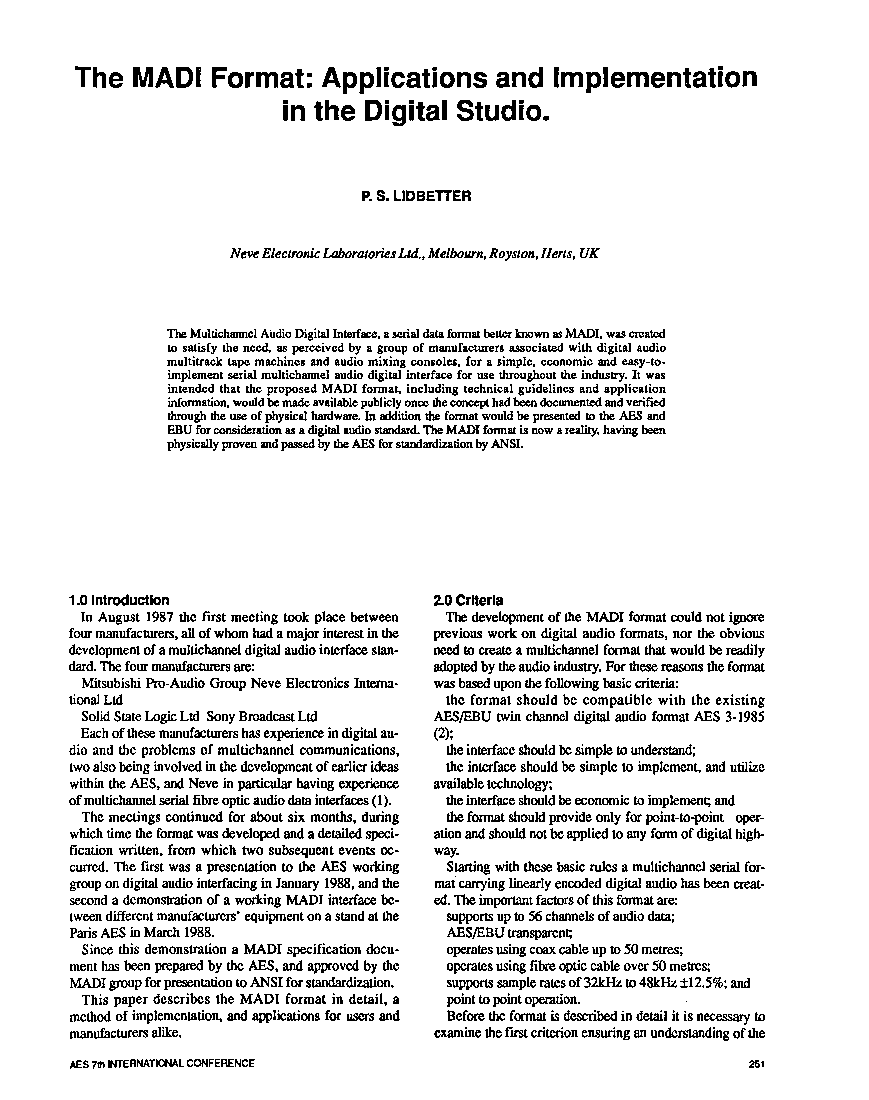
The Multichannel Audio Digital Interface, a serial data format better known as MADI, was created to satisfy the need, as perceived by a group of manufacturers associated with digital audio multitrack tape machines and audio mixing consoles, for a simple, economic and easy-to-implement serial multichannel audio digital interface for use throughout the industry. It was intended that the proposed MADI format, including technical guidelines and application information, would be made available publicly once the concept had been documented and verified through the use of physical hardware. In addition the format would be presented to the AES and EBU for consideration as a digital audio standard. The MADI format is now a reality, having been physically proven and passed by the AES for standardization by ANSI.
Author (s): Lidbetter, Paul S.;
Affiliation:
Neve Electronic Laboratories Ltd., Melbourn, Royston, Herts, UK
(See document for exact affiliation information.)
Publication Date:
1989-05-06
Session subject:
Audio in Digital Times
DOI:
Click to purchase paper as a non-member or login as an AES member. If your company or school subscribes to the E-Library then switch to the institutional version. If you are not an AES member Join the AES. If you need to check your member status, login to the Member Portal.
Lidbetter, Paul S.; 1989; The MADI Format: Applications and Implementation in the Digital Studio [PDF]; Neve Electronic Laboratories Ltd., Melbourn, Royston, Herts, UK; Paper 7-037; Available from: https://aes.org/publications/elibrary-page/?id=5459
Lidbetter, Paul S.; The MADI Format: Applications and Implementation in the Digital Studio [PDF]; Neve Electronic Laboratories Ltd., Melbourn, Royston, Herts, UK; Paper 7-037; 1989 Available: https://aes.org/publications/elibrary-page/?id=5459
@inproceedings{Lidbetter1989the,
title={{The MADI Format: Applications and Implementation in the Digital Studio}},
author={Lidbetter, Paul S.},
year={1989},
month={may},
booktitle={Journal of the Audio Engineering Society},
publisher={Paper 7-037; AES Conference: 7th International Conference: Audio in Digital Times; May 1989},
number={7-037},
organization={AES},
}
Notifications
