You are currently logged in as an
Institutional Subscriber.
If you would like to logout,
please click on the button below.
Home / Publications / E-library page
Only AES members and Institutional Journal Subscribers can download
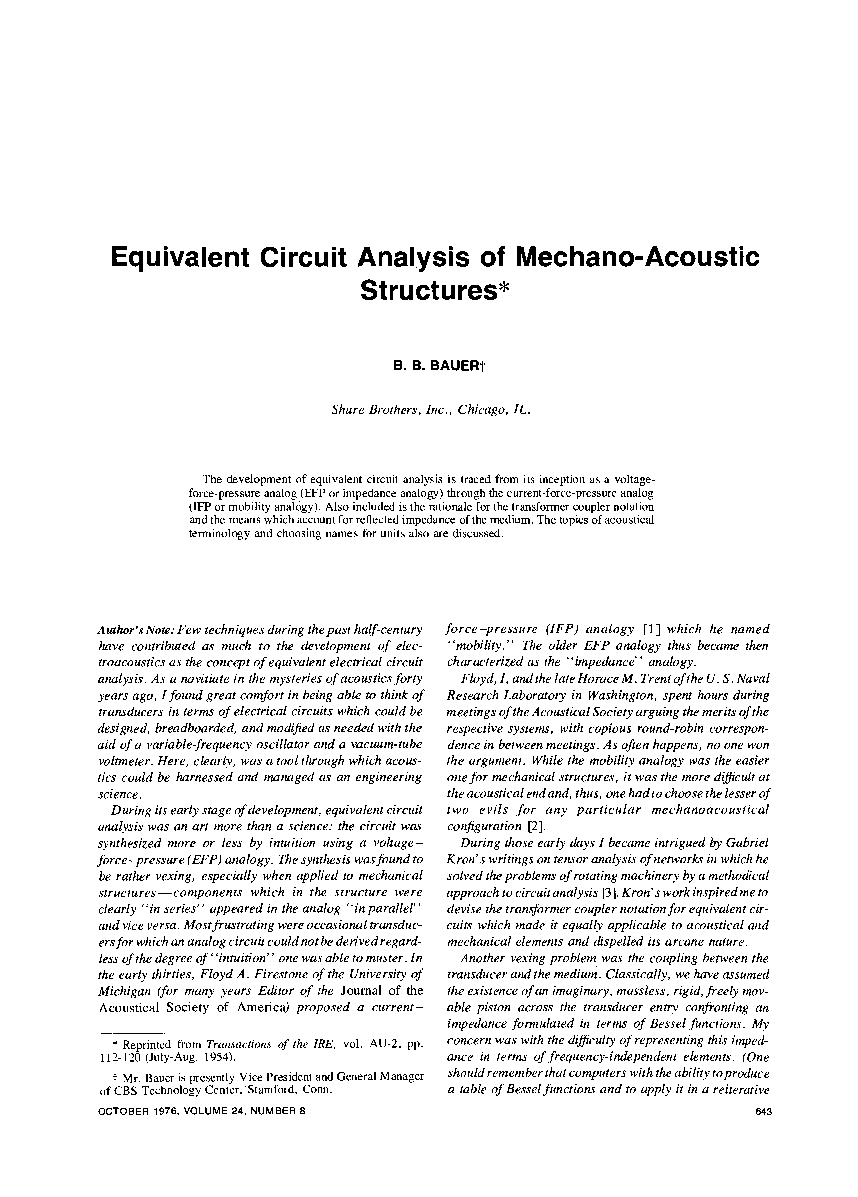
The development of equivalent circuit analysis is traced from its inception as a voltage-force-pressure analog (EFP or impedance analogy) through the current-force-pressure analog (IFP or mobility analogy). Also included is the rationale for the transformer coupler notation and the means which account for reflected impedance of the medium. The topics of acoustical terminology and choosing names for units also are discussed.
Author (s): Bauer, Benjamin B.;
Affiliation:
Shure Brothers, Inc., Chicago, IL.
(See document for exact affiliation information.)
Publication Date:
1976-10-06
DOI:
Click to purchase paper as a non-member or login as an AES member. If your company or school subscribes to the E-Library then switch to the institutional version. If you are not an AES member Join the AES. If you need to check your member status, login to the Member Portal.

Bauer, Benjamin B.; 1976; Equivalent Circuit Analysis of Mechano-Acoustic Structures (Reprint) [PDF]; Shure Brothers, Inc., Chicago, IL.; Paper ; Available from: https://aes.org/publications/elibrary-page/?id=2595
Bauer, Benjamin B.; Equivalent Circuit Analysis of Mechano-Acoustic Structures (Reprint) [PDF]; Shure Brothers, Inc., Chicago, IL.; Paper ; 1976 Available: https://aes.org/publications/elibrary-page/?id=2595
Notifications