
You are currently logged in as an
Institutional Subscriber.
If you would like to logout,
please click on the button below.
Home / Publications / E-library page
Only AES members and Institutional Journal Subscribers can download
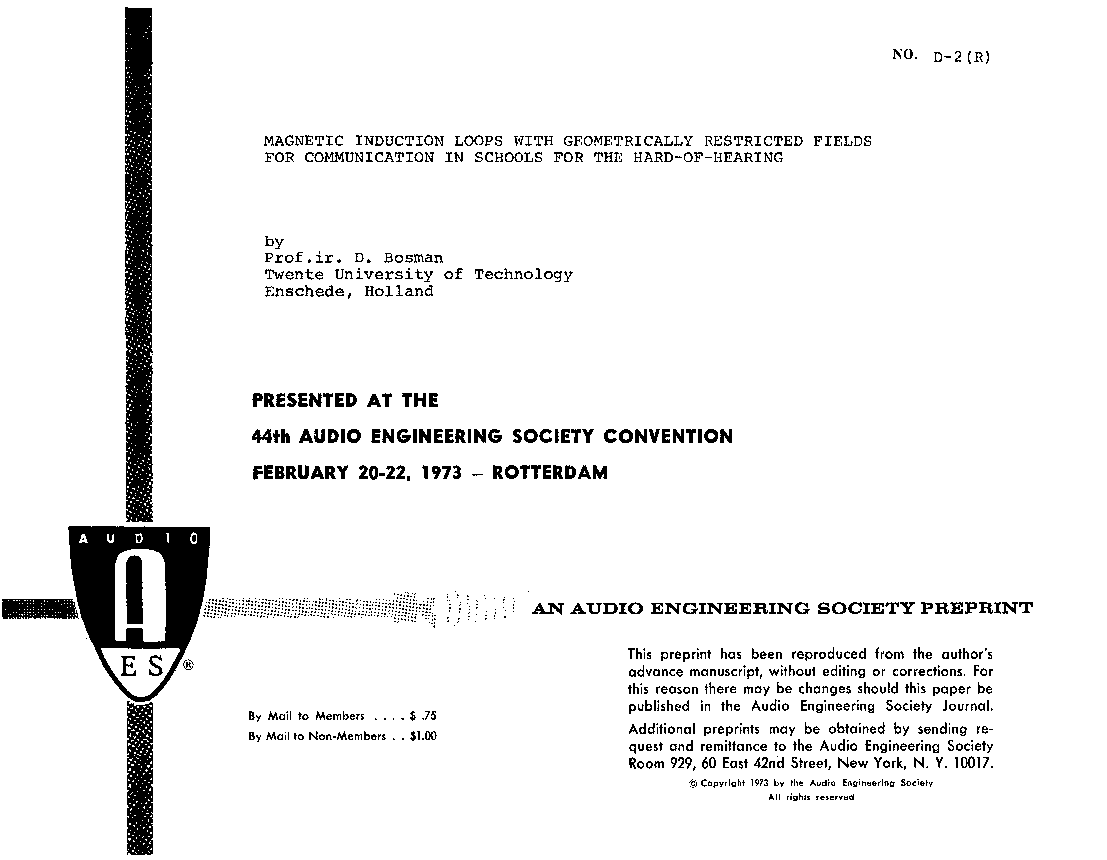
In the education of the hard-of-hearing the quality of communication is of prime importance. One method to achieve this is through the use of a magnetic loop induction system. In schools with adjacent classrooms, each fitted with its own loop system, the crosstalk between adjacent classrooms will be quite objectionable unless special measures are taken to discriminate against spill over. Discrimination between classrooms can be effected either by frequency-selectivity (carrier systems) or by restriction of the range of each classroom field. It is possible to design magnetic induction loops generating fields which are geometrically confined within a prescribed area. An earlier system (1965, de Boer, Rosman, Joosten) not only realized low cosstalk between adjacent classrooms, but also afforded freedom of movement of the pupils. It depends for its operation on two spatially orthogonal fields which are excited by two loops fed by speech currents being 90° out of phase over the entire frequency range. In this paper a different approach is described, with which comparable results have been obtained with only one induction loop.
Author (s): Bosman, D.;
Affiliation:
Twente University of Technology, Enschede, Holland
(See document for exact affiliation information.)
AES Convention: 44
Paper Number:D-2
Publication Date:
1973-03-06
DOI:
Click to purchase paper as a non-member or login as an AES member. If your company or school subscribes to the E-Library then switch to the institutional version. If you are not an AES member Join the AES. If you need to check your member status, login to the Member Portal.
Bosman, D.; 1973; Magnetic Induction Loops with Geometrically Restricted Fields for Communication in Schools for the Hard-of-Hearing [PDF]; Twente University of Technology, Enschede, Holland; Paper D-2; Available from: https://aes.org/publications/elibrary-page/?id=1742
Bosman, D.; Magnetic Induction Loops with Geometrically Restricted Fields for Communication in Schools for the Hard-of-Hearing [PDF]; Twente University of Technology, Enschede, Holland; Paper D-2; 1973 Available: https://aes.org/publications/elibrary-page/?id=1742
@inproceedings{Bosman1973magnetic,
title={{Magnetic Induction Loops with Geometrically Restricted Fields for Communication in Schools for the Hard-of-Hearing}},
author={Bosman, D.},
year={1973},
month={mar},
booktitle={Journal of the Audio Engineering Society},
publisher={Paper D-2; AES Convention 44; March 1973},
number={D-2},
organization={AES},
}
Notifications
