
You are currently logged in as an
Institutional Subscriber.
If you would like to logout,
please click on the button below.
Home / Publications / E-library page
Only AES members and Institutional Journal Subscribers can download
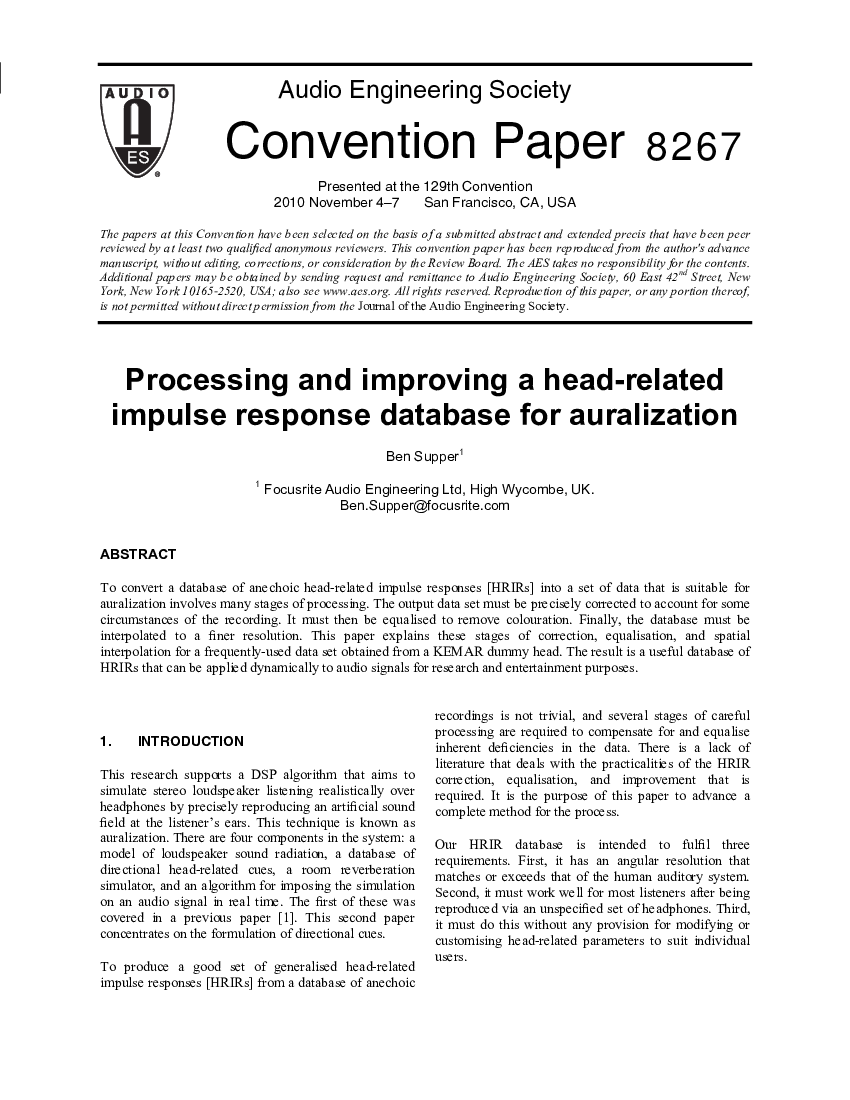
To convert a database of anechoic head-related impulse responses [HRIRs] into a set of data that is suitable for auralization involves many stages of processing. The output data set must be precisely corrected to account for some circumstances of the recording. It must then be equalised to remove colouration. Finally, the database must be interpolated to a finer resolution. This paper explains these stages of correction, equalisation, and spatial interpolation for a frequently-used data set obtained from a KEMAR dummy head. The result is a useful database of HRIRs that can be applied dynamically to audio signals for research and entertainment purposes.
Author (s): Supper, Ben;
Affiliation:
Focusrite Audio Engineering Ltd., High Wcombe, UK
(See document for exact affiliation information.)
AES Convention: 129
Paper Number:8267
Publication Date:
2010-11-06
Session subject:
Binaural Audio
DOI:
Click to purchase paper as a non-member or login as an AES member. If your company or school subscribes to the E-Library then switch to the institutional version. If you are not an AES member Join the AES. If you need to check your member status, login to the Member Portal.
Supper, Ben; 2010; Processing and Improving a Head-Related Impulse Response Database for Auralization [PDF]; Focusrite Audio Engineering Ltd., High Wcombe, UK; Paper 8267; Available from: https://aes.org/publications/elibrary-page/?id=15689
Supper, Ben; Processing and Improving a Head-Related Impulse Response Database for Auralization [PDF]; Focusrite Audio Engineering Ltd., High Wcombe, UK; Paper 8267; 2010 Available: https://aes.org/publications/elibrary-page/?id=15689
@inproceedings{Supper2010processing,
title={{Processing and Improving a Head-Related Impulse Response Database for Auralization}},
author={Supper, Ben},
year={2010},
month={nov},
booktitle={Journal of the Audio Engineering Society},
publisher={Paper 8267; AES Convention 129; November 2010},
number={8267},
organization={AES},
}
Notifications
