
You are currently logged in as an
Institutional Subscriber.
If you would like to logout,
please click on the button below.
Home / Publications / E-library page
Only AES members and Institutional Journal Subscribers can download
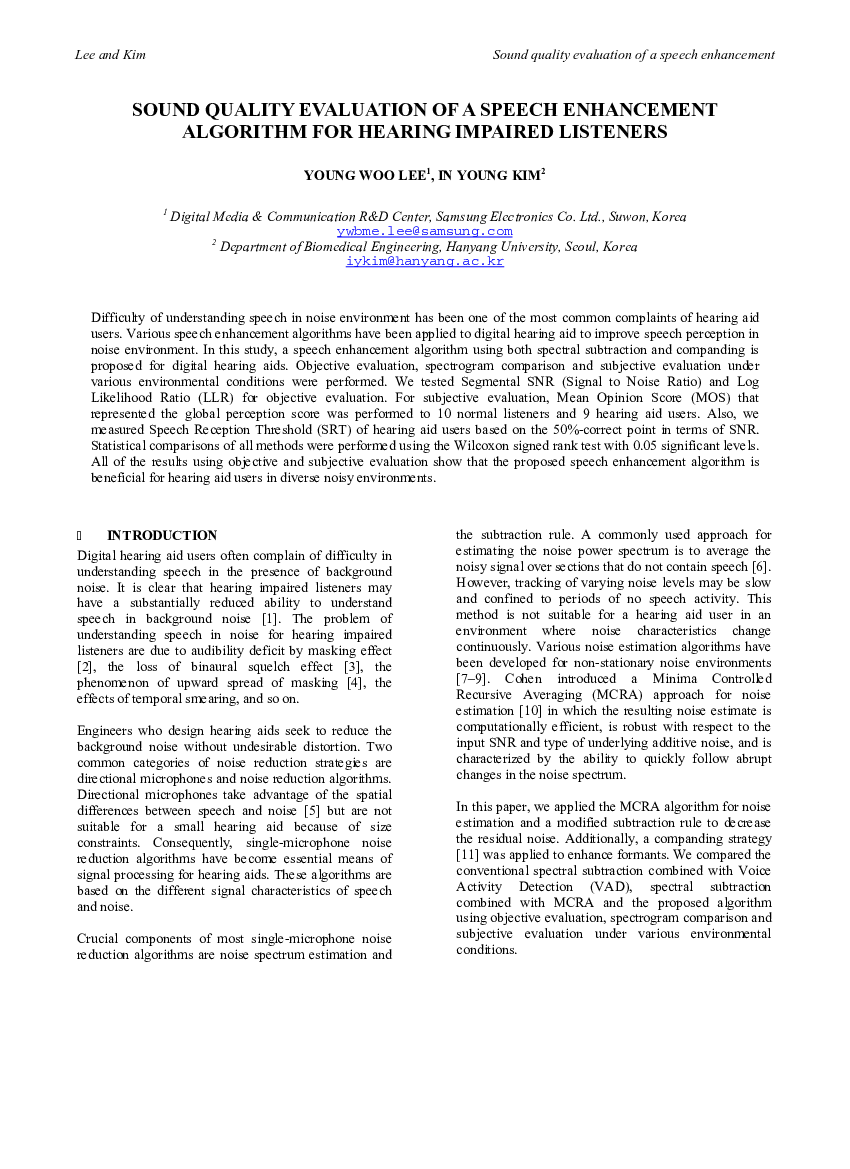
Difficulty of understanding speech in noise environment has been one of the most common complaints of hearing aid users. Various speech enhancement algorithms have been applied to digital hearing aid to improve speech perception in noise environment. In this study, a speech enhancement algorithm using both spectral subtraction and companding is proposed for digital hearing aids. Objective evaluation, spectrogram comparison and subjective evaluation under various environmental conditions were performed. We tested Segmental SNR and LLR (Log Likelihood Ratio) for objective evaluation. For subjective evaluation, mean opinion score (MOS) that represented the global perception score was performed to 10 normal listeners and 9 hearing aid users. Also, we measured speech reception threshold (SRT) of hearing aid users based on the 50%-correct point in terms of SNR. Statistical comparisons of all methods were performed using the Wilcoxon signed rank test with 0.05 significant levels. All of the results using objective and subjective evaluation show that the proposed speech enhancement algorithm is beneficial for hearing aid users in diverse noisy environments.
Author (s): Lee, Young Woo;
Kim, In Young;
Affiliation:
Hanyang University, Seoul, Korea; Samsung Electronics Co., Ltd.
(See document for exact affiliation information.)
Publication Date:
2010-06-06
Session subject:
Sound Quality Evaluation
DOI:
Click to purchase paper as a non-member or login as an AES member. If your company or school subscribes to the E-Library then switch to the institutional version. If you are not an AES member Join the AES. If you need to check your member status, login to the Member Portal.
Lee, Young Woo; Kim, In Young; 2010; Sound Quality Evaluation of a Speech Enhancement Algorithm for Hearing Impaired Listeners [PDF]; Hanyang University, Seoul, Korea; Samsung Electronics Co., Ltd.; Paper 1-2; Available from: https://aes.org/publications/elibrary-page/?id=15458
Lee, Young Woo; Kim, In Young; Sound Quality Evaluation of a Speech Enhancement Algorithm for Hearing Impaired Listeners [PDF]; Hanyang University, Seoul, Korea; Samsung Electronics Co., Ltd.; Paper 1-2; 2010 Available: https://aes.org/publications/elibrary-page/?id=15458
@inproceedings{Lee2010sound,
title={{Sound Quality Evaluation of a Speech Enhancement Algorithm for Hearing Impaired Listeners}},
author={Lee, Young Woo and Kim, In Young},
year={2010},
month={jun},
booktitle={Journal of the Audio Engineering Society},
publisher={Paper 1-2; AES Conference: 38th International Conference: Sound Quality Evaluation; June 2010},
number={1-2},
organization={AES},
}
Notifications
