
You are currently logged in as an
Institutional Subscriber.
If you would like to logout,
please click on the button below.
Home / Publications / E-library page
Only AES members and Institutional Journal Subscribers can download
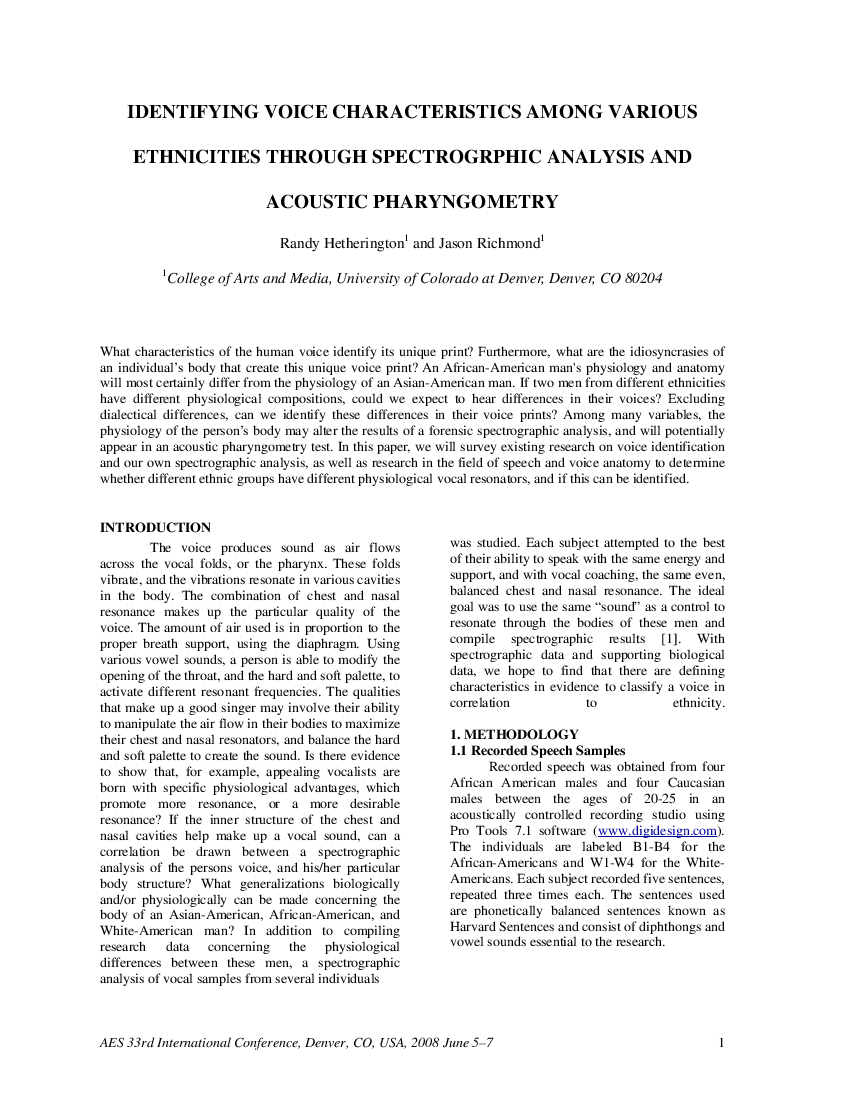
What characteristics of the human voice identify its unique print? Furthermore, what are the idiosyncrasies of an individual’s body that create this unique voice print? An African-American man`s physiology and anatomy will most certainly differ from the physiology of an Asian-American man. If two men from different ethnicities have different physiological compositions, could we expect to hear differences in their voices? Excluding dialectical differences, can we identify these differences in their voice prints? Among many variables, the physiology of the person’s body may alter the results of a forensic spectrographic analysis, and will potentially appear in an acoustic pharyngometry test. In this paper, we will survey existing research on voice identification and our own spectrographic analysis, as well as research in the field of speech and voice anatomy to determine whether different ethnic groups have different physiological vocal resonators, and if this can be identified.
Author (s): Hetherington, Randy;
Richmond, Jason;
Affiliation:
University of Denver, Colorado
(See document for exact affiliation information.)
Publication Date:
2008-06-06
Session subject:
Audio Forensics: Voice Identification
DOI:
Click to purchase paper as a non-member or login as an AES member. If your company or school subscribes to the E-Library then switch to the institutional version. If you are not an AES member Join the AES. If you need to check your member status, login to the Member Portal.
Hetherington, Randy; Richmond, Jason; 2008; Identifying Voice Characteristics Among Various Ethnicities Through Spectrogrphic Analysis And Acoustic Pharyngometry [PDF]; University of Denver, Colorado; Paper 13; Available from: https://aes.org/publications/elibrary-page/?id=14407
Hetherington, Randy; Richmond, Jason; Identifying Voice Characteristics Among Various Ethnicities Through Spectrogrphic Analysis And Acoustic Pharyngometry [PDF]; University of Denver, Colorado; Paper 13; 2008 Available: https://aes.org/publications/elibrary-page/?id=14407
@inproceedings{Hetherington2008identifying,
title={{Identifying Voice Characteristics Among Various Ethnicities Through Spectrogrphic Analysis And Acoustic Pharyngometry}},
author={Hetherington, Randy and Richmond, Jason},
year={2008},
month={jun},
booktitle={Journal of the Audio Engineering Society},
publisher={Paper 13; AES Conference: 33rd International Conference: Audio Forensics-Theory and Practice; June 2008},
number={13},
organization={AES},
}
Notifications
