
You are currently logged in as an
Institutional Subscriber.
If you would like to logout,
please click on the button below.
Home / Publications / E-library page
Only AES members and Institutional Journal Subscribers can download
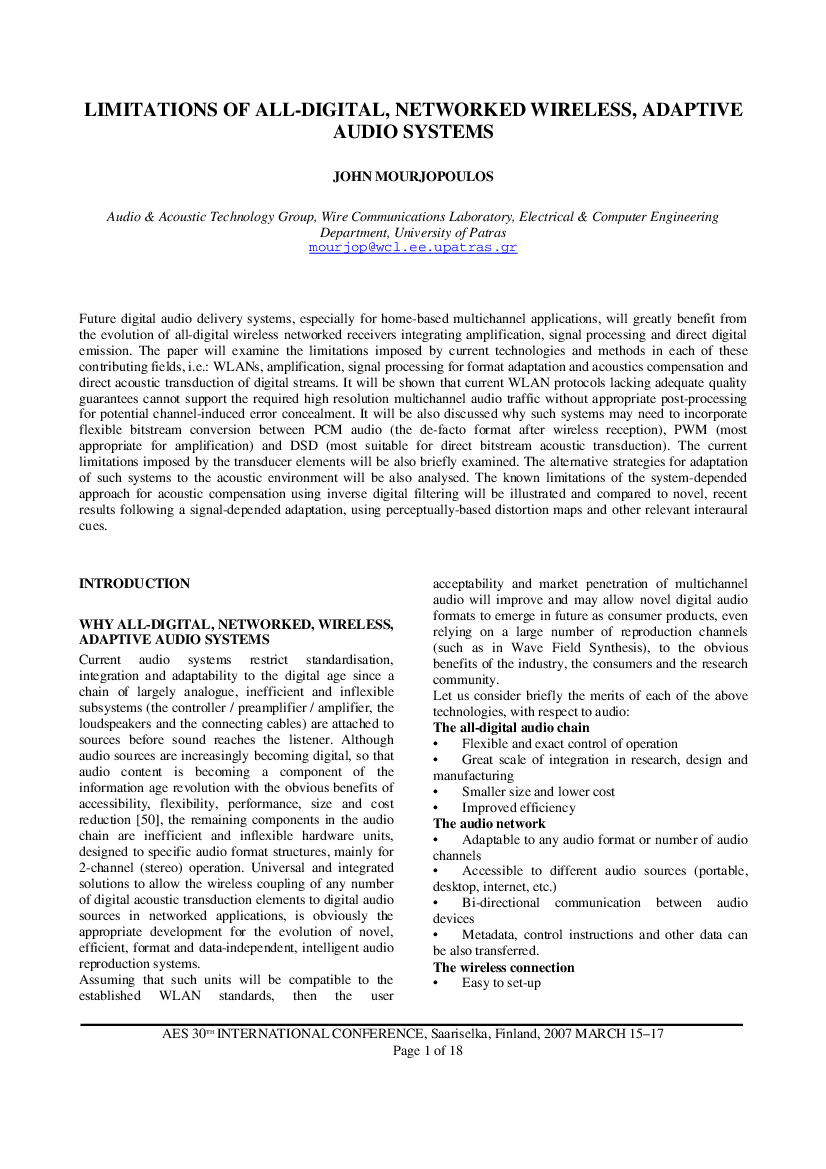
Future digital audio delivery systems, especially for home-based multichannel applications, will greatly benefit from the evolution of all-digital wireless networked receivers integrating amplification, signal processing and direct digital emission. The paper will examine the limitations imposed by current technologies and methods in each of these contributing fields, i.e.: WLANs, amplification, signal processing for format adaptation and acoustics compensation and direct acoustic transduction of digital streams. It will be shown that current WLAN protocols lacking adequate quality guarantees cannot support the required high resolution multichannel audio traffic without appropriate post-processing for potential channel-induced error concealment. It will be also discussed why such systems may need to incorporate flexible bitstream conversion between PCM audio (the de-facto format after wireless reception), PWM (most appropriate for amplification) and DSD (most suitable for direct bitstream acoustic transduction). The current limitations imposed by the transducer elements will be also briefly examined. The alternative strategies for adaptation of such systems to the acoustic environment will be also analysed. The known limitations of the system-depended approach for acoustic compensation using inverse digital filtering will be illustrated and compared to novel, recent results following a signal-depended adaptation, using perceptually-based distortion maps and other relevant interaural cues.
Author (s): Mourjopoulos, John;
Affiliation:
University of Patras
(See document for exact affiliation information.)
Publication Date:
2007-03-06
Session subject:
Intelligent Audio Environments
DOI:
Click to purchase paper as a non-member or login as an AES member. If your company or school subscribes to the E-Library then switch to the institutional version. If you are not an AES member Join the AES. If you need to check your member status, login to the Member Portal.
Mourjopoulos, John; 2007; Limitations of All-Digital, Networked Wireless, Adaptive Audio Systems [PDF]; University of Patras; Paper 33; Available from: https://aes.org/publications/elibrary-page/?id=13933
Mourjopoulos, John; Limitations of All-Digital, Networked Wireless, Adaptive Audio Systems [PDF]; University of Patras; Paper 33; 2007 Available: https://aes.org/publications/elibrary-page/?id=13933
@inproceedings{Mourjopoulos2007limitations,
title={{Limitations of All-Digital, Networked Wireless, Adaptive Audio Systems}},
author={Mourjopoulos, John},
year={2007},
month={mar},
booktitle={Journal of the Audio Engineering Society},
publisher={Paper 33; AES Conference: 30th International Conference: Intelligent Audio Environments; March 2007},
number={33},
organization={AES},
}
Notifications
