
You are currently logged in as an
Institutional Subscriber.
If you would like to logout,
please click on the button below.
Home / Publications / E-library page
Only AES members and Institutional Journal Subscribers can download
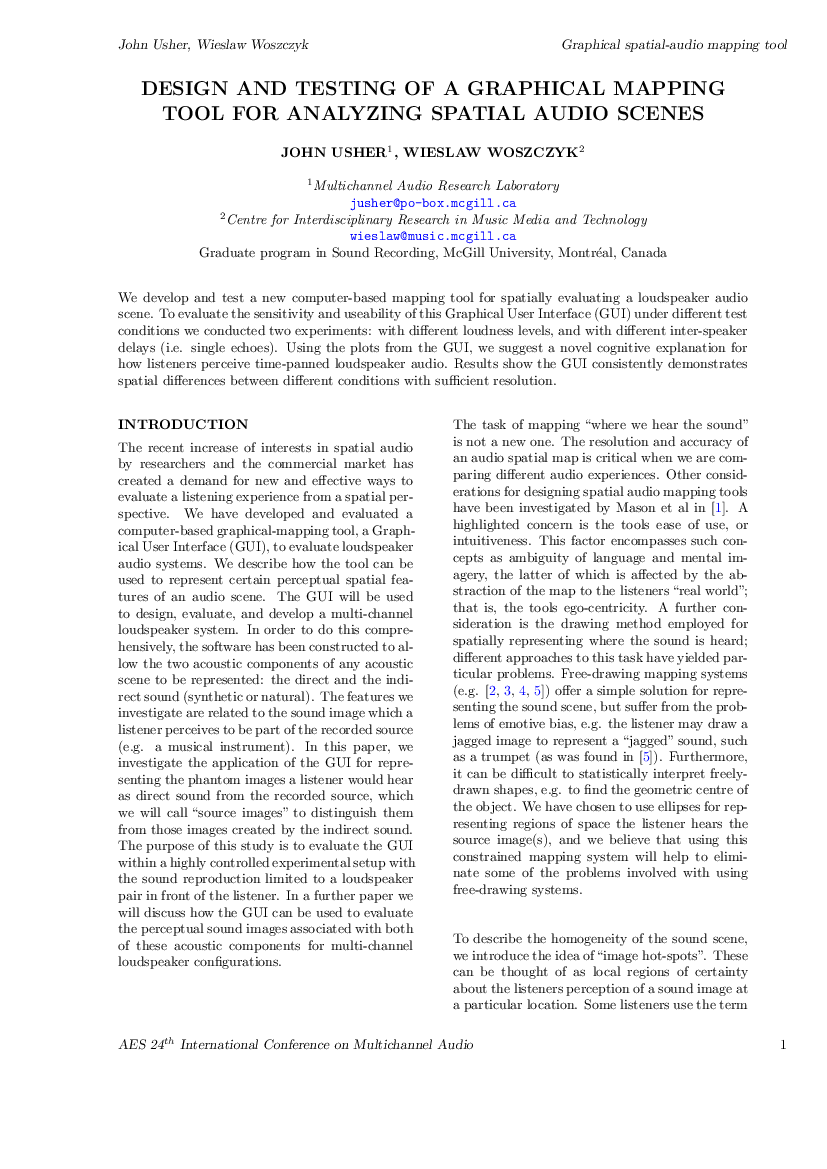
A computer-driven graphical user interface (GUI) was developed for the evaluation of spatial attributes of simple auditory scenes created by one, two and four loudspeakers. The GUI allows subjects to draw ellipses to represent locations from which they hear direct sound of the source and the indirect sound of the simulated room (reflections and/or reverberation). Ellipses were chosen rather than a free-drawing system for a variety of reasons, and overlayed response plots (so called density plots) were used to visualize the spatial hearing of subjects. The sensitivity and reliability of this tool used as the measure of listeners` impressions of space has been investigated and quantified through a series of tests. Within-subject GUI responses were found to be highly consistent, whereas between-subject responses showed more variation suggesting a subject related bias. Results indicate that listeners can reliably separate direct and simulated reverberant sound and indicate them independently and accurately using the system. Various loudspeaker configurations were also tested and the graphical elicitation tool demonstrated spatial differences between them with sufficient resolution.
Author (s): Usher, John;
Woszczyk, Wieslaw;
Affiliation:
Multichannel Audio Research Laboratory, Centre for Interdisciplinary Research in Music Media and Technology, McGill University, Montr´eal, Canada
(See document for exact affiliation information.)
Publication Date:
2003-06-06
Session subject:
Multichannel Audio
DOI:
Click to purchase paper as a non-member or login as an AES member. If your company or school subscribes to the E-Library then switch to the institutional version. If you are not an AES member Join the AES. If you need to check your member status, login to the Member Portal.
Usher, John; Woszczyk, Wieslaw; 2003; Design and Testing of a Graphical Mapping Tool for Analyzing Spatial Audio Scenes [PDF]; Multichannel Audio Research Laboratory, Centre for Interdisciplinary Research in Music Media and Technology, McGill University, Montr´eal, Canada; Paper 11; Available from: https://aes.org/publications/elibrary-page/?id=12304
Usher, John; Woszczyk, Wieslaw; Design and Testing of a Graphical Mapping Tool for Analyzing Spatial Audio Scenes [PDF]; Multichannel Audio Research Laboratory, Centre for Interdisciplinary Research in Music Media and Technology, McGill University, Montr´eal, Canada; Paper 11; 2003 Available: https://aes.org/publications/elibrary-page/?id=12304
@inproceedings{Usher2003design,
title={{Design and Testing of a Graphical Mapping Tool for Analyzing Spatial Audio Scenes}},
author={Usher, John and Woszczyk, Wieslaw},
year={2003},
month={jun},
booktitle={Journal of the Audio Engineering Society},
publisher={Paper 11; AES Conference: 24th International Conference: Multichannel Audio, The New Reality; June 2003},
number={11},
organization={AES},
}
Notifications
