
You are currently logged in as an
Institutional Subscriber.
If you would like to logout,
please click on the button below.
Home / Publications / E-library page
Only AES members and Institutional Journal Subscribers can download
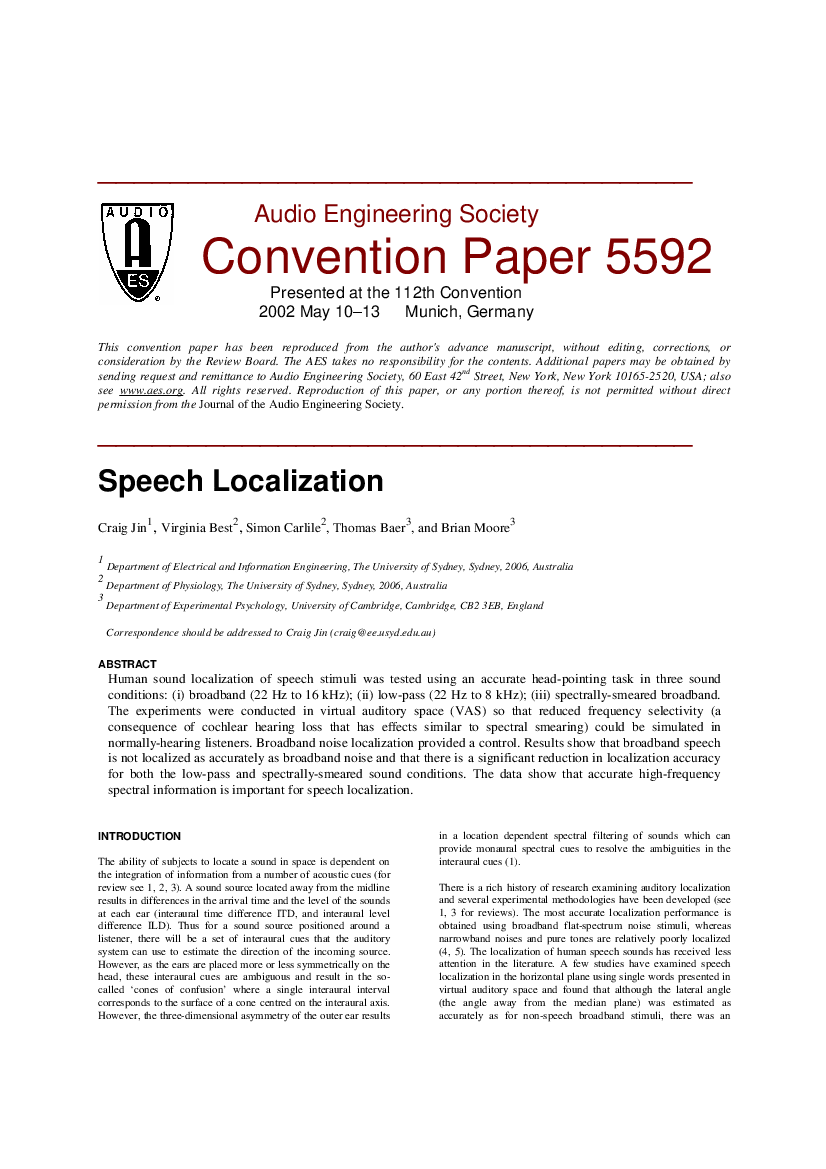
Human sound localization of speech stimuli was tested using an accurate head-pointing task in three sound conditions: (i) broadband (22 Hz to 16 kHz); (ii) low-pass (22 Hz to 8 kHz); (iii) spectrally-smeared broadband. The experiments were conducted in virtual auditory space (VAS) so that reduced frequency selectivity (a consequence of cochlear hearing loss that has effects similar to spectral smearing) could be simulated in normally-hearing listeners. Broadband noise localization provided a control. Results show that broadband speech is not localized as accurately as broadband noise and that there is a significant reduction in localization accuracy for both the low-pass and spectrally-smeared sound conditions. The data show that accurate high-frequency spectral information is important for speech localization.
Author (s): Jin, Craig;
Best, Virginia;
Carlile, Simon;
Baer, Thomas;
Moore, Brian;
Affiliation:
Department of Electrical and Information Engineering, The University of Sydney, Sydney, Australia ; Department of Physiology, The University of Sydney, Sydney, Australia ; Department of Experimental Psychology, University of Cambridge, Cambridge, England
(See document for exact affiliation information.)
AES Convention: 112
Paper Number:5592
Publication Date:
2002-04-06
Session subject:
Spatial Audio
DOI:
Click to purchase paper as a non-member or login as an AES member. If your company or school subscribes to the E-Library then switch to the institutional version. If you are not an AES member Join the AES. If you need to check your member status, login to the Member Portal.
Jin, Craig; Best, Virginia; Carlile, Simon; Baer, Thomas; Moore, Brian; 2002; Speech Localization [PDF]; Department of Electrical and Information Engineering, The University of Sydney, Sydney, Australia ; Department of Physiology, The University of Sydney, Sydney, Australia ; Department of Experimental Psychology, University of Cambridge, Cambridge, England; Paper 5592; Available from: https://aes.org/publications/elibrary-page/?id=11398
Jin, Craig; Best, Virginia; Carlile, Simon; Baer, Thomas; Moore, Brian; Speech Localization [PDF]; Department of Electrical and Information Engineering, The University of Sydney, Sydney, Australia ; Department of Physiology, The University of Sydney, Sydney, Australia ; Department of Experimental Psychology, University of Cambridge, Cambridge, England; Paper 5592; 2002 Available: https://aes.org/publications/elibrary-page/?id=11398
@inproceedings{Jin2002speech,
title={{Speech Localization}},
author={Jin, Craig and Best, Virginia and Carlile, Simon and Baer, Thomas and Moore, Brian},
year={2002},
month={apr},
booktitle={Journal of the Audio Engineering Society},
publisher={Paper 5592; AES Convention 112; April 2002},
number={5592},
organization={AES},
}
Notifications
