
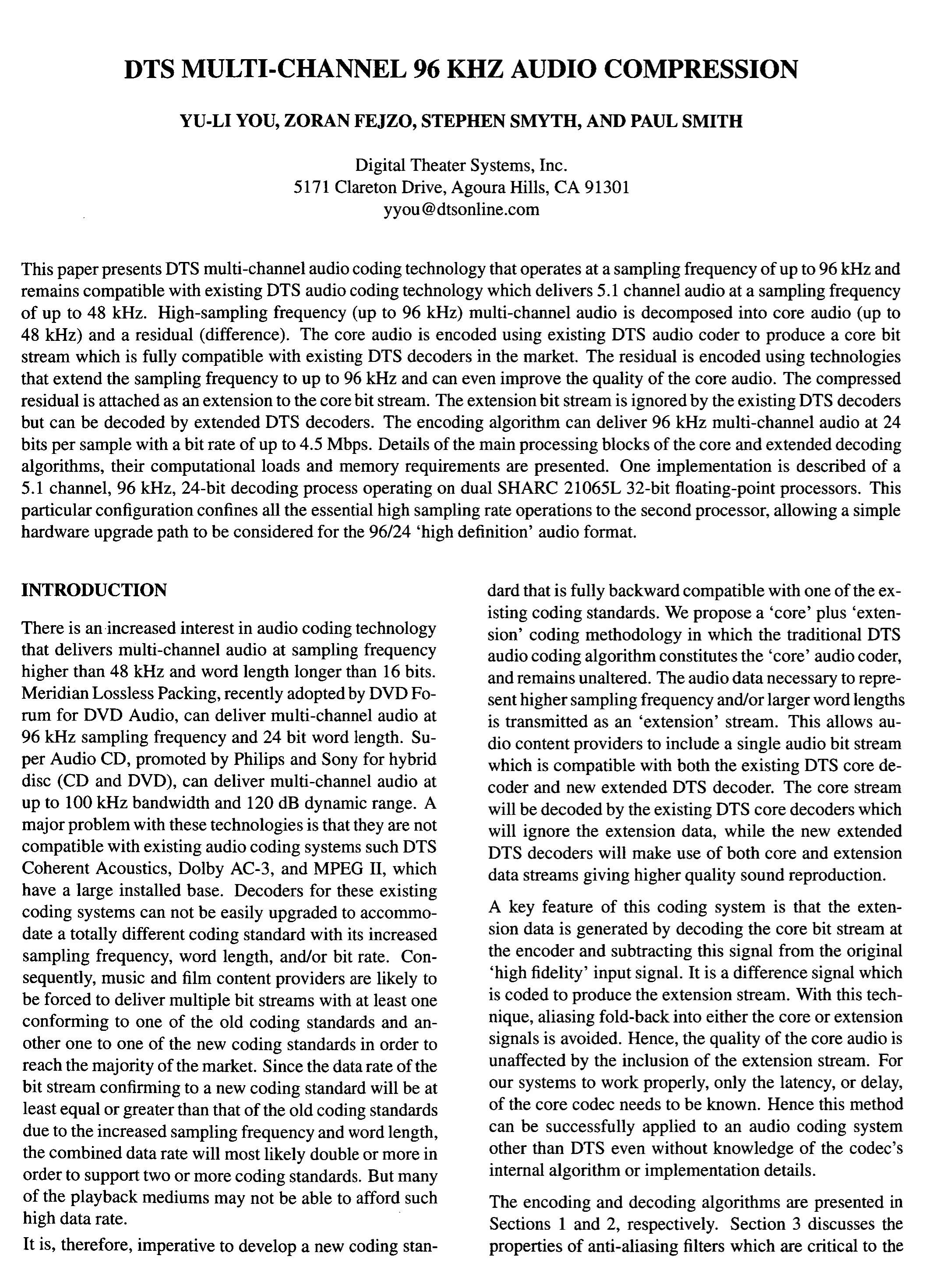
This paper presents DTS multichannel audio compression technology which operates at a sampling frequency of up to 96 kHz and remains compatible with DTS first-generation technology, delivering 5.1-channel audio at a sampling frequency of up to 48 kHz. High-sampling frequency (up to 96-kHz) multichannel audio is decomposed into core audio (up to 48 kHz) and a residual. The core audio is encoded using DTS first-generation technology, and the encoded core bitstream is fully compatible with first-generation DTS decoders available in the market. The residual is encoded using technologies that extend the sampling frequency up to 96 kHz and can even improve the quality of the core audio. The compressed residue is attached as an extension to the core bitstream. The extension bitstream is ignored by the first-generation DTS decoders but can be decoded by the second-generation DTS decoders. The encoding algorithm can deliver 96-kHz multichannel audio at 24 bits/sample with a rate of up to 4.5 Mb/s. Details of the main processing blocks of the core and extension decoding algorithms, their computational load, and memory requirements are presented. One implementation of a 5.1-channel, 96-kHz, 24-bit decoding process operating on dual SPARC 21065L 32-bit floating-point processors is described. This particular configuration confines all the essential high-sampling rate operations to the second processor, allowing a simple hardware upgrade path to be considered for the 96/24 high-definition audio format.
https://www.aes.org/e-lib/browse.cfm?elib=8081
Click to purchase paper as a non-member or login as an AES member. If your company or school subscribes to the E-Library then switch to the institutional version. If you are not an AES member and would like to subscribe to the E-Library then Join the AES!
This paper costs $33 for non-members and is free for AES members and E-Library subscribers.
Learn more about the AES E-Library
Start a discussion about this paper!