
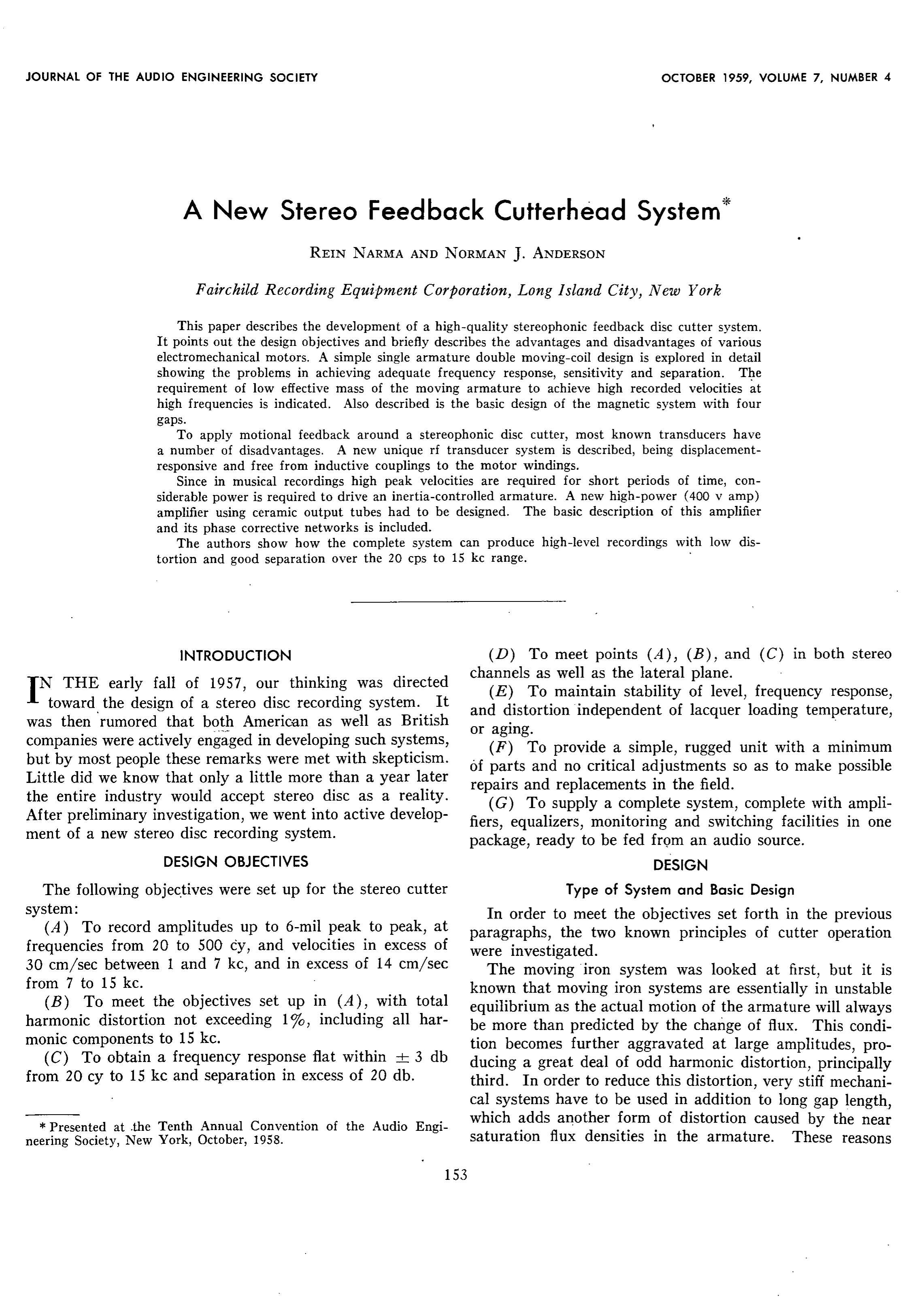
This paper describes the development of a high-quality stereophonic feedback disc cutter system. It points out the design objectives and briefly describes the advantages and disadvantages of various electromechanical motors. A simple single armature double moving-coil design is explored in detail showing the problems in achieving adequate frequency response, sensitivity and separation. The requirement of low effective mass of the moving armature to achieve high recorded velocities at high frequencies is indicated. Also described is the basic design of the magnetic system with four gaps. To apply motional feedback around a stereophonic disc cutter, most known transducers have a number of disadvantages. A new unique rf transducer system is described, being displacement-responsive and free from inductive couplings to the motor windings. Since in musical recordings high peak velocities are required for short periods of time, considerable power is required to drive an inertia-controlled armature. A new high-power (400 v amp) amplifier using ceramic output tubes had to be designed. The basic description of this amplifier and its phase corrective networks is included. The authors show how the complete system can produce high-level recordings with low distortion and good separation over the 20 cps to 15 kc range.
https://www.aes.org/e-lib/browse.cfm?elib=559
Click to purchase paper as a non-member or login as an AES member. If your company or school subscribes to the E-Library then switch to the institutional version. If you are not an AES member and would like to subscribe to the E-Library then Join the AES!
This paper costs $33 for non-members and is free for AES members and E-Library subscribers.
Learn more about the AES E-Library
Start a discussion about this paper!