
You are currently logged in as an
Institutional Subscriber.
If you would like to logout,
please click on the button below.
Home / Publications / E-library page
Only AES members and Institutional Journal Subscribers can download
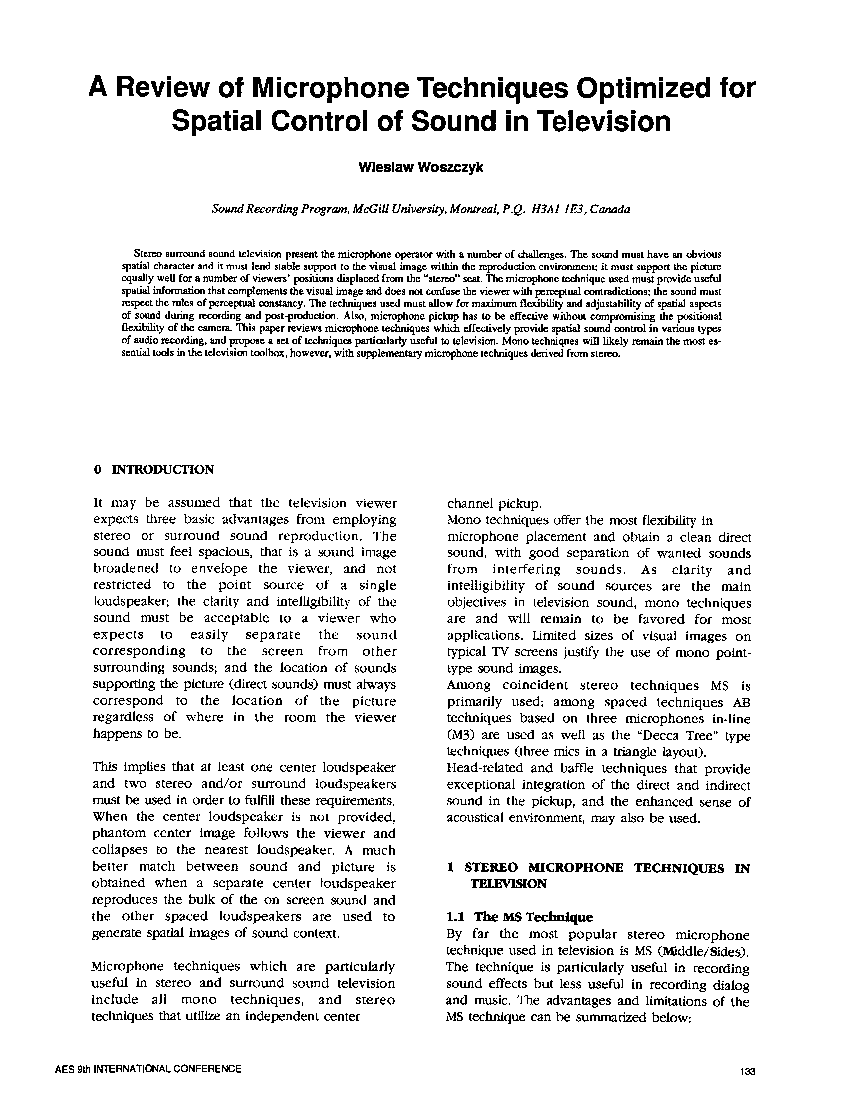
Stereo surround sound television present the microphone operator with a number of challenges. The sound must have an obvious spatial character and it must lend stable support to the visual image within the reproduction environment; it must support the picture equally well for a number of viewers` positions displaced from the -stereo- seat. The microphone technique used must provide useful spatial information that complements the visual image and does not confuse the viewer with perceptual contradictions; the sound must respect the rules of perceptual constancy. The techniques used must allow for maximum flexibility and adjustability of spatial aspects of sound during recording and post-production. Also, microphone pickup has to be effective without compromising the positional flexibility of the camera. This paper reviews microphone techniques which effectively provide spatial sound control in various types of audio recording, and propose a set of techniques particularly useful to television. Mono techniques will likely remain the most essential tools in the television toolbox, however, with supplementary microphone techniques derived from stereo.
Author (s): Woszczyk, Wieslaw;
Affiliation:
Sound Recording Program, McGill University, Montreal, P.Q. H3A1 1E3, Canada
(See document for exact affiliation information.)
Publication Date:
1991-02-06
Session subject:
Television Sound
DOI:
Click to purchase paper as a non-member or login as an AES member. If your company or school subscribes to the E-Library then switch to the institutional version. If you are not an AES member Join the AES. If you need to check your member status, login to the Member Portal.
Woszczyk, Wieslaw; 1991; A Review of Microphone Techniques Optimized for Spatial Control Sound in Television [PDF]; Sound Recording Program, McGill University, Montreal, P.Q. H3A1 1E3, Canada; Paper 9-023; Available from: https://aes.org/publications/elibrary-page/?id=5357
Woszczyk, Wieslaw; A Review of Microphone Techniques Optimized for Spatial Control Sound in Television [PDF]; Sound Recording Program, McGill University, Montreal, P.Q. H3A1 1E3, Canada; Paper 9-023; 1991 Available: https://aes.org/publications/elibrary-page/?id=5357
@inproceedings{Woszczyk1991a,
title={{A Review of Microphone Techniques Optimized for Spatial Control Sound in Television}},
author={Woszczyk, Wieslaw},
year={1991},
month={feb},
booktitle={Journal of the Audio Engineering Society},
publisher={Paper 9-023; AES Conference: 9th International Conference: Television Sound Today and Tomorrow; February 1991},
number={9-023},
organization={AES},
}
Notifications
