
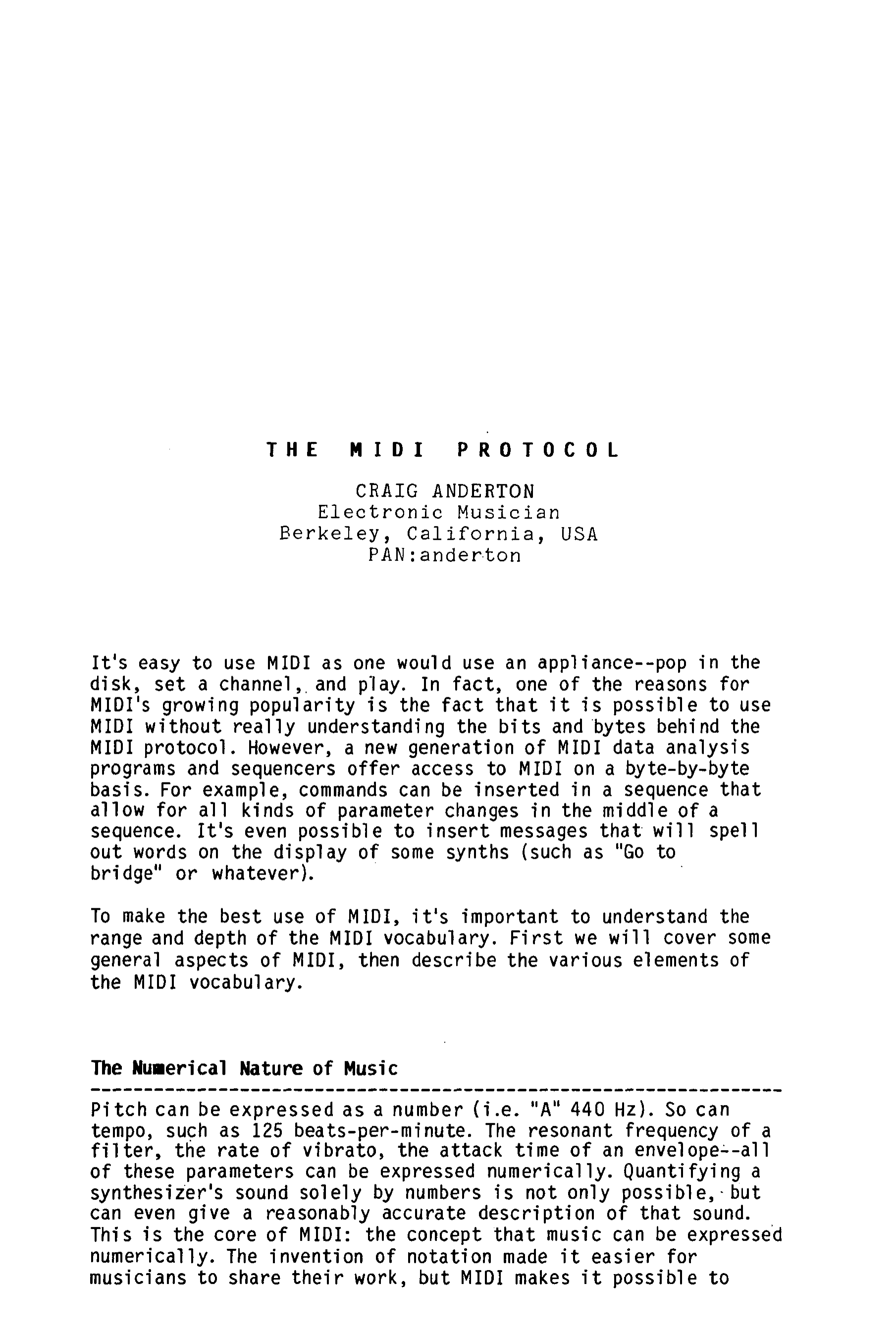
It's easy to use MIDI as one would use an appliance - pop in the disk, set a channel, and play. In fact, one of the reasons for MIDI's growing popularity is the fact that it is possible to use MIDI without really understanding the bits and bytes behind the MIDI protocol. However, a new generation of MIDI data analysis programs and sequencers offer access to MIDI on a byte-by-byte basis. For example, commands can be inserted in a sequence that allow for all kinds of parameter changes in the middle of a sequence. It's even possible to insert messages that will spell out words on the display of some synths (such as -Go to bridge- or whatever).: To make the best use of MIDI, it's important to understand the range and depth of the MIDI vocabulary. First we well cover some general aspects of MIDI, then describe the various elements of the MIDI vocabulary.
https://www.aes.org/e-lib/browse.cfm?elib=4666
Click to purchase paper as a non-member or login as an AES member. If your company or school subscribes to the E-Library then switch to the institutional version. If you are not an AES member and would like to subscribe to the E-Library then Join the AES!
This paper costs $33 for non-members and is free for AES members and E-Library subscribers.
Learn more about the AES E-Library
Start a discussion about this paper!