
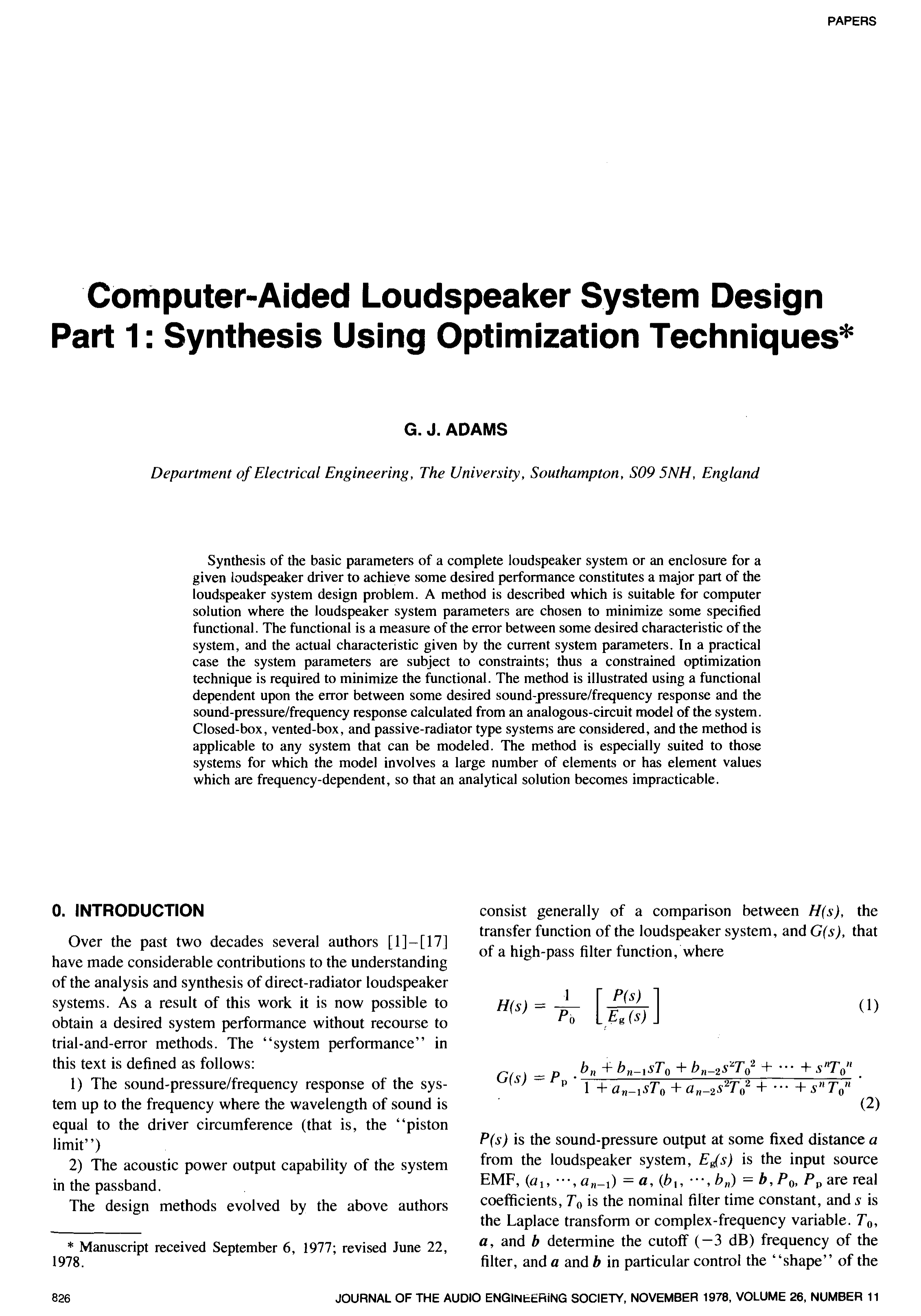
Synthesis of the basic parameters of a complete loudspeaker system or an enclosure for a given loudspeaker driver to achieve some desired performance constitutes a major part of the loudspeaker system design problem. A method is described which is suitable for computer solution where the loudspeaker system parameters are chosen to minimize some specified functional. The functional is a measure of the error between some desired characteristic of the system, and the actual characteristic given by the current system parameters. In a practical case the system parameters are subject to constraints; thus a constrained optimization technique is required to minimize the functional. The method is illustrated using a functional dependent upon the error between some desired sound-pressure/frequency response and the sound-pressure/frequency response calculated from an analogous-circuit model of the system. Closed-box, vented-box, and passive-radiator type systems are considered, and the method is applicable to any system that can be modeled. The method is especially suited to those systems for which the model involves a large number of elements or has element values which are frequency-dependent, so that an analytical solution becomes impracticable.
https://www.aes.org/e-lib/browse.cfm?elib=3241
Click to purchase paper as a non-member or login as an AES member. If your company or school subscribes to the E-Library then switch to the institutional version. If you are not an AES member and would like to subscribe to the E-Library then Join the AES!
This paper costs $33 for non-members and is free for AES members and E-Library subscribers.
Learn more about the AES E-Library
Start a discussion about this paper!