
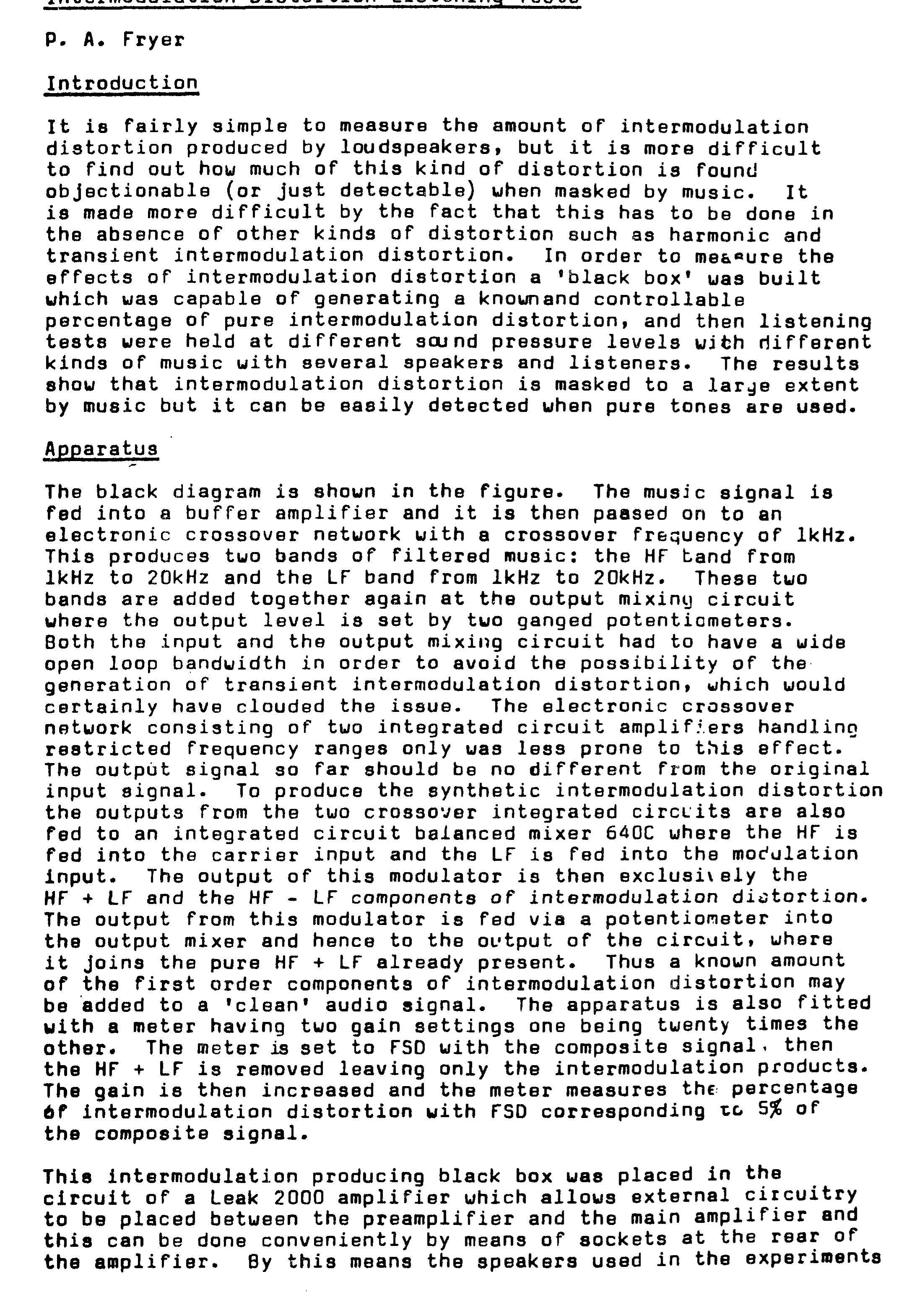
It is fairly simple to measure the amount of intermodulation distortion produced by loudspeakers, but it is more difficult to find out how much of this kind of distortion is found objectionable (or just detectable) when masked by music. It is made more difficult by the fact that this has to be done in the absence of other kinds of distortion such as harmonic and transient intermodulation distortion. In order to measure the effects of intermodulation distortion, a 'black box' was built which was capable of generating a known and controllable percentage of pure intermodulation distortion, and then listening tests were held at different sound pressure levels with different kinds of music with several speakers and listeners. The results show that intermodulation distortion is masked to a large extent by music but it can be easily detected when pure tones are used.
https://www.aes.org/e-lib/browse.cfm?elib=2476
Click to purchase paper as a non-member or login as an AES member. If your company or school subscribes to the E-Library then switch to the institutional version. If you are not an AES member and would like to subscribe to the E-Library then Join the AES!
This paper costs $33 for non-members and is free for AES members and E-Library subscribers.
Learn more about the AES E-Library
Start a discussion about this paper!