
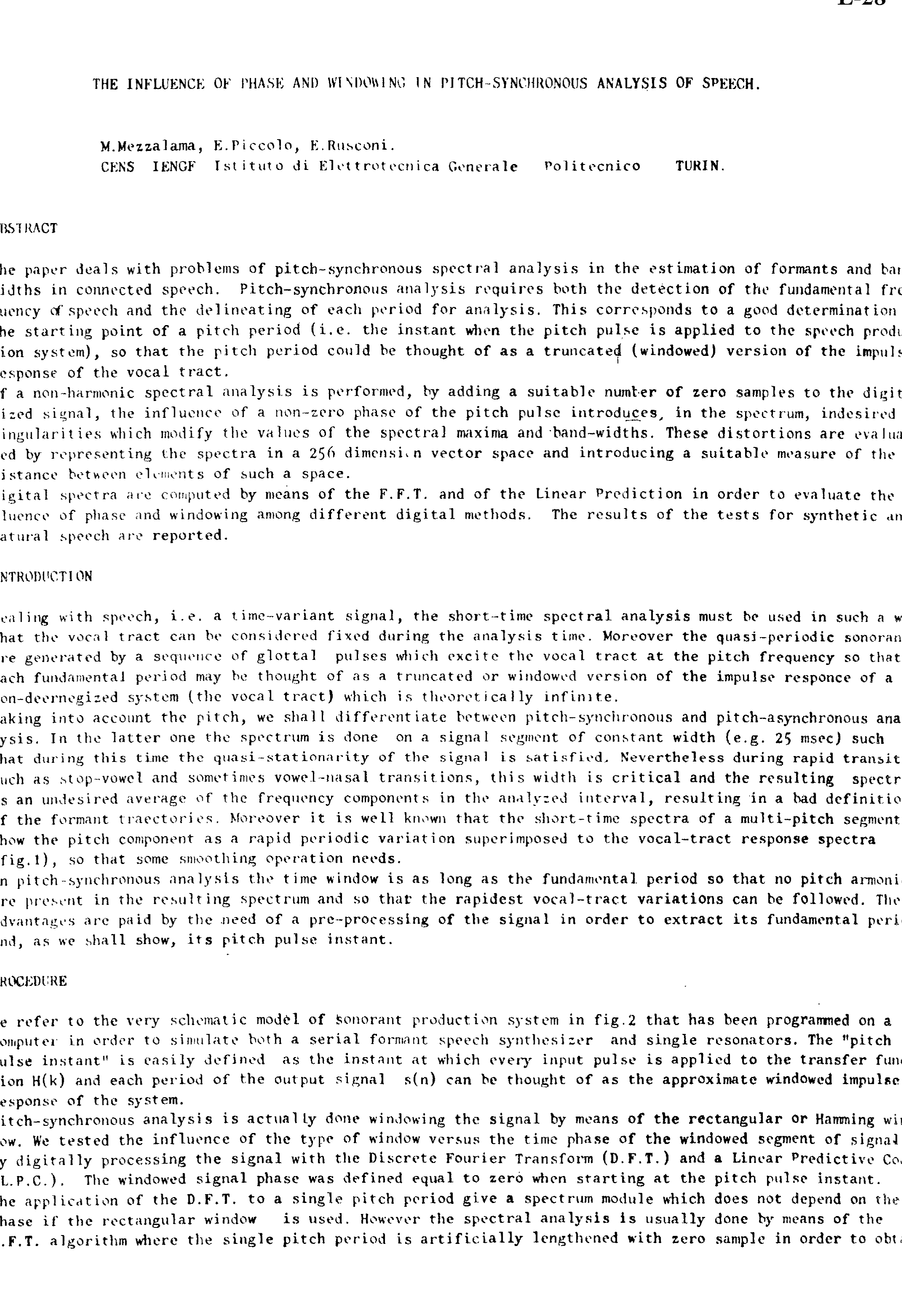
This paper deals with problems of pitch-synchronous spectral analysis in the estimation of formants and bandwidths in connected speech. Pitch-synchronous analysis requires both the detection of the fundamental frequency of speech and the delineating of each period for analysis. This corresponds to a good determination of the starting point of a pitch period (i.e. the instant when the pitch pulse is applied to the speech production system), so that the pitch period could be thought of as a truncated (windowed) version of the impulse response of the vocal tract. If a nonharmonic spectral analysis is performed, by adding a suitable number of zero samples to the digitalized signal, the influence of a non-zero phase of the pitch pulse introduces, in the spectrum, undesired singularities which modify the values of the spectral maxima and bandwidths. These distortions are evaluated by representing the spectra in a 256 dimension vector space and introducing a suitable measure of the distance between elements of such a space. Digital spectra are computed by means of the F.F.T. and of the linear prediction in order to evaluate the influence of phase and windowing among different digital methods. The results of the tests for synthetic and natural speech are reported.
https://www.aes.org/e-lib/browse.cfm?elib=2458
Click to purchase paper as a non-member or login as an AES member. If your company or school subscribes to the E-Library then switch to the institutional version. If you are not an AES member and would like to subscribe to the E-Library then Join the AES!
This paper costs $33 for non-members and is free for AES members and E-Library subscribers.
Learn more about the AES E-Library
Start a discussion about this paper!