
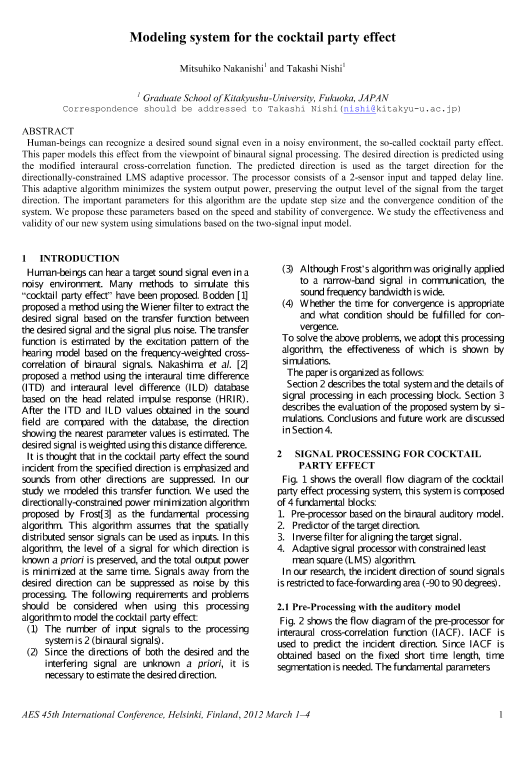
Human-beings can recognize a desired sound signal even in a noisy environment, the so-called cocktail party effect. This paper models this effect from the viewpoint of binaural signal processing. The desired direction is predicted using the modified interaural cross-correlation function. The predicted direction is used as the target direction for the directionally-constrained LMS adaptive processor. The processor consists of a 2-sensor input and tapped delay line. This adaptive algorithm minimizes the system output power, preserving the output level of the signal from the target direction. The important parameters for this algorithm are the update step size and the convergence condition of the system. We propose these parameters based on the speed and stability of convergence. We study the effectiveness and validity of our new system using simulations based on the two-signal input model.
https://www.aes.org/e-lib/browse.cfm?elib=16195
Click to purchase paper as a non-member or login as an AES member. If your company or school subscribes to the E-Library then switch to the institutional version. If you are not an AES member and would like to subscribe to the E-Library then Join the AES!
This paper costs $33 for non-members and is free for AES members and E-Library subscribers.
Learn more about the AES E-Library
Start a discussion about this paper!