
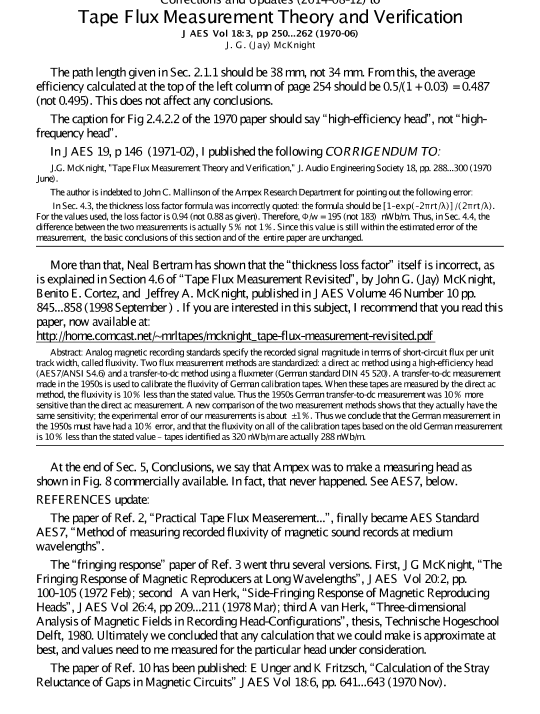
Tape flux measurement is useful for standardizing program levels on magnetic tape records, and for measuring the performance of tapes and recording and reproducing heads. A ring-core head is the most satisfactory tape-flux measuring instrument, but calibration of the flux-to-voltage sensitivity is difficult in the general practical case. By using a -symmetrical head- construction, however, the average sensitivity of front and rear gaps is accurately calculated quite easily. For practical measurements, a -high-efficiency head- has the advantage of requiring only one (not two) measurements. The flux-efficiency of the core, and the frequency- and wavelength-response factors are all calculated and experimentally verified for both the symmetrical and the high-efficiency designs. A transfer to unidirectional flux and magnetometer flux measurement gives further verification. A flux measurement accuracy of better than 3% is achieved at medium wavelengths of 0.25 to 2.0 mm.
https://www.aes.org/e-lib/browse.cfm?elib=1507
Click to purchase paper as a non-member or login as an AES member. If your company or school subscribes to the E-Library then switch to the institutional version. If you are not an AES member and would like to subscribe to the E-Library then Join the AES!
This paper costs $33 for non-members and is free for AES members and E-Library subscribers.
Learn more about the AES E-Library
Start a discussion about this paper!