
You are currently logged in as an
Institutional Subscriber.
If you would like to logout,
please click on the button below.
Home / Publications / E-library page
Only AES members and Institutional Journal Subscribers can download
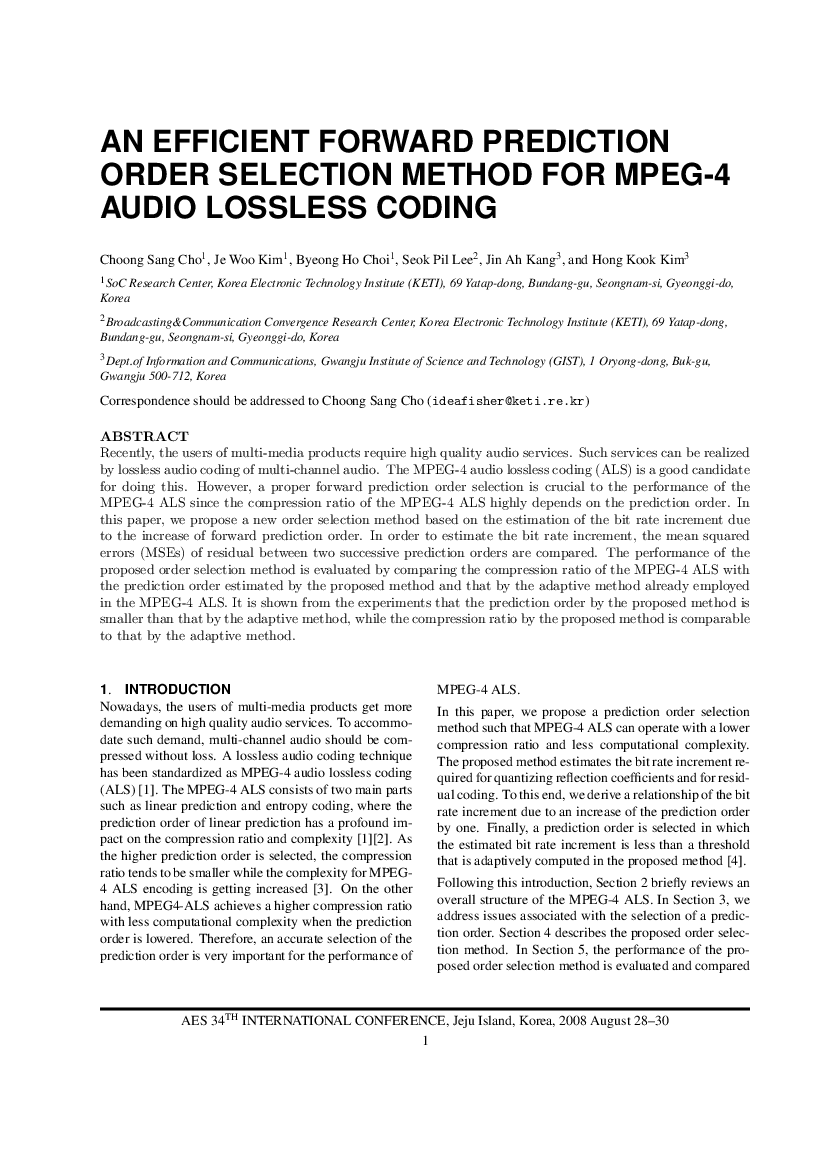
Recently, the users of multi-media products require high quality audio services. Such services can be realized by lossless audio coding of multi-channel audio. The MPEG-4 audio lossless coding (ALS) is a good candidate for doing this. However, a proper forward prediction order selection is crucial to the performance of the MPEG-4 ALS since the compression ratio of the MPEG-4 ALS highly depends on the prediction order. In this paper, we propose a new order selection method based on the estimation of the bit rate increment due to the increase of forward prediction order. In order to estimate the bit rate increment, the mean squared errors (MSEs) of residual between two successive prediction orders are compared. The performance of the proposed order selection method is evaluated by comparing the compression ratio of the MPEG-4 ALS with the prediction order estimated by the proposed method and that by the adaptive method already employed in the MPEG-4 ALS. It is shown from the experiments that the prediction order by the proposed method is smaller than that by the adaptive method, while the compression ratio by the proposed method is comparable to that by the adaptive method.
Author (s): Cho, Choong Sang;
Choi, Byeong Ho;
Kang, Jin Ah;
Kim, Hong Kook;
Kim, Je Woo;
Lee, Seok Pil;
Affiliation:
Korea Electronic Technology Institute (KETI); Gwangju Institute of Science and Technology (GIST)
(See document for exact affiliation information.)
Publication Date:
2008-08-06
Session subject:
Audio for Mobile & Handheld Devices: Coding Technologies for Audio & Speech
DOI:
Click to purchase paper as a non-member or login as an AES member. If your company or school subscribes to the E-Library then switch to the institutional version. If you are not an AES member Join the AES. If you need to check your member status, login to the Member Portal.
Cho, Choong Sang; Choi, Byeong Ho; Kang, Jin Ah; Kim, Hong Kook; Kim, Je Woo; Lee, Seok Pil; 2008; An Efficient Forward Prediction Order Selection Method for MPEG-4 Audio Lossless Coding [PDF]; Korea Electronic Technology Institute (KETI); Gwangju Institute of Science and Technology (GIST); Paper 20; Available from: https://aes.org/publications/elibrary-page/?id=14430
Cho, Choong Sang; Choi, Byeong Ho; Kang, Jin Ah; Kim, Hong Kook; Kim, Je Woo; Lee, Seok Pil; An Efficient Forward Prediction Order Selection Method for MPEG-4 Audio Lossless Coding [PDF]; Korea Electronic Technology Institute (KETI); Gwangju Institute of Science and Technology (GIST); Paper 20; 2008 Available: https://aes.org/publications/elibrary-page/?id=14430
@inproceedings{Cho2008an,
title={{An Efficient Forward Prediction Order Selection Method for MPEG-4 Audio Lossless Coding}},
author={Cho, Choong Sang and Choi, Byeong Ho and Kang, Jin Ah and Kim, Hong Kook and Kim, Je Woo and Lee, Seok Pil},
year={2008},
month={aug},
booktitle={Journal of the Audio Engineering Society},
publisher={Paper 20; AES Conference: 34th International Conference: New Trends in Audio for Mobile and Handheld Devices; August 2008},
number={20},
organization={AES},
}
TY – paper
TI – An Efficient Forward Prediction Order Selection Method for MPEG-4 Audio Lossless Coding
AU – Cho, Choong Sang
AU – Choi, Byeong Ho
AU – Kang, Jin Ah
AU – Kim, Hong Kook
AU – Kim, Je Woo
AU – Lee, Seok Pil
PY – 2008
JO – Journal of the Audio Engineering Society
VL – 20
Y1 – August 2008
Notifications
