
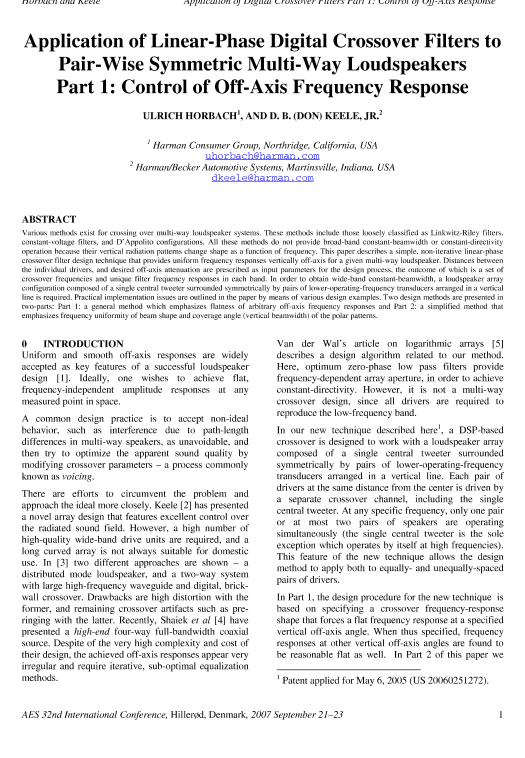
Various methods exist for crossing over multi-way loudspeaker systems. These methods include those loosely classified as Linkwitz-Riley filters, constant-voltage filters, and D’Appolito configurations. All these methods do not provide broad-band constant-beamwidth or constant-directivity operation because their vertical radiation patterns change shape as a function of frequency. This paper describes a simple, non-iterative linear-phase crossover filter design technique that provides uniform frequency responses vertically off-axis for a given multi-way loudspeaker. Distances between the individual drivers, and desired off-axis attenuation are prescribed as input parameters for the design process, the outcome of which is a set of crossover frequencies and unique filter frequency responses in each band. In order to obtain wide-band constant-beamwidth, a loudspeaker array configuration composed of a single central tweeter surrounded symmetrically by pairs of lower-operating-frequency transducers arranged in a vertical line is required. Practical implementation issues are outlined in the paper by means of various design examples. Two design methods are presented in two-parts: Part 1: a general method which emphasizes flatness of arbitrary off-axis frequency responses and Part 2: a simplified method that emphasizes frequency uniformity of beam shape and coverage angle (vertical beamwidth) of the polar patterns.
https://www.aes.org/e-lib/browse.cfm?elib=14199
Click to purchase paper as a non-member or login as an AES member. If your company or school subscribes to the E-Library then switch to the institutional version. If you are not an AES member and would like to subscribe to the E-Library then Join the AES!
This paper costs $33 for non-members and is free for AES members and E-Library subscribers.
Learn more about the AES E-Library
Start a discussion about this paper!